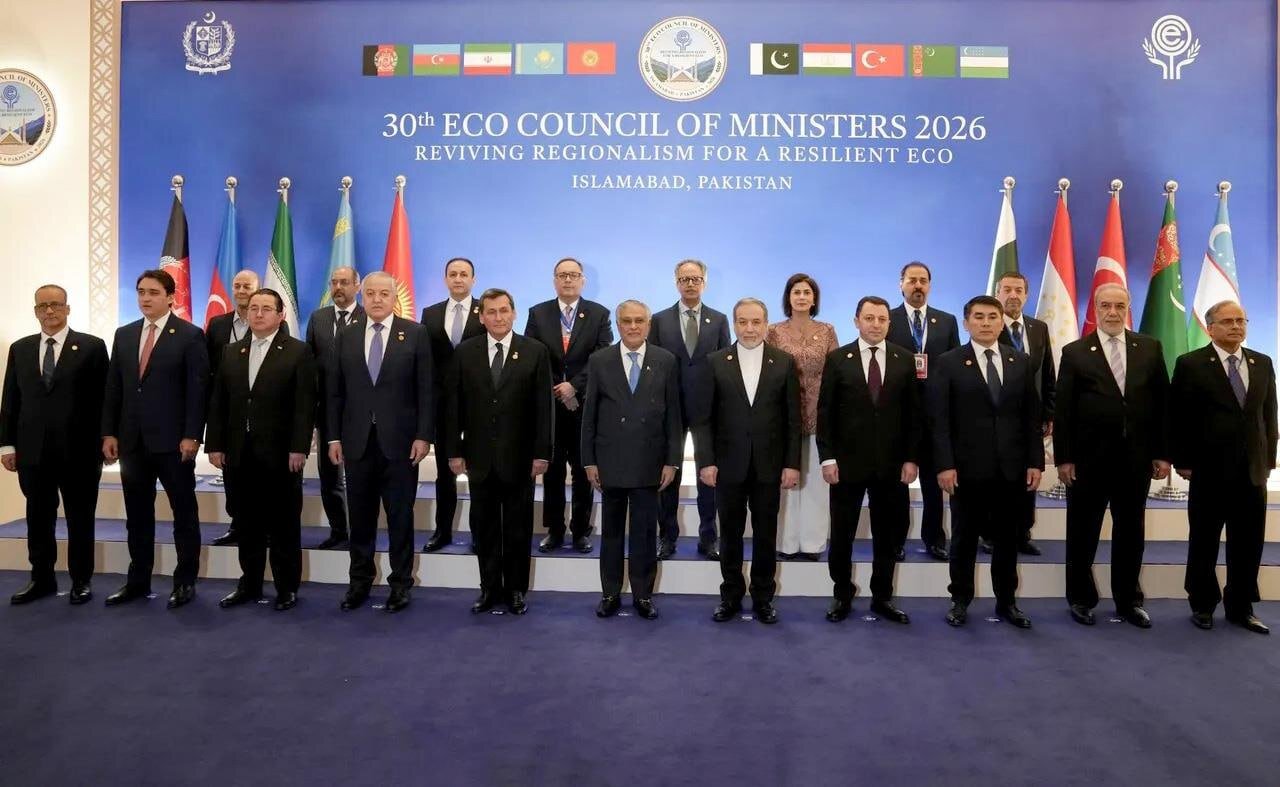
ISLAMABAD – Foreign ministers of the Economic Cooperation Organization (ECO) have expressed support for Iran’s latest initiative to bring the US-Israeli imposed war to a complete and permanent end, underlining diplomacy and regional solidarity as the only path to lasting stability.
The backing was announced in the final declaration of the 30th meeting of the ECO Council of Ministers, which concluded in Islamabad, Pakistan, on Monday after a day of intensive deliberations on regional security, trade, connectivity and energy.
Islamabad declaration: concern over aggression, vote for diplomacy.
In one of the most political paragraphs of the communiqué, the ministers voiced deep concern over the regional security situation following what they described as US-Israeli military aggression against Iran.
According to a Tehran Times correspondent in Islamabad, the member states welcomed Iran’s recent initiative for a full, complete and permanent end to the imposed war. The statement stressed the importance of diplomatic engagement and expressed explicit support for good offices and mediation efforts by Pakistan and Qatar aimed at defusing tensions and reviving talks.
The ministers also underlined the status of the Islamic Republic of Iran as one of the founding members of ECO, stressing Tehran’s significant and effective role in advancing the organization’s objectives and regional cooperation.
The declaration comes at a highly sensitive moment, as indirect contacts continue over a ceasefire, reopening of the Strait of Hormuz and a possible resumption of Iran-US diplomacy, which remains stalled amid what Tehran calls frequent shifts in Washington’s positions.
Tehran’s two-day plan: seven conditions for lasting peace
Iran has recently conveyed through mediators its so-called two-day plan as part of what officials describe as Tehran’s responsible approach to using diplomacy to end the imposed war.
The plan, according to Iranian officials, contains Tehran’s seven demands and conditions together with practical and operational solutions to establish peace and stability in the region. While details have not been made public, Iranian sources say the roadmap could pave the way for reopening of the Strait of Hormuz and resumption of negotiations.
Tehran has made clear that Washington must meet the seven conditions before Iran agrees to return to diplomatic negotiations. Iranian officials argue that talks cannot resume under military threat, economic blockade and continued acts of aggression.
The ECO ministers’ endorsement is seen in Tehran as an important regional signal that Iran’s diplomatic track enjoys broad neighborhood support, in contrast to US-Israeli military pressure.
Araghchi: Hormuz insecurity rooted in US-Israeli aggression
Iranian Foreign Minister Abbas Araghchi, addressing the ministerial session, began by thanking Pakistan’s Foreign Ministry and the ECO Secretariat for organizing the meeting. He thanked Deputy Prime Minister and Foreign Minister Ishaq Dar for his leadership of ECO and warm hospitality, and ECOSecretary General Asad Majid Khan and his colleagues.
He also thanked all countries that condemned acts of aggression against Iran’s territorial integrity and people, and expressed condolences and solidarity over the martyrdom of Iran’s Leader and a number of other Iranians in the aggression.
Araghchi said Iran has always adhered to international law, the UN Charter and peaceful settlement of disputes, including through diplomacy, and maintained its commitment to diplomatic engagement over the past two years. The United States, he said, chose a totally different path marked by aggression, threats, targeted assassinations, economic pressure and blockade, in clear violation of international law.
The aggression, he said, led to the martyrdom of senior political and military officials and the brutal killing of more than 5,000 Iranian citizens, including 168 students and teachers in a school in Minab.
Insecurity in the Persian Gulf and developments around the Strait of Hormuz, Araghchi stressed, are the direct result of joint hostile policies and aggressive actions by the United States and the Israeli regime against Iran, a fact that he said cannot be distorted.
Iran, he added, has always sought friendly and constructive relations with neighbors and has no inherent dispute with regional states. He laid out a clear principle: the territory, airspace and facilities of regional countries must not become a platform for attacks against one another. Iran’s legitimate defensive measures, he said, target only military objectives and bases of the aggressors and should in no way be interpreted as action against neighboring peoples or governments.
He called for urgent formation of a genuine, inclusive and region-owned dialogue on security arrangements, based on non-aggression and preventing any third country from using one state’s territory or facilities for aggression against another.
He said continued sanctions aimed at intensifying economic pressure and depriving Iranians of basic rights have only strengthened their resolve to defend legitimate rights and resist excessive and unlawful demands, and thanked ECO members for solidarity in difficult times.
Trade, transport and energy as strategic pillars
Despite the dominance of security issues, much of the Islamabad session focused on ECO’s economic agenda.
Araghchi said that amid continuous transformation of the international system and global economic dynamics, ECO is moving beyond its traditional role toward becoming an effective platform for collective action, enabling members to address emerging challenges and contribute to a more inclusive and just global economic order.
In current global and regional conditions, he said, trade, transport and energy must constitute the three strategic pillars of ECO cooperation. Strengthening connectivity, facilitating intra-regional trade and enhancing energy cooperation will increase collective resilience, reduce vulnerability to external factors and help build a more integrated and self-reliant region.
Iran, he said, welcomes the formation of a technical negotiating committee to revise the ECO Trade Agreement (ECOTA). He urged current parties to actively pursue renegotiation while encouraging other members to join, with the aim of crafting a modern, next-generation, more inclusive, effective and operational trade agreement that expands regional trade and supports economies for the benefit of all peoples of the region.
With US-Israeli aggression increasingly affecting regional energy security, Araghchi said strengthening energy cooperation has become an urgent and strategic necessity. The region, he argued, needs not only an independent security framework but also a reliable and sustainable regional energy mechanism to protect energy flows, ensure stable supply, reduce vulnerability to external factors and boost resilience against geopolitical shocks.
He also pointed to ECO Vision for the next decade, prepared after extensive meetings and consultations. Drawing lessons from the previous vision, the document emphasizes result-oriented approaches, practical implementation and measurable achievements. Its implementation, he said, should be based on guidelines to be provided by leaders at the 18th ECO Summit in Tehran on December 4, 2026, for which he invited all dignitaries.
Gaza, mediation push and road to Tehran summit
On Palestine, Araghchi said the situation in occupied Palestine must remain high on the collective agenda and not be forgotten, calling it a source of shame for humanity and one of the gravest moral and human crises of the present era amid what he called deeply regrettable international inaction.
Over the past three years, he said, Gaza has witnessed full-scale genocide, including war crimes, continued occupation, attempts to change demographic composition, use of prohibited weapons, widespread destruction, forced displacement and blocking of essential humanitarian aid by the Israeli regime. He also warned of escalating expansionist policies in the West Bank and occupied Al-Quds, including illegal settlement expansion, daily terrorist attacks by extremist settlers, systematic displacement, and the dire situation of nearly 10,000 Palestinian prisoners reportedly subjected to severe physical and psychological torture.
Today, especially in harsh winter conditions, he said, Gaza urgently needs effective action to force Israel to lift the blockade and ensure unhindered entry of international aid, particularly food, medicine, temporary shelter and reconstruction material for more than 1.5 million displaced and homeless Palestinians. He said the international community faces a major test of adherence to humanitarian principles in Gaza and the West Bank, calling for practical action, collective responsibility and an end to silence.
Speaking after the meeting, Araghchi said the summit paid special attention to Gaza, where he said a silent genocide is underway with food, clean water and medicine blocked and heavy rains and floods worsening suffering. He said ECO members reacted positively to Iran’s two-day plan and expressed hope it would lead to a permanent and complete end to the current war. ECO Vision, energy and renewables, science and technology and regional security were also discussed, he said.
In an interview with Pakistani television, Araghchi said: “We trust Pakistan as a good friend… Pakistan is doing its job. The issue is very complex and difficult.”
On the sidelines, Araghchi held bilateral talks with Ishaq Dar and joined other ministers in a group meeting with Prime Minister Shehbaz Sharif, who stressed regional economic, trade and transit cooperation. The ministers thanked Pakistan for successful hosting of the 30th Council meeting and stressed multilateral cooperation and integration. Araghchi underlined regional cooperation in economy, trade, transport and transit as requirements for sustainable development and expressed Iran’s readiness to assist.
On Monday evening, he also met and held talks with Field Marshal Asim Munir, Pakistan’s Chief of Defense Forces.
During the meeting, the two sides reviewed regional and international developments and discussed the expansion of bilateral relations in areas of mutual interest.
Furthermore, they exchanged views on existing challenges and threats to regional peace and security, as well as ways to strengthen cooperation to safeguard peace and stability.
Araghchi leaves Pakistan for Oman for further consultations.
Disclaimer : This story is auto aggregated by a computer programme and has not been created or edited by DOWNTHENEWS. Publisher: tehrantimes.com