
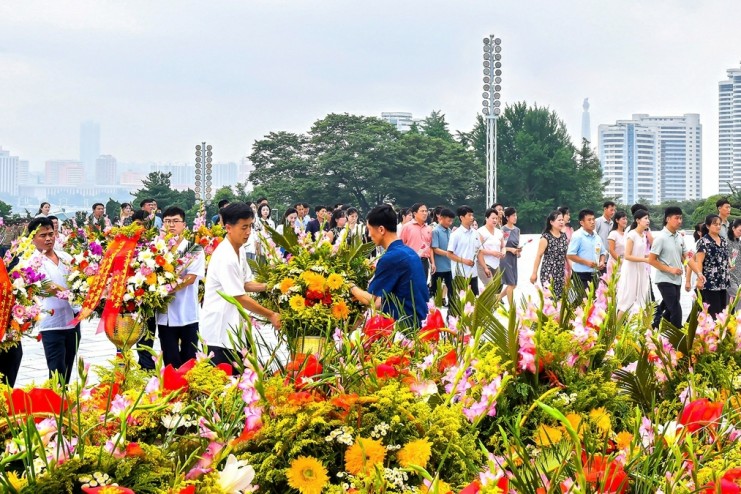
Elderly North Koreans in several regions are voicing nostalgia for the era of founding leader Kim Il Sung. They unfavorably compare today’s economic hardship to what they remember as an easier time. State media marked the 32nd anniversary of Kim Il Sung’s death in 2026 with extensive coverage of his achievements.
A source in South Pyongan province told Daily NK on Monday that older residents of Pyongsong miss “the Great Leader’s era.” The comments follow the anniversary of Kim Il Sung’s death on July 8. Many sigh deeply when they compare living conditions then and now, the source said. North Korean state media uses “the Great Leader” as an honorific for founder Kim Il Sung, who died in 1994.
On July 8, Rodong Sinmun ran several articles on its second page. The headline credited Kim Il Sung’s “immortal achievements” for the country’s present-day prosperity and strength. The paper said he established ideological and theoretical guidance across party building, state building, military strengthening, and social transformation. It also said his on-site guidance trips covered a total distance of roughly 1.445 million li over his lifetime.
Memories of abundance and hope
After reading the coverage, older people who lived through the Kim Il Sung era recalled the period fondly. Some said “life felt human back then” and people were more trustworthy. Pollock was so plentiful, they said, that it would go to waste. Some recalled rumors that circulated shortly before Kim Il Sung’s death that unification was imminent. Those rumors fueled hope for a better future.
The source said these same people describe the present very differently. They say it is hard to make ends meet. People cannot trust one another, and constant tension pervades daily life. Some said they always watch their surroundings for fear that someone might inform on them. Others said people now smile on the outside while harboring suspicion underneath.
Others said the world has changed a great deal, but people’s living standards have barely improved. Some said they cannot eat rice and meat soup as Kim Il Sung once envisioned. But they wish they could at least eat their fill of corn rice.
Most people who directly experienced the Kim Il Sung era are now elderly and struggling economically, the source said. Younger people can move around and earn money in various ways. Older people lack the physical stamina to do the same. That gap leaves many older residents more pessimistic about their circumstances.
Authorities likely intended the coverage of Kim Il Sung’s achievements to rally internal unity, the source suggested. Instead, elderly people who lived through his era have grown more disappointed and dissatisfied with the present. They compare it unfavorably to the past.
“China is better off now”
Similar reactions have emerged in border regions including North Hamgyong and Ryanggang provinces. Some elderly people there said China’s living conditions were worse than North Korea’s during Kim Il Sung’s rule. Chinese people would cross the Tumen or Yalu rivers just to buy North Korean goods, they said.
A source in North Hamgyong province said a documentary on Kim Il Sung’s past activities aired recently. Many older people recalled that era after watching it. “Back then, China was poor, but now it has visibly developed and is far better off,” some said. Others said, “It feels like our country is falling behind, given how many people are still worried about their next meal.”
A source in Ryanggang province said some elderly people describe the Kim Il Sung era as the best period of their lives. It is difficult to get by without money today, the source said. People who cannot find hope for the future seem to be longing instead for their younger years, when conditions were comparatively better.
Reporting from inside North Korea
Daily NK operates networks of sources inside North Korea who document events in real-time and transmit information through secure channels. Unlike reporting based on state media, satellite imagery, or defector accounts from years past, our journalism comes directly from people currently living under the regime. We verify reports through multiple independent sources and cross-reference details before publication.
Our sources remain anonymous because contact with foreign media is treated as a capital offense in North Korea — discovery means imprisonment or execution. This network-based approach allows Daily NK to report on developments other outlets cannot access: market trends, policy implementation, public sentiment, and daily realities that never appear in official narratives.
Maintaining these secure communication channels and protecting source identities requires specialized protocols and constant vigilance. Daily NK serves as a bridge between North Koreans and the outside world, documenting what’s happening inside one of the world’s most closed societies.
Disclaimer : This story is auto aggregated by a computer programme and has not been created or edited by DOWNTHENEWS. Publisher: dailynk.com





