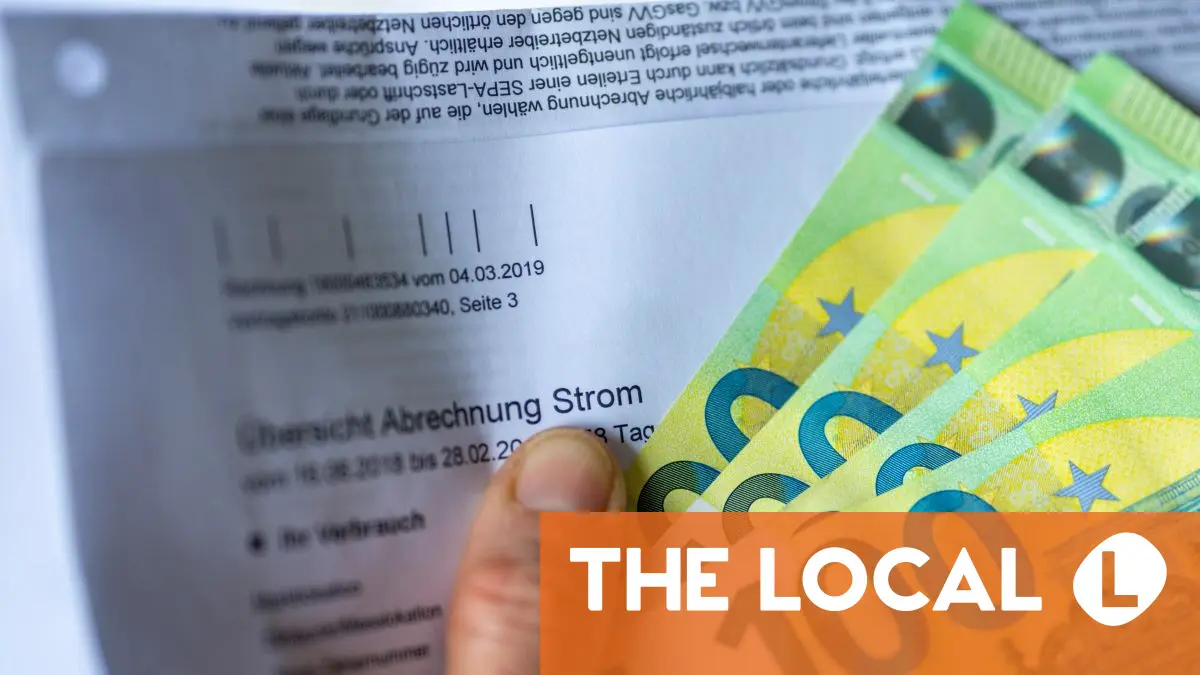
After a long-running row, Germany’s coalition leaders agreed in the early hours of Wednesday to cut electricity tax for everyone from January 1st, 2027. But the cut is only funded for a period of twelve months.
Electricity bills in Germany should drop from January 1st, 2027, saving a typical household roughly €93 a year.
Chancellor Friedrich Merz (CDU), Finance Minister Lars Klingbeil (SPD) and CSU leader Markus Söder agreed the deal after more than eight hours of budget related talks leading into Wednesday morning.
Despite plans to make the cut permanent, the necessary funding has only been agreed up to the end of 2027 so far.
What the tax cut means for residents in Germany
Germany’s electricity tax is falling from 2.05 cents per kilowatt-hour to the EU minimum of 0.1 cent. That is good news for German households’ electricity bills, provided that suppliers pass the savings on.
Comparison site Verivox reckons a three-person household using 4,000 kilowatt-hours a year will save about €7.75 a month.
READ ALSO: Electricity and gas bills in Germany expected to rise in early 2027
A single person using 1,500 kilowatt-hours will save about €3 a month.
Businesses with heavy consumption will save considerably more.
But funding is only secured for 2027. The coalition says “a permanent reduction is intended”, but only if “sustainable offsetting financing” is found when the 2028 budget is drawn up.
A long saga
Arguments over lowering the electricity tax have dragged on since last year. Initially – because budgets were tight – the cut applied only to industry, agriculture and forestry.
Merz then repeatedly pushed for the lower rate to apply to households and small businesses too.
The sticking point was cost. Bringing the tax down to the EU minimum costs roughly €5.4 billion a year, and the coalition could not agree on how to secure the funds.
READ ALSO: Global comparison reveals Germany has highest energy prices in the G20
Last week the cut was left out of the draft 2027 budget. Finance Minister Klingbeil had insisted on a plan to offset the lost revenue.
Merz has staked a lot on this, to the point where delivering the tax cut was widely seen as a test of his credibility. Afterwards he declared: “We promised to lower the electricity tax, and we kept our word.”
How it will be paid for
For 2027, the money will come from spare capacity in the account used for Germany’s renewable energy subsidies (the EEG).
How much is available from that account is expected to depend largely on renewable electricity prices. If the sum falls short, the coalition has promised “a package of measures”, which could reportedly mean subsidy cuts or higher taxes elsewhere, such as the withholding tax on capital gains.
The deal must now be written into the 2027 budget, which the Bundestag is due to approve on November 27th.
Disclaimer : This story is auto aggregated by a computer programme and has not been created or edited by DOWNTHENEWS. Publisher: thelocal.de