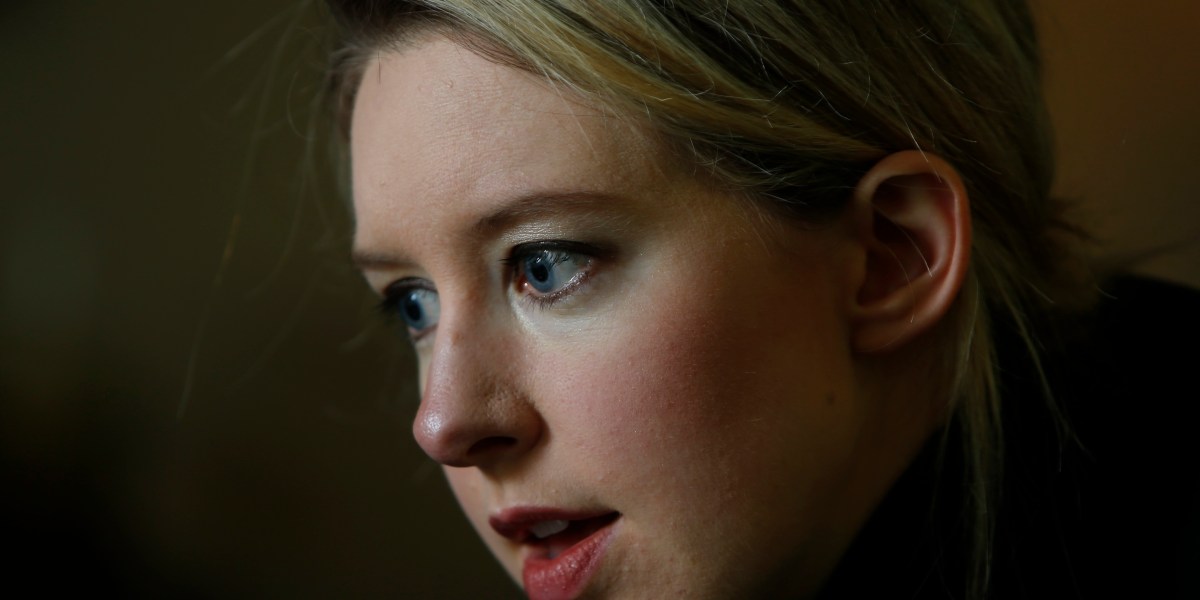
You Can See Everything, the A24 documentary from Nathan Fielder and Lance Oppenheim about Theranos founder Elizabeth Holmes, is one of the buzziest movies in theaters right now. Audiences are leaving the 174-minute film debating its famously slippery subject: how authentic Holmes is, and how culpable she is for the fraud that landed her in federal prison.
The truth about Holmes, and whether she’s intentionally duplicitous, isn’t quite black-and-white—or at least that’s what Nick Brody, a professor of communication studies at the University of Puget Sound, argues in a viral TikTok he posted after seeing the film. Brody teaches a course on lying and deception, where he challenges students to study how people lie, the ethics of lying, and how language shapes our understanding of the truth.
Why one word—‘can’—matters so much
Language plays an enormous role in You Can See Everything. In a pivotal scene in the film’s first half, Fielder and Holmes debate the meaning of the word “can,” and what Holmes meant when she infamously claimed Theranos’s blood-testing technology “can” run any test. Holmes argues she meant the device was capable of it; Fielder counters that most people hear “can” as “can, right now.” (Theranos whistleblower Tyler Shultz was quoted by Fortune as saying the device Holmes shows off on camera isn’t the one used on patients.)
Later, Holmes seems lost on the linguistic humor of Abbott and Costello’s “Who’s on First?” And an unresolved mystery throughout the documentary is whether the New York Times accurately quoted Holmes in a 2023 profile. Holmes and her partner, Billy Evans, insist she was misquoted; the Times stands by its reporting.
“One of the most basic ideas in communication is that language is arbitrary,” Brody begins in his video. “Meanings are arbitrary. Meanings are in people, not in words. Words don’t have meaning built into them. We just agree on what they mean. We often agree on what they mean in a synchronous fashion in the moment. This gives us a lot of room to deceive. It’s the main reason why miscommunication occurs and why conflict occurs.”
By that logic, Holmes could have exploited the arbitrary nature of words, and people’s unspoken assumptions about what they mean, to deceive. She might have leaned on what communication scholar Timothy Levine calls truth-default theory, the idea that people tend to presume others are being honest, to get investors to back Theranos and its not-quite-ready technology. But the documentary’s central tension is less about whether Holmes deceived people than whether she meant to: whether she misled people with careful words or told the truth with careless ones.
“You can say something false with the intent to deceive someone. That is a lie,” Brody says. “But you can also say something true, leave out crucial information, or say something true that creates a false impression. There’s also a term for that, and it’s called ‘paltering.’ Paltering is the use of a truthful statement with the intent of creating a false impression.”
Paltering, from the first iPhone to a ‘flying’ Tesla
Paltering, which researchers at Harvard and Wharton have identified as a distinct form of deception, is a common marketing technique. Food packaging highlights healthy-sounding qualities while burying the fuller nutritional picture. Tech companies might be the most notorious palterers. Brody points to Steve Jobs, Holmes’s idol, who walked through the first iPhone demo onstage in 2007 using a prototype that barely worked.
A more recent example is Tesla’s unveiling of a Roadster that briefly took flight using SpaceX-built thrusters. Yes, the car flew. But Tesla says production won’t begin until 2028, and the company’s own website says the flying version isn’t approved for public road use. It gets people excited, but it isn’t the full truth.
Holmes could have been paltering when she said Theranos’s technology “can” run any test, leaving out that it wasn’t reliable enough to claim it actually did. A jury ultimately convicted her in 2022 on four counts of defrauding investors and conspiracy, while acquitting her on charges related to patients; an appeals court upheld the conviction last year.
Despite the verdict, Holmes maintains throughout the documentary, which captures her final weeks before reporting to prison in 2023, that she did nothing wrong. As Brody put it in a follow-up video, “The big question that this documentary gets at, but can’t directly answer, is whether Holmes herself actually thinks she is lying.”
Even Nathan Fielder can’t tell
Even Fielder doesn’t know the answer. “When I met her, I remember having this weird experience where she seems so genuine at times,” Fielder said in a Q&A following the film’s screening at the New York Film Festival. “But then I’m like, ‘No,’ and clocking and tracking my thoughts and being like, ‘Okay, I know she’s a liar.’” He added, “It wasn’t until we started shooting that moments would happen, some of them are in the film, and then after Lance and I would talk about what we thought happened there, and we’d completely disagree on what something meant to us.”
Fielder is an unusual figure to helm a documentary about truth and deceit. Through Nathan for You and The Rehearsal, he has built a brand around deception and performance. Brody calls Holmes “a prolific liar,” a term deception researchers use for the small group of people who tell the most lies. In one U.K. study, prolific liars were people who reported telling five or more a day. Whether Fielder himself qualifies is another head-scratcher.
“I guess that would broaden the question to anybody who’s engaged in any kind of performance art or creative enterprise,” Brody told Fortune in a follow-up interview. “He’s an entertainer. He’s a show person. Even here, he’s a documentary filmmaker that they selected, but they had to know that he’s the kind of documentary filmmaker who’s going to take a really unexpected approach.”
Those questions move to the foreground in the film’s quasi-meta second half. After Holmes reports to prison, Amanda Seyfried, who won an Emmy for playing Holmes in Hulu’s The Dropout, reprises the role in reenactments of moments that couldn’t be caught on camera. Through these reenactments, Fielder and Seyfried dig further into Holmes’s intentions and actions, though the audience is now hyperaware of the artificiality on-screen.
A documentary for the post-truth moment
The film’s grip on the zeitgeist says something about contemporary anxieties around truth and reality. It grossed an estimated $15 million from just 855 theaters in its opening weekend, the biggest debut for a nonmusic documentary since Fahrenheit 9/11 in 2004. “Post-truth” has become shorthand for a moment of declining trust in the institutions once seen as arbiters of what’s real: journalism, science, market data, the justice system, and, indeed, documentary film.
“We see attacks on journalism. We see attacks on science. We see attacks on the courts,” Brody says. “We’re living in a reality where the things that we took for granted about how we know what is true are not shared anymore.”
He concludes, “I think that the documentary hit at a moment where we are acutely feeling all of these things, with an election coming up, with AI surrounding us everywhere, not just claims from tech companies about what AI can do, but people not being able to trust whether the text that they’re reading or the images that they’re viewing have been produced by humans or these models. I think that these questions have become front of mind for many people, and even if they’re not aware of it, it speaks to those anxieties.”
Holmes’s own story isn’t finished. She’s scheduled to move to a halfway house in Texas in August 2027, and Evans is now running a blood-testing startup of his own that, Fortune has reported, has patents and investors but no product. (For more on the film, read Fortune’s review and what Bad Blood author John Carreyrou thought of it.)
The film’s titular promise only becomes more loaded as these questions unfold. Whether it delivers depends on each viewer’s sense of trust and truth, and on how they choose to interpret “can.”
Disclaimer : This story is auto aggregated by a computer programme and has not been created or edited by DOWNTHENEWS. Publisher: fortune.com