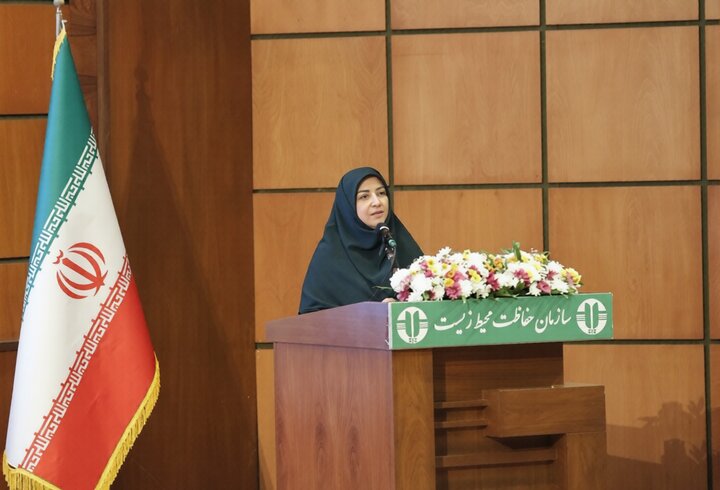
TEHRAN – A ceremony was held on Thursday to mark National Environmental Ranger Day and honor the dedication, sacrifices, and vital role of environmental rangers in protecting the country’s environment and natural resources.
President Masoud Pezeshkian and Head of the Department of Environment (DOE) Shina Ansari addressed the event.
Emphasizing the need to reform environmental management approaches, Pezeshkian said protecting natural resources requires balancing available resources with consumption, preventing environmental degradation, strengthening continuous monitoring, revising regulations, and encouraging public participation. He added that the government is responsible for safeguarding the country’s natural assets and preventing their destruction.
The president described environmental rangers as being on the front lines of protecting the country’s natural heritage, stressing that they should receive greater attention and support in recognition of their responsibilities, challenging working conditions, and services.
Pezeshkian also warned that wars, misguided actions, and destructive decisions are damaging the planet and threatening human life. He described environmental protection as an intergenerational responsibility, emphasizing that education is the first step toward preserving natural resources for future generations. He cautioned that once the Earth’s natural resources are destroyed, restoring them to their original condition is far from easy.
Criticizing the benefits some developed countries derive from environmental degradation in developing nations, he said the consequences of such practices are increasingly threatening the planet.
For her part, Ansari said more than 13 protected areas across the country had been damaged during recent wars, with ranger stations, equipment, vehicles, and wildlife also suffering losses.
She noted that, alongside their conservation duties, environmental rangers had worked during the wartime period in coordination with military and provincial authorities to defend the country’s territorial integrity and continue protecting its natural assets.
Ansari also paid tribute to 154 environmental rangers who have lost their lives in the line of duty over the years, adding that 374 others had been injured or sustained disabilities while carrying out conservation missions.
In September, Pezeshkian described environmental protection as a key pillar of the country’s national and social security, stressing that the preservation of natural resources must be addressed within this framework.
Speaking at a meeting with environmental experts, Pezeshkian said the government was prepared to create the necessary conditions for using the plans, ideas and initiatives put forward by environmental activists and specialists.
He added that the government would support scientific and practical solutions for addressing the country’s real environmental challenges, IRNA reported.
Pezeshkian emphasized that tackling environmental problems requires close cooperation among the government, universities, the private sector, civil society organizations and the public.
“This shared capacity must be used to move toward sustainable governance, balanced development and the protection of the country’s resources for future generations,” he said.
The president also identified education and public awareness as key elements in reforming consumption patterns and protecting the environment.
“If we invest in properly educating the next generation, we are in fact investing in the future of the country,” Pezeshkian said.
He warned that without educating children and teenagers from an early age about environmental protection, efficient use of water and electricity, energy management and social responsibility toward natural resources, future generations could repeat patterns of environmental degradation, even if significant resources are spent on environmental protection today.
Pezeshkian stressed that environmental awareness should begin at school, saying that teaching students how to use water, electricity, gas, and other natural resources responsibly should be incorporated into the educational and developmental process.
The Department of Environment has taken different steps to promote public participation in environmental protection.
Encouraging eco-friendly students, teaching environmental awareness courses in universities, developing a plan titled “skilled ranger soldier”, and preparing guidelines for environmental protection are among the most important measures.
Over the past Iranian year, which ended on March 21, DOE mainly focused on enhancing formal and informal environmental education, developing public participation, utilizing the potential of new technologies, and promoting the culture of environmental protection, IRNA reported.
In the education sector, the DOE designed a ‘national environmental curriculum’, and the first scientific-educational event based on a book titled ‘Humans and the Environment’ was held for teachers and eleventh-grade students at the national level. During the event, the provincial and national winners were honored.
A national plan for environmental helpers has also been implemented. About 20 percent of the elementary students are health ambassadors. Some 25 percent of them will join the national plan over five years. Currently, there are 11,000 environmental helpers at schools across the country. The plan has also empowered 7,258 elementary school principals and 6,051 elementary school health care providers so far.
Another initiative of the DOE is to offer environmental courses in all universities in the country. It was previously implemented on a pilot basis in 10 selected universities. In addition, the Health, Safety, and Environment (HSE) major for the MA degree has been revised.
The DOE has developed two other plans. The first, titled ‘skilled ranger soldier’, aims to employ students in environmental protection stations, and the second one intends to train and empower local communities with the participation of environmental protection students.
In an effort to strengthen the participation of local communities in conserving nature, the DOE has approved seven natural areas to be protected by the public.
The initiative showcases national determination to conserve the country’s environment and also opens a new prospect for people’s contribution and the development of participatory governance in protecting the country’s biodiversity.
Disclaimer : This story is auto aggregated by a computer programme and has not been created or edited by DOWNTHENEWS. Publisher: tehrantimes.com