
The Australian economy will be $10 billion a year worse off if parliament fails to ratify a landmark free trade pact, the European Union’s new ambassador has warned as he urges against any attempt to renegotiate the deal.
The Coalition has indicted it will vote against the pact on the grounds it could lock Australia into legally binding action on climate change and expose the nation to European sanctions, prompting former finance minister Mathias Cormann to urge his former colleagues to support the agreement.
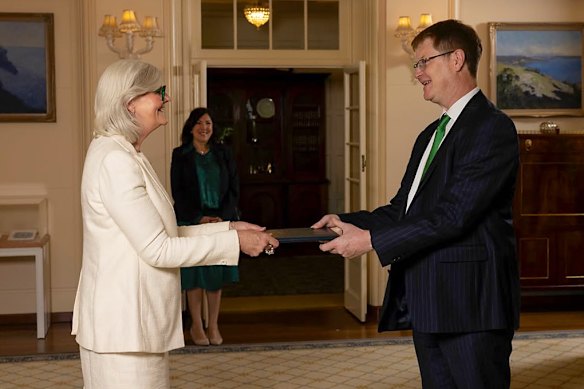
Lawrence Meredith, who presented his credentials to Governor-General Sam Mostyn this week, also said Australia and Europe could “play an absolutely crucial role” in developing stronger regulation of artificial intelligence despite resistance from the United States and China.
Meredith said Australia and the EU had struck “a comprehensive, ambitious, and balanced trade agreement” that he hopes could come into force early next year.
“I think that what’s important here is that the people, the businesses of Australia, stand to benefit greatly,” he said.
“It’s an enormous opportunity, and of course, in a free trade deal, you know, on both sides, there’s always parties who feel the deal could have been better.”
Meat and Livestock Australia branded the pact the “worst ever free trade agreement” when it was unveiled in March during a visit by European Commission President Ursula von der Leyen, attacking the government for failing to secure enough access for Australian lamb and beef producers.
The lobby group said it was an “outrageous discrepancy” that New Zealand had been able to secure a sheep meat quota of 163,769 tonnes compared to around 25,000 tonnes for Australia.
Meredith, an Irish native who previously served as the EU’s ambassador to New Zealand, said Australia had secured an eightfold increase in access on beef and a fivefold increase on access on lamb, describing the gains as “significant benefits”.
He downplayed the climate aspects of the deal, saying both nations had made emissions reduction commitments under the Paris climate accord.
“The objective of a free trade agreement is free trade, and the top priority is to bring in the economic benefits,” he said.
The government could strike an unusual deal with the Greens to pass the free trade pact through parliament because, unlike past trade deals blocked by the left-wing party, it does not contain an investor state dispute settlement clause allowing foreign companies to sue host governments.
He said he hoped the deal could achieve “as broad support as possible” in parliament.
Asked if the deal could be renegotiated, as the Coalition has urged, Meredith said it had taken years to finalise and should not be delayed.
“So let’s get it into force, and let’s bring those benefits to the people and businesses of both Australia and the European Union,” he said, citing estimates of a $10 billion annual boost to the Australian economy.
With the Trump administration determined to impose tariffs on friendly nations as well as adversaries, Meredith said more was at stake than a mere trade deal.
“We’re in troubled geopolitical times, and we all need to invest in our closest friends and most like-minded partners,” he said.
His arrival comes at a time of significant diplomatic turnover in Canberra, with new American and Chinese ambassadors also taking up their posts in recent weeks.
Meredith said regulating artificial intelligence was “a concern Australia and the European Union share, and that’s an area we very much work to want to work on”.
Even though Chinese and American governments have resisted calls for a slowdown of AI development, Meredith said the EU, working together with like-minded nations such as Australia, could exert influence over the emerging technology.
“The European Union is a single market of 450 million consumers and citizens, and Australia is already showing leadership in this space,” he said.
In September the EU announced a plan to restrict social media access for under 15 year-olds across its member states, following last year’s Australian move to ban children under 16 from having social media accounts.
Cut through the noise of federal politics with news, views and expert analysis. Subscribers can sign up to our weekly Inside Politics newsletter.
 Matthew Knott is the foreign affairs and national security correspondent for The Sydney Morning Herald and The Age.Connect via X, Facebook or email.
From our partners
Disclaimer : This story is auto aggregated by a computer programme and has not been created or edited by DOWNTHENEWS. Publisher: www.smh.com.au