-
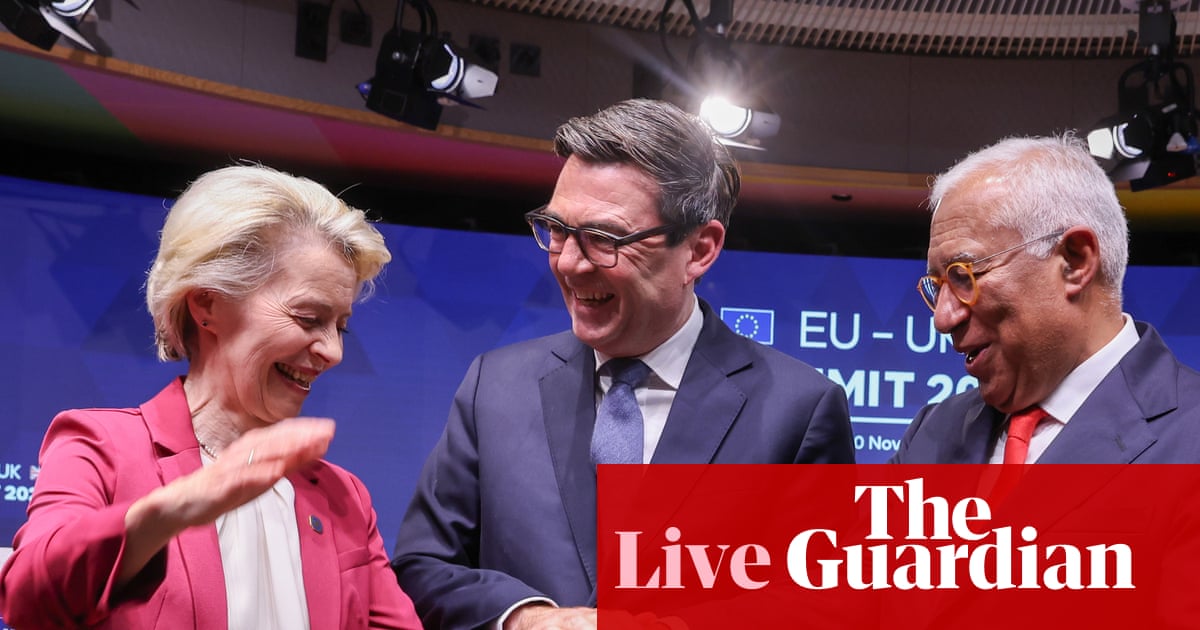
The British prime minister Andy Burnham said his deal with the European Union will add up to £17bn a year to the British economy as he paved the way for even closer ties to Brussels. Burnham said it was a “good day for Britain and a good day for Europe”, as he met EU chiefs in Brussels to announce a package covering food and agriculture exports, emissions trading, and a youth experience scheme which could open the doors for 100,000 young Europeans to temporarily work in the UK, with Britons able to do the same on the continent.
-
Burnham said Friday’s deal was “probably the limit” of what could be done before the next national election due by mid-2029, but he envisaged an informal conversation in about a year with the EU about what could be achieved next.
-
European Commission President Ursula von der Leyen said she welcomed Burnham’s willingness to have a broad debate about future relations with the EU. “We are open for brainstorming, and we welcome this brainstorming, so count on us,” she said.
-
At the summit, postponed from July after the resignation of Burnham’s predecessor Keir Starmer, the two sides addressed some of the Brexit losses with a package of agreements. The most significant allows cross-border trade in animals, plants and related products, such as sausages or seeds, without the certificates and controls currently required. Britain has estimated this could add up to £5.1bn per year to its economy.
-
A further agreement will link the emissions trading systems of Britain and the EU, which would exempt British and EU goods, such as steel, from each other’s border carbon levies. Each side is also set to allow 100,000 young people a year in to work or study for three years.
-
However, one potential dampener emerged as the 27-nation bloc and London jostled over linking ultimate implementation of the new deals to Britain agreeing to cut university fees for EU students. Britain prefers to offer only “significantly reduced” fees, and the aim is to resolve the issue within six months.
-
Retailers and manufacturers have welcomed Andy Burnham’s new trade deal with the European Union as a “big win” but warned they need “clear and early” guidance from government to aid the transition, Press Association reported. The chief executive of the British Retail Consortium (BRC) called the SPS deal a “big win” for UK retailers but warned that businesses need “at least 18 months” to transition to the new arrangements.
-
Nigel Farage, the veteran anti-EU campaigner and leader of the Reform UK party, said the deal “was about the first steps, incrementally, to taking us back into membership of the European Union,” and again predicted an early election next year. Farage told reporters he would campaign to preserve Brexit. “I am ready for this fight,” he said.
-
Meanwhile, Denmark’s foreign minister on Friday said Moscow’s defence attache in Copenhagen would be expelled after Russia was suspected of being behind an attempted assassination of a Ukrainian rapper. “We have just summoned the Russian ambassador to the ministry of foreign affairs and notified him of the government’s decision to expel the Russian defence attache from Denmark” within seven days, Lars Lokke Rasmussen told a news conference.
-
Students and young workers have taken to the streets in more than 20 European countries in coordinated protests over the surging cost of living and housing, deteriorating learning conditions and rising military spending. Activists from more than 50 groups in countries including Belgium, France, Germany, Greece, Italy, Portugal, Spain and the UK held rallies on Friday, lighting flares, burning cardboard models of tanks and waving placards, many reading “fight for our future”.
You can read more in our full story:
Denmark’s foreign minister on Friday said Moscow’s defence attache in Copenhagen would be expelled after Russia was suspected of being behind an attempted assassination of a Ukrainian rapper.
“We have just summoned the Russian ambassador to the ministry of foreign affairs and notified him of the government’s decision to expel the Russian defence attache from Denmark” within seven days, Lars Lokke Rasmussen told a news conference.
“We are saying this very clearly: we have exposed you”, he said.
He also added Denmark was mulling suspending Schengen visas to Russians.
The UK prime minister called the newly agreed post-Brexit reset deal a “win-win” for the UK and the EU, although the level of tuition fees EU students will pay to study at UK universities remains unresolved.
The prime minister met Ursula von der Leyen, the European Commission president, and António Costa, the European Council president, at the EU-UK summit in Brussels.
Reform UK leader Nigel Farage claimed that Andy Burnham’s reset agreements with the EU “was in direct contradiction of the Labour manifesto upon which they were elected in 2024”.
He also said Burnham’s actions “went completely against the pledge that he made to the voters of Makerfield just a few months ago”.
The Reform leader later added: “Burnham’s whole rationale is 73% of the people want to be closer to Europe.
“Well, if you ask me do I want better relations with our European neighbours? Do I think we could have a better trade deal than we’ve got at the moment? I am part of that 73%.
“But what he completely misunderstands is that is not an open ticket to rejoin a significant chunk of the single market today.”
Students and young workers have taken to the streets in more than 20 European countries in coordinated protests over the surging cost of living and housing, deteriorating learning conditions and rising military spending.
Activists from more than 50 groups in countries including Belgium, France, Germany, Greece, Italy, Portugal, Spain and the UK held rallies on Friday, lighting flares, burning cardboard models of tanks and waving placards, many reading “fight for our future”.
Calling it Europe’s biggest coordinated youth protest of recent years, the Youth Strike coalition said demonstrations were planned in about 400 cities under the slogan “fight for our future, not their wars”.
It made five broad demands, including an end to militarisation and conscription; structural investment in education and welfare; solidarity with Palestine; climate and social justice, and a “radical transformation of the system we live in”.
An Italian organiser, Alessandro di Miceli, said the Europe-wide protests were “to claim our right to a better and dignified future”. Specific demands differed from country to country, he said, but were all “deeply connected between each other”.
A Portuguese organiser, Leonor Chicó, said: “As young people, we know that we must organise and fight for our future, because no one else will do it for us.” Governments “show us every day that the needs of our generation are not their priority”, she said.
Shabbir Lakha from the UK-based Stop The War coalition said the mobilisation was “a crucial step towards building a lasting international movement capable of bringing together young people, students and workers around common demands”.
After weeks of demonstrations across several countries sparked by long-running French school protests, governments are struggling to respond to growing calls for affordable housing, functioning public services and greater social equality.
Speaking to British reporters following the leaders’ lunch, Burnham stressed that nothing would happen in the current parliament that went much beyond this deal.
He said: “There is a clear democratic mandate for what has been done today. It’s in the Labour manifesto… There will be nothing beyond the significance of this in this parliament.”
The so-called brainstorming process was, he said, “just looking at options in a new world, and having an open discussion about what those what those might might might be – it will be to inform the next parliament”,
He also challenged political opponents, notably Nigel Farage, who was in Brussels on Friday to hold a retaliatory press conference, to justify why they would reject a deal which, he said, would boost growth and lead to cheaper food and electricity.
“Why would anybody turn their back on that?” he said. “I think it’s for them to justify now [whether] they won’t support the bill that will be presented to parliament next week.”
The campaign group Best for Britain says the UK-EU agreement is an “essential and laudable step” towards Britain rejoining the union.
Commenting on the deal, chief executive Naomi Smith said:
Today marks one small step in our economic fortunes but one giant leap for young people’s opportunities, and British businesses who for too long have had their horizons narrowed and wings clipped by needless Brexit red tape.
Having drawn a line under a decade of drift and division, the prime minister must now build on the bold leadership he has shown so far, and take the essential and laudable step towards restoring our EU membership, as the majority of voters the length and breadth of Great Britain now demand.
The joint commitment to open a dialogue on bloc wide touring artists permits (15:20) is a win for the UK.
Brussels always resisted talks on the topic as work permits for singers, actors and other performers are a national competence and not the preserve of Brussels.
This is also the reason behind the length of time it will take to implement the youth mobility programme – the joint statement confirms it will be at least 2028 and latest 2030 when the scheme will be operational.
One EU diplomat this week said of the youth scheme:
“The problem is the UK is negotiating with Brussels but it is the member states that make the decisions.”
However if Brussels can find some way to achieve a “one size fits all” work permit for under 31s in the youth mobility scheme that might apply to touring artists too.
Retailers and manufacturers have welcomed Andy Burnham’s new trade deal with the European Union as a “big win” but warned they need “clear and early” guidance from government to aid the transition, Press Association reported.
The chief executive of the British Retail Consortium (BRC) called the SPS deal a “big win” for UK retailers but warned that businesses need “at least 18 months” to transition to the new arrangements.
Helen Dickinson said:
“Reducing border friction and simplifying trade will cut costs and support smoother trade in food, drink and plants between the UK and EU, including moving goods to Northern Ireland.
The benefits will be felt across the entire supply chain, from producers and suppliers through to retailers and the millions of consumers they serve.”
The priority now must be to get the detail right and give businesses at least 18 months, alongside clear and early guidance, to transition to the new arrangements without unnecessary cost or disruption.”
But the BRC also told the Press Association that it does not expect to see prices on supermarket shelves fall in response to this deal, even though this is a welcome intervention.
Upward pressures remain heavy and will not be alleviated by the agreement, it said.
The National Farmers Union said they had worked with the Government to secure the deal which “should help” the industry, but warned that it was “only the beginning”.
President of the NFU Tom Bradshaw said that while reducing border friction is welcome, “rebuilding lost exports will take time” as in some cases British products have been replaced by goods from elsewhere.
The managing director of Marks + Spencer Food, Alex Freudmann, said in a blog on Friday that the deal will “remove bureaucracy” from the current regulations.
He wrote:
“How hard can it be to get a spaghetti bolognese from a factory in Lincolnshire onto a shelf in Dublin?
Today, it takes hundreds of extra miles, mountains of paperwork, a vet’s signature and the Latin name of a cow (Bos taurus, if you’re wondering).
This is what food trade looks like after Brexit. And it’s why we need the UK-EU food trade deal announced today.”
To celebrate the EU-UK reset deal Andy Burnham and his cabinet are invited to lunch with the European Commission and European Council.
The menu couldn’t be more fitting: creamy pea and mint soup, battered North Sea cod and chips, followed by Brussels waffle with fruit.
Because everyone in the EU loves a bit of Brussels waffle, in both senses.
For what it’s worth, the EU’s explainer – helpfully written as a Q&A – is here.
The main document from today’s summit is this one: the joint declaration signed by the two sides.
Fancy reading it with me? Let’s go.
I won’t read it chronologically, but jump a bit, reflecting what I think you are looking for, and not how the document is written.
On “people to people” relations (pages 7-8), the document confirms the Youth Experience Scheme (YES) that will allow “100,000 people from the EU and the UK respectively to reside for up to three years to engage in activities such as work, studies, au-pairing, volunteering or simply travelling.”
On timing, it says the sides “aim to apply this agreement no later than 2028,” and want it to kick in “no later than January 2030.” It will apply to those up to the age of 31, so effectively will help those born in 1999 and later.
The document also confirms the UK’s return to the Erasmus+ programme in 2027, which we already knew about.
On the thorny issue of tuition fees, it says the parties will “work towards a supplementing agreement” to be agreed within six months. It’s very much unfinished business on that point.
In a win for artists and performers, the document also includes a somewhat vague, but promising, commitment to “explore further mutually beneficial solutions” to help touring artists with ridiculous red tape currently in place.
The statement also covers some of the key sectoral deals we mentioned earlier (pages 9-10), on emissions trading systems, sanitary and phytosanitary measures (SPS), and yes – of course – on fish (noting the decision on full reciprocal access to waters to fish until 30 June 2038).
In similarly practical decisions, there is also a note on “the significant progress achieved in discussions on the mutual recognition of professional qualifications for architects” which are set to continue.
The statement also covers important issues on judicial and security matters, noting plans to enhance cooperation between law enforcement agencies and, particularly, on the removal of foreign national offenders and migrant returns (pages 11-12).
The new language on economic resilience and cooperation is on pages 13-14, including commitment to “counter technology leakage in critical sectors, mitigate risks to critical infrastructure, and [to build] resilient supply chains” and so on.
The document, finally, also covers foreign and defence policy, in generally vague language, but across several pages (1-7).
It includes a long list of things the EU and the UK agree on, including on their support for Ukraine, foreign and defence policy priorities related to Africa, Arctic, Gaza, Iran, Lebanon, Nato, Moldova, and the Western Balkans.
It also includes a line on commitment to “effective multilateralism” through the UN, the international criminal court, which continues to attract attacks from the US, and the global rules-based trade system.
Meanwhile, the UK government has published some documents from the reset deal here.
27 pages to go through this beautiful Friday afternoon.
And more to come, no doubt, as there are no legal texts published yet.
Burnham rejects a suggestion that today’s deal is merely “a fig leaf,” saying it is “a little harsh”.
He says today’s developments are “a sign of sensible, constructive collaboration where it is beneficial for both sides.”
“Our experts and European experts, in the same room, dealing with these challenges, together, that is progress. I would say not a fig leaf.”
And that ends the press conference.
And then we are back to questions on today’s deal and the tuition fees disagreement – and whether the two EU leaders agree with Burnham that today’s deal marks the high point of what can be done without a broader vision for the EU-UK relationship.
Costa smiles and says that the focus needs to be on building “the closest relationship possible” between the EU and the UK, but how close it can get needs to be defined by the British.
“In the meantime, we need to work very hard to try to solve problems to our companies, to our citizens, to improve the competitiveness of our economies,” he says.
But, somewhat echoing Burnham’s language earlier (14:37), he focuses on younger generations and says “these young people, a large part of them, was not here ten years ago, but they are here today.”
“And this is our duty to open to them new opportunities,” he says.
He says today’s deal on youth mobility for 100,000 people “is the best way to give future to our shared values, our mutual interest, our historic bond and cultural values that we share together.”
Von der Leyen says “we can always work on an incremental improvement to our relationship,” but she agrees that there is a much broader question on “the wider picture, the bigger picture” of how Europe should respond to “dramatic and big changes globally.”
The next question is on something very different – on continuing hybrid attacks about different European countries, asked in the context of airspace violations in Poland.
Two Russian cruise missiles and a jet-powered drone are reported to have crashed in Poland during Russian air attacks on Ukraine that took place amid major western military exercises by allied countries.
All three speakers condemn the incident.
EU’s Costa says “it shows that, unfortunately, Russia instead of showing willingness to engage in peace talks continue to spread the threats.”
“This is very dangerous and shows Russia is going in the wrong direction,” he says.
Von der Leyen strikes a similar line.
Burnham says the incursion into Polish airspace is “utterly unacceptable,” as he says he wants to send “a strong message of solidarity to prime minister Tusk and the Polish people who we will support, always, in any way that we can.”
He makes a broader point on the back of that, saying “Europe is becoming more coordinated in terms of defence and security,” and today’s agreement helps with that.
He pivots to Ukraine more broadly, saying “if European security is to come into that question, first we must have a ceasefire, and we must have the basis of a peace deal between Russia and Ukraine.”
“We will have to think this through carefully, together, to ensure that we are stronger in the next decade, than we were in the last.
I think some of what we’ve seen in Europe came at us without us being fully prepared. Not just the aggression, but also the disruption within our democracies and other factors that have sought to weaken Europe.
We will come back stronger in this decade, and we collaborate more deeply on security and defence.”
Asked about British people making up their minds, von der Leyen smiles that “I have many British friends and they are very good at making up their minds.”
“I know that by experience.”
On today’s deals, she backs Burnham’s line that today’s deal matters.
“We have three major agreements where many people thought we would never be able, to come to the finish line.”
Disclaimer : This story is auto aggregated by a computer programme and has not been created or edited by DOWNTHENEWS. Publisher: theguardian.com