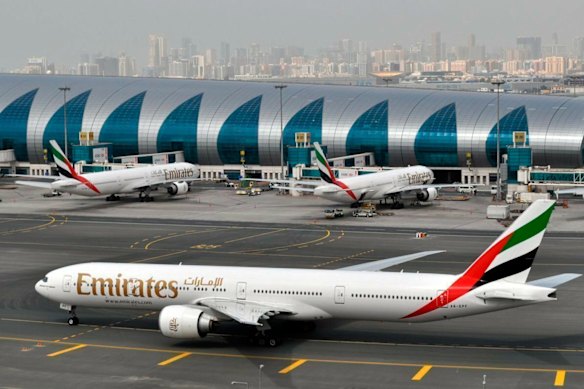

The Australian government is poised to lower its travel warnings for the key Middle East hubs of Dubai and Abu Dhabi as soon as Wednesday, removing a major hurdle for travellers to buy travel insurance for flights via the region.
The pending move follows a signed agreement between the US and Iran to end the conflict in the Gulf and comes ahead of peak season for Australian holidaymakers heading to Europe for the northern hemisphere summer.
Sources familiar with the matter said the Department of Foreign Affairs and Trade was set to downgrade the United Arab Emirates and Qatar from its highest Level 4 (“Do Not Travel”) advisory to Level 3 (“Reconsider your need to travel”).
The move will clear a major hurdle for the region’s major carriers – Emirates, Etihad and Qatar Airways – while restoring a vital aviation corridor for Australians travelling to and from Europe and the UK. When the warning was at level four, almost all insurers refused to issue policies for people flying via the Gulf.
“We keep all Smartraveller travel advisories under close review, including the Middle East region, regularly and carefully assessing the risks to Australians overseas and providing the latest information,” a DFAT spokesperson said. “The safety and security of Australians is our highest priority”, the department added, while still urging travellers to secure appropriate insurance and closely monitor official advice.
The months-long conflict heavily disrupted travel plans for hundreds of thousands of passengers, forcing airlines to reroute flights, cancel trips, and bypass the region entirely. The resulting uncertainty crippled forward bookings and devastated the business of international tour operators.
The war also damaged the reputation of Dubai, Abu Dhabi, and Doha, which have long been marketed to Australian travellers as secure, stable transit hubs.
Level 4 “Do Not Travel” instructs Australians to leave the region “if it’s safe to do so” and if a person does travel there, they should seek professional security advice. “Your travel insurance policy might be void. The Australian Government may not be able to help you.”
Level 3 instead urges travellers to avoid non-essential travel and to “check that your insurer will cover you.”
US President Donald Trump confirmed on Monday that a preliminary peace agreement had been signed, offering an end to a conflict that saw airports, hotels, and civilian infrastructure routinely targeted by drone strikes and forced repeated airspace closures. The details of the agreement have not been made public and many crucial details have been pushed back to future negotiations, while Israel’s stance on the pact is unclear.
Emirates currently operates the highest volume of daily flights connecting Sydney, Melbourne, Brisbane, and Perth to Dubai, while Virgin Australia partner Qatar Airways routes heavily through Doha.
Brett Mitchell, managing director for ANZ at Intrepid Travel, noted the broader impact of the de-escalation. “Any move towards peace is good news for the world,” Mitchell said.
“We also hope that, as conditions evolve, official travel advice will continue to reflect the situation on the ground, including for major transit hubs that play a critical role in connecting travellers with destinations around the world.”
The Business Briefing newsletter delivers major stories, exclusive coverage and expert opinion. Sign up to get it every weekday morning.
 Chris Zappone is a senior reporter covering aviation and business. He is former digital foreign editor.Connect via X, Facebook or email.
From our partners
Disclaimer : This story is auto aggregated by a computer programme and has not been created or edited by DOWNTHENEWS. Publisher: www.smh.com.au