
Updated ,first published
Frustrated doctors from the state’s major hospitals walked off the job in the pouring rain, demanding better pay and working conditions as their ongoing dispute with the government escalates.
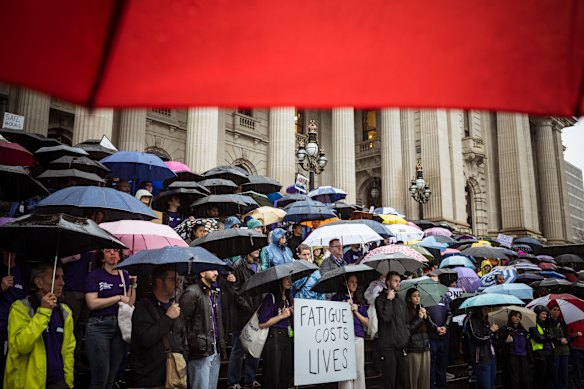
Hundreds of doctors braved the elements on the steps of Parliament House in Melbourne, huddled under umbrellas and swapping scrubs for raincoats as they called for improvements to their working conditions.
The doctors want a 30 per cent pay rise over four years, a cap of 12½ hours on shifts, paid overtime and a guarantee of three consecutive days off during a fortnight as they warned patient safety was at risk.
The four-hour industrial action follows more than a year of strained negotiations with the Victorian government.
There were roars from the crowd as the Australian Medical Association’s (AMA) Victorian chair of doctors in training Dr Stephanie Davies declared the state government was holding doctors in a “hostage situation with a HECS debt”.
“This government is banking on us doing nothing about it,” she yelled to cheers from the crowd.
Australian Medical Association union member Seamus Horan said he feared for his colleagues’ wellbeing and for the safety of the rising number of patients arriving in hospitals across the state.
“The government is scared of us coming out to tell people what it is like working in public hospitals,” Horan said.
“Well, I’m scared about rural hospitals that are under-staffed, under-funded and forced to put second-year doctors in charge of their emergency departments overnight.”
Doctors held signs, including one with the words “Enough Crap Pay”, decorated with poo emojis, a roll of toilet paper and a can of air freshener. Others held placards warning “tired doctors means patients suffer” and “fatigue costs lives”.
Melbourne medical registrar Laura Panozzo, who was holding a sign with an image of Victorian Premier Ben Carroll’s head with the words “A bad Christmas Carroll” scrawled across it, said doctors across the state were burnt out by unsustainable working hours and conditions.
“There are patients lined up in ED corridors… The hospitals are just blowing out of capacity, and it is really hard for us to do our jobs,” she said. “Every day is getting harder and harder. I am really worried about the cumulative fatigue.”
Australian Salaried Medical Officers Federation (ASMOF) president Dr Roderick McRae said this week working hours and fatigue among doctors in hospitals were so severe, they felt they had no option but to strike again.
“Our doctors do not take the decision to go on strike lightly,” McRae said.
“But the reality is they are being rostered on for 84-hour weeks and frequently work even longer when emergencies occur. They are often completely exhausted and burnt out, with little opportunity to rest between shifts. The threat that this systemic fatigue presents to patient safety is simply unacceptable.”
Emergency departments were exempt from the strike, and staffing remained above Saturday levels to ensure patient safety would not be put at risk.
McRae said despite more than 14 months of negotiations and more than 60 meetings with three health ministers, the state government had failed to address doctors’ concerns.
“The Victorian hospital system is in crisis, and everyday patient safety is under threat,” he said.
He said doctors had already undertaken four separate strikes in specific regional and metropolitan locations.
“Over the last six months, the government has repeatedly promised doctors that ‘an offer was imminent’,” McRae said. “But despite this, we’ve seen absolutely nothing put forward.”
Non-critical and elective surgeries are expected to be delayed as a result of the mass walkout on Thursday afternoon.
The government refused to answer questions about how many and which surgical and medical procedures would be impacted by the strike.
It has maintained there will be no impact to category 1 planned surgeries, which are critical and life-threatening cases.
All affected hospitals have confirmed they have safe staffing levels to deliver care to patients.
Australian Medical Association Victoria president Dr Simon Judkins said doctors were not asking for anything unreasonable and wanted sustainable working conditions to protect patient welfare.
“Doctors do not want to be attending protests,” he said. “They want to be in their hospitals doing what they’ve dedicated their lives to, and that’s caring for their patients.”
He said that to ensure the best care for patients, Victorian doctors are asking for a 12½-hour limit to shifts and at least three guaranteed days off every fortnight to support proper rest and recovery.
“As other emergency services recognise, these basic measures are critical in managing fatigue and in keeping doctors and patients safe,” he said.
Judkins vowed the doctors would not stop their industrial action until a fair deal was struck.
Victorian Health Minister Ingrid Stitt said anyone who turns up to a public hospital relied on the people working there.
“We recognise the care and commitment they bring to their work,” she said.
“We’ve been working directly with AMA and ASMOF, and discussions are progressing.”
Stitt said patient care remained the government’s priority and hospitals were braced to manage any disruption.
“My message to doctors is we are listening and absolutely committed to continuing discussions with your union to make sure that we come to a settlement,” she said.
Be the first to know when major news happens. Sign up for breaking news alerts on email or turn on notifications in the app.
 Melissa Cunningham is a health reporter for The Age. She has previously covered crime and justice.Connect via X or email.
From our partners
Disclaimer : This story is auto aggregated by a computer programme and has not been created or edited by DOWNTHENEWS. Publisher: www.smh.com.au