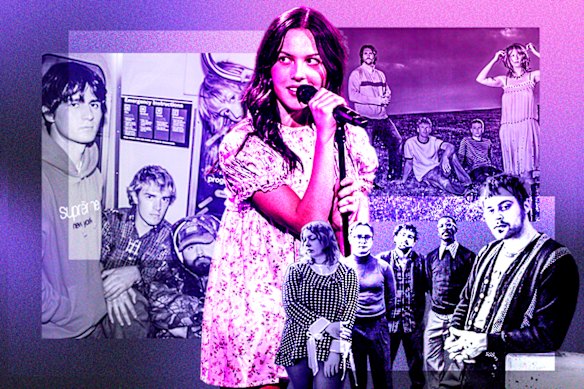
A new generation, including chart-topper Olivia Rodrigo, is tapping into the sound and spirit of ’90s guitar music.
It’s happened often lately. I’m listening to the week’s buzzy new albums, and all of a sudden – amid chiming guitars, singsong harmonies and crunchy distortion – I’m transported back to my teenage bedroom, listening to Siamese Dream and watching Daria in the orange after-school glow.
The sound and spirit of ’90s guitar music – from the melodic jangle of R.E.M. and Sugar, to the lush distortion of Sonic Youth and My Bloody Valentine – is suddenly everywhere. Earlier this year, Olivia Rodrigo – a noted ’90s lover who took The Breeders on tour and recently revived Lilith Fair for a new generation – even sent the sound to the top of the pop charts with her album You Seem Pretty Sad for a Girl So in Love, and its jangly highlight, U + Me = <3.
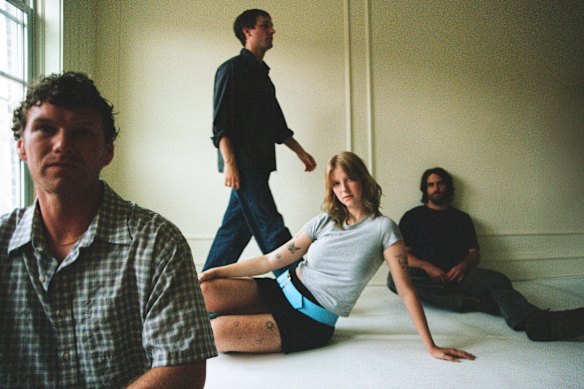
Emily Massey, lead singer of US indie darlings Slow Pulp – whose new album Melodie builds inventively on their signature alt-’90s foundations – says the era holds an untarnished mystique for Millennials and Zoomers raised in its wake. “We were little kids in the ’90s, so there’s a sense of longing for a time you have some sense of but don’t have fully formed memories of,” she says.
Slow Pulp formed in Madison, Wisconsin, the city where Butch Vig famously produced the likes of Nirvana and The Smashing Pumpkins at his Smart Studios. “Growing up, there was something in the air, this feeling of, oh, that’s what’s cool,” says Henry Stoehr, the band’s songwriter and guitarist.
Over a decade removed from the last dregs of blokey landfill-indie, and with pop’s top stars offering diminished returns, rock music and fuzzy guitars – so central to youth culture in the ’90s – are cool again.
Charli XCX, a couple of years removed from “Brat Summer”, this year declared “the dance floor is dead” and pivoted to rock music on her new album. Alt-rockers like Phoebe Bridgers and Cameron Winter (along with his band Geese) have become surprise chart phenomenons, and bands like Turnstile, Fontaines D.C., Wednesday and This Is Lorelei are critical darlings and festival favourites.
Stoehr understands why the ’90s and its sonics has captivated a generation who came of age amid COVID lockdowns. “I feel like post-2020, there was this pent-up feeling of wanting to get out and enjoy yourself and just ‘vibe’, that psychologically lent itself towards club culture and party culture, just because people were deprived of that for longer than was ideal.
“We loved that stuff, too!” he adds. “But you reach a point where it’s like, ‘I’m kind of done partying and I want something that is packed with meaning, something that’s gonna hit me in the gut.’ And I feel like that’s the purpose that rock music has always served, and people are craving that.”
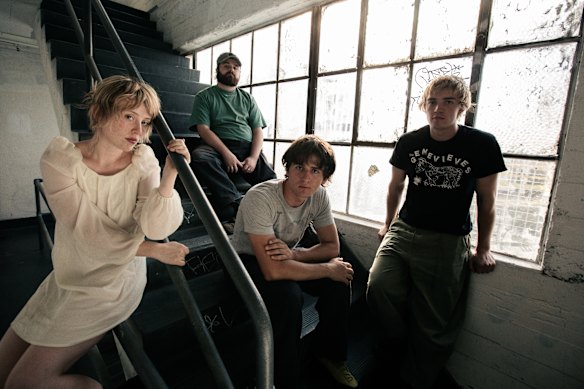
Swapmeet, a buzzy Adelaide band whose members are all 23, bonded over a shared love of ’90s acts like Sonic Youth and Pavement. Their new album Mount Zero touches on Swirlies-style noise and Flying Nun-inflected jangle-pop, while their last EP featured the reverb-drenched atmospherics of Mazzy Star.
Guitarist Maxwell Elphick says he got into grunge via Guitar Hero and the CDs his uncle gave him as a teen. The ’90s era’s scrappy DIY looseness immediately appealed to him.
“It feels like weird music became cool and popular then, like you didn’t have to be a great vocalist to be in a good band. It was very much just if you could write songs, you could do it, which was really cool. That’s why I gravitated towards it,” he says.
“We’d be making this kind of music anyway, but it’s great that people think rock music is cool again. Because I feel like everyone thought it was a little cringe for a bit.”
Of course, amid a critical discourse that favours innovation and “forward-thinking music” over repeating the sounds of yore, looking back can mean being overlooked.
“There’s not much originality left in music in terms of what hasn’t been done, and that’s not what we’re trying to do anyway, and I’m sure a lot of music heads would have something to say about that,” says Nina Pitchkites, vocalist/guitarist of US band Wishy, with an era-appropriate eye roll.
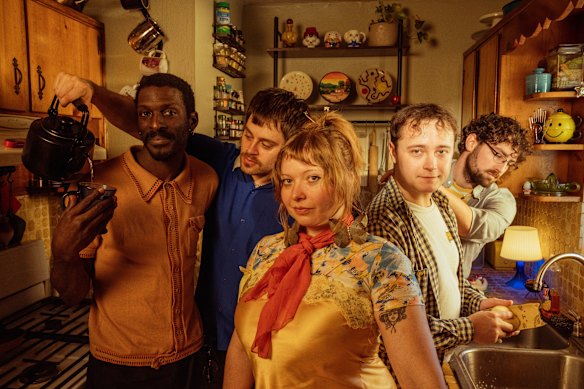
Kevin Krauter, the band’s guitarist, says while the new wave of ’90s revivalists aren’t reinventing the wheel, they’re tapping into the way music has functioned since the dawn of time. “Think about blues music,” he says, “they’re all just playing these standards, but what makes someone stand out and special is the unique style and personality they bring to it.”
For Wishy, whose fantastic new album Nature’s Pill revives ’90s power-pop and twee – a particular strain of sweet, fuzzy, melodic alt-rock laden with boy-girl harmonies and inspired by cult ’90s indie-rockers like Velocity Girl and Tiger Trap – the current era’s cultural conditions have set an intriguing proposition.
In the ’90s in the US, twee and riot grrrl – mostly on Pacific Northwest record labels like K Records and Kill Rock Stars – were driven by feminist politics and anti-macho sensibilities. So, has the age of Donald Trump and the manosphere set the stage for a ’90s-twee revival?
On a couch in his parents’ home in Carmel, Indiana, Krauter ponders the question. “You saw the same thing in the Bush-era of the early 2000s, and we got a lot of effeminate emo music coming out of that, guys wearing really skinny jeans and guyliner, sort of throwing a big middle finger to the macho stereotype that was the dominant structure of the state and culture at the time,” he says.
When chauvinism and toxic masculinity is the prevailing culture, it seems natural that artists would want to subvert it. Suddenly, it’s more transgressive to be gentle and sincere – or, as three-inch badges in the ’90s put it, “twee as f—.” There’s already evidence in the burgeoning nu-twee movement featuring (admittedly less guitar-centric) cult bands like ear and Worldpeace DMT and The Femcels.
“You think about the Obama-era when we had Burger Records and garage rock, that whole scene was so macho,” Krauter adds as a contrast, citing the hipster hub of trash-rock bands like Black Lips. Burger Records folded in 2020 amid sexual assault accusations over its roster.
“I remember being in high school and going to DIY shows and the whole attitude of that scene was very ‘whatever, f— it’. But then, around 2016 when Trump was elected, you started to see more of this ‘softboi’ vibe enter the culture. And so it makes sense that people would rediscover twee attitudes and aesthetics right now”.
Although they’re an indie act, signed to the label Winspear, the wild success of bands like Geese points to breakout potential they never imagined a couple of years ago when Wishy released their debut, Triple Seven.
“I mean, hopefully all this will result in some kind of favour for us, that’d be nice,” Krauter deadpans. “Like, suddenly rock music is super lucrative again? That would be convenient.”
His cynicism is noted, but it’s not out of the realm of possibility that Rodrigo – noted fan of lovelorn indie melodies and crunchy riffs, a true ’90s twee-girl at heart – could bring them on tour as an opener.
“That’d be crazy,” Krauter says. “Olivia, hit us up.”
Slow Pulp’s Melodie, Wishy’s Nature’s Pill and Swapmeet’s Mount Zero are out now.
Want more music stories and reviews?
Disclaimer : This story is auto aggregated by a computer programme and has not been created or edited by DOWNTHENEWS. Publisher: www.smh.com.au