
ACMI’s Reverb exhibition is a celebration of music’s most iconic object.
Vinyl records appeared doomed when German artist and musician Carsten Nicolai created his interactive art installation bausatz-noto in 1998. Made up of a turntable, sound mixer and brightly coloured 10-inch records, it was conceived as both a hymn and a requiem. Sales of CDs were still booming; the file-sharing revolution was a few years away. Vinyl LPs, with their pops, crackles and limited capacity (just 20 minutes of music a side) seemed destined to go the way of Betamax and Bakelite telephones.
Nicolai, who also owns a record label, is part of the generation that grew up listening to vinyl. His installation invited visitors to put on a pair of headphones, select some discs and create their own music. When bausatz-noto comes to Melbourne as part of The Vinyl Factory: Reverb exhibition opening at ACMI on May 22, locals will be able to do just that.
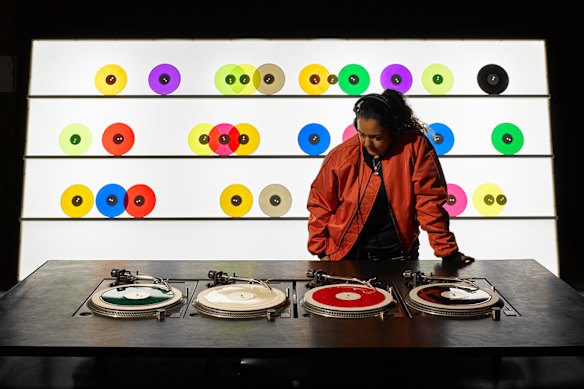
The experience is tactile and can’t be hurried. It requires concentration. It is the antithesis, perhaps, of the instant, all-you-can-eat ethos of digital music. “For me,” says Nicolai, “vinyl records are the iconic object that best represents music.”
Vinyl did not expire, of course. Today, it is music’s dominant physical medium, a revival that has been going so long (about 20 years) it feels wrong to even call it a revival. Streaming is the world’s dominant form of music consumption (it accounts for almost 70 per cent of the industry’s income), but sales of old-fashioned records in old-fashioned sleeves are, whisper it, robust.
The Vinyl Factory, a record label and pressing plant in Hayes, a part of west London where EMI once made 20 million records a year, is evidence of the medium’s resilience. A box set of Nicolai’s bausatz-noto is among the thousands of records it has produced since the start of the millennium, when it acquired EMI’s automatic presses – venerable machines that once turned out era-defining LPs such as Abbey Road, The Dark Side of the Moon and Never Mind the Bollocks, Here’s the Sex Pistols.
The ACMI exhibition celebrates the company’s collaborations with artists and musicians. Along with bausatz-noto, there will be a 50-person listening room with a state-of-the-art audio system that will spin vinyl LPs from an eclectic group of artists including Sonic Youth, Ryuichi Sakamoto, Miles Davis and Grace Jones.
Sean Bidder, The Vinyl Factory’s creative director, says the exhibition, which is part of this year’s RISING festival, is a celebration of the “enduring legacy of the medium”. Some heavyweights of the art world – Jeremy Deller and William Kentridge – have work in the show, and there’s an eye-popping display of 100 LP covers.
If vinyl’s resurgence was only driven by older people returning to the format that defined their youth, its days would be numbered. But that’s not the case. Bidder says there’s plenty of evidence that the digital natives of Gen Z are a major force in today’s market. He points to a report by The Vinyl Alliance that found people aged 18 to 24 are the largest group buying vinyl records regularly, and 76 per cent of Gen Z vinyl fans buy records at least once a month.
“As much as digital culture is omnipresent, we’re still human beings; we can only move at a certain pace, and we want some respite from the relentlessness of digital culture,” he says. “People who are passionate about music want to experience it in a richer, deeper way.”
Other reasons young music fans buy LPs include wanting to support artists who earn more from records than streaming services. “It’s a bit like wearing a T-shirt by a band you like – it’s an expression of how passionate you are, how committed you are,” says Bidder. They’re also valued as beautiful objects worthy of display, or simply a way to detach from your phone and computer.
Not far from where Bidder is sitting is evidence of that engagement: a wall of discs demonstrating the 250 bespoke colours artists can choose from when commissioning a run of LPs or singles. Fun fact: Bjork named the hue she picked for one of her releases “genital white”.
The pressing plant itself is a busy, cacophonous place full of electroplating baths and heavy machinery; the kind of shop floor you see in movies from the 1940s and ’50s. It is here that six EMI presses turn pellets of polyvinyl chloride (PVC) resembling black lentils into a 12-inch disc that looks and feels as iconic as Warhol’s soup can. A single LP takes 27 seconds to make. The process involves heat, 2400 psi (pounds per square inch) of pressure and steam to help stamp every quaver and drum beat into the grooves. A shot of cold water returns the vinyl to its rigid state before the finished record is dropped into a sleeve.
Musicians – Suzi Quatro was a recent visitor – often gather at the business end of the presses to watch in wonder as the music they recorded in studios in every corner of the world emerges as an object that is part vessel, part artwork.
Pressing is the final part of the process, says manufacturing director Alex Deninson, a 29-year-old who joined The Vinyl Factory from university. The first step is cutting the music into a blank lacquer disc using a mastering lathe. The result, an engraved “lacquer”, is coated with nickel to create what’s known as a “master”. As the “master” is a negative of the “lacquer” – it has ridges rather than grooves – the electroplating process is used again to create a “mother” or “positive”. That is used to make a “stamper”, the mould that sits inside the press and shapes the finished product.
Says Deninson: “The master allows you to grow 20 positives and each positive can grow 20 stampers. A single stamper can press 1000 records, so it’s exponential.”
Each of The Vinyl Factory’s six EMI presses can produce up to 1000 LPs a day, and its seven-inch machine can turn out more than 1000 singles in a 24-hour period. “The busiest year we ever had was during COVID, when we pressed 2 million records,” says Deninson. “Everyone was furloughed, stuck at home and rediscovering music.”
Keeping the presses running is a labour of love. The Vinyl Factory has a “graveyard” of retired presses it strips for parts and a full set of EMI’s technical drawings. Luckily, the machines were built to last. “They’re so over-engineered they’re still running brilliantly; they’re just phenomenal,” says Deninson with pride. “They press some of the best records in the world.”

Outside in the car park is yet another press: a manual machine housed in a shipping container. It once sat in London’s White Cube gallery as part of a Vinyl Factory collaboration with the artist and composer Christian Marclay. Music was recorded live in the gallery and pressed on site. The manual press, which can produce LPs with coloured stripes, is yet another option for artists seeking to put a unique stamp on their releases. British drum ‘n’ bass titan Goldie used it to create LPs that matched the blue and gold of his trainers. Daft Punk, Sakamoto and “a lot of German death metal bands” have also manipulated their “wax” here.
This kind of customisation is part of vinyl culture; the idea that the LP is an artefact that’s at least as important as the music it carries. Gatefold sleeves, silkscreen printing, stickers, engravings on the LP’s surface and heavyweight discs (180 and 200-gram LPs can be made at a cost) are all ways of standing out from the crowd.
“The Vinyl Factory’s vision was to take the process back to when it was craft-led and focused on the relationship between the creator and the manufacturer,” says Bidder. “The days when you could walk into a studio on London’s Denmark Street, record a track in a day and get the pressing soon afterwards.
“The difference now is the internet, a way for artists to market directly to consumers. We want to make the product as good as it can be both in terms of the audio and what you can do creatively. You’re trying to make a collectible item that people are prepared to pay for. These aren’t things to be thrown away.”
ACMI and RISING present The Vinyl Factory: Reverb, May 22 to Aug 31.
Disclaimer : This story is auto aggregated by a computer programme and has not been created or edited by DOWNTHENEWS. Publisher: www.smh.com.au