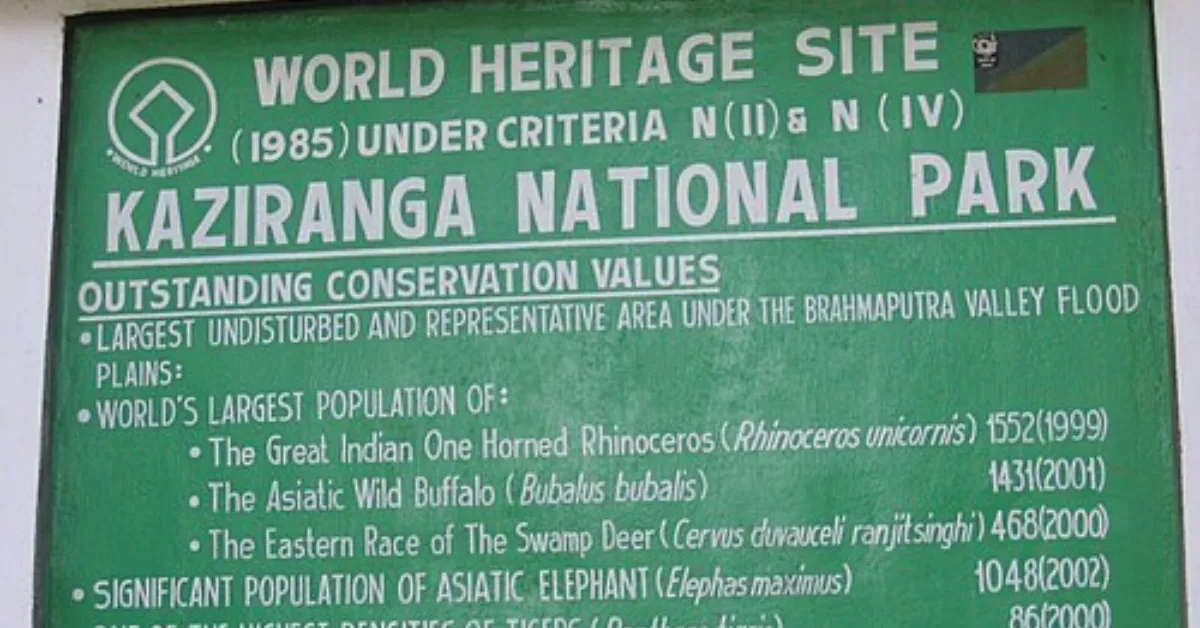
On a map, Kaziranga National Park has a boundary. A rhino does not.
When the Brahmaputra rises, and the grasslands begin to disappear under floodwater, a rhino may move towards higher ground. An elephant may follow an old route into the Karbi Anglong hills. The animal does not stop because a line on a map says the protected area has ended.
Hold on to that image, because it is the whole story. Everything now being argued over — the viral posts, the court orders, the trucks in the riverbeds — comes down to a single stubborn fact: the creatures Kaziranga exists to protect have never agreed to stay inside it.
The argument itself began on 8 August, when the Assam government announced that the state would seek to have the Eco-Sensitive Zone (ESZ) around Kaziranga National Park and Tiger Reserve formally notified at one kilometre instead of the 10-km default provision.
Within hours it was everywhere: a protective buffer, people said, was being shrunk by ninety per cent.
It is a clean, alarming story. It is also not quite the story.
Because it raises a sharper question than the one trending online: who protects the land beyond Kaziranga’s boundary, when the animals don’t recognise it in the first place?
The Better India looked at court orders, government records, complaints, reports, and recent developments around Kaziranga. Mining, construction, roads, rivers, flood refuges, and wildlife corridors all intersect here, and much of it is unfolding right now, while the timeline fills with arguments about a single number. After speaking to conservationists and examining those concerns, the real question turns out to be this: can the larger landscape that sustains Kaziranga stay connected at all?
First — what is the 10-km rule, really?
An Eco-Sensitive Zone is meant to create a regulated area around protected forests, national parks and wildlife sanctuaries, so that activities capable of placing pressure on these ecosystems can be controlled.
It does not mean every human activity inside an ESZ is banned. Different activities can be prohibited, regulated, or permitted depending on the applicable rules and notification. Mining and highly polluting activities face the most stringent restrictions.
So Assam is cutting a firm 10-km shield down to one — that’s the outrage, and that’s the story. Except here is the detail almost no one arguing about it has mentioned:
There is no final, formally notified 10-km Kaziranga ESZ. There never has been.
In its 3 June 2022 judgment, the Supreme Court directed that every national park and wildlife sanctuary should have an ESZ of at least one kilometre from its demarcated boundary. It also said that where a wider ESZ already existed, or where a wider buffer had been proposed and was awaiting a final decision, that wider area would continue to prevail.
A subsequent legal proceeding in 2026 recorded the position even more clearly. The Gauhati High Court noted that where a protected area’s ESZ has not been finally notified, the 10-km buffer continues to operate as the default, with ESZ restrictions applying within it.
/filters:format(webp)/english-betterindia/media/media_files/2026/08/13/kaziranga-2-2026-08-13-20-16-44.png)
The court also recorded that, at that time, no final Kaziranga ESZ notification had been submitted by the state to the Centre.
Which means the viral shorthand — “Kaziranga’s 10-km ESZ has been cut to 1 km” — misses an important detail. There is no final, Kaziranga-specific ESZ notification at all. The 10 km is a legally binding default the Supreme Court applies wherever a park’s own zone hasn’t been formally notified — protective and real, but never the fixed, Kaziranga-drawn boundary many assume it to be.
What Assam is proposing is to finally run that notification process, and to set the figure at one kilometre when it does.
And while that line is debated, the landscape it is supposed to describe is already changing.
“Wildlife does not understand administrative boundaries”
That is how environmental activist Rohit Choudhury, who has worked for years on the Kaziranga landscape, puts it. For him, the number announced by the government is not the urgent problem. What is already happening around the park is.
“We cannot compare Kaziranga with any other national park because Kaziranga is a UNESCO World Heritage Site. It is extremely important that we talk about the violations that are already happening and that those violations need to stop right away,” Choudhury tells The Better India, sounding agitated by the situation.
The law, on paper, already agrees with him. On 12 April 2019, the Supreme Court acted on concerns about illegal mining around Kaziranga. It restrained all kinds of mining and related activities along the southern boundary of the park and across the catchment areas of rivers, streams, and rivulets originating in the Karbi Anglong hills and flowing into the national park and tiger reserve.
It also directed that no new construction be permitted on private lands forming part of the nine identified animal corridors.
The reasoning matters because the court looked past the park itself. A construction site can sit entirely outside the protected area and still block the movement of an animal. So the court’s protection followed ecological connections, not the park’s administrative boundary — the same logic a rhino uses when it walks out of the floodplain and up into the hills.
So has the pressure eased in the years since? The opposite.
In May this year, Choudhury approached the Supreme Court-appointed Central Empowered Committee with allegations of new construction in the Haldhibari and Panbari corridors. He alleged that a school was being built in Haldhibari, a residential structure was coming up in Panbari, and land filling was taking place near the Singjuri water channel — three of the very corridors the 2019 order was meant to keep clear.
/filters:format(webp)/english-betterindia/media/media_files/2026/08/13/kaziranga-4-2026-08-13-20-19-22.png)
And this is not a new drift. A 2021 inspection by L J Syiemiong, the DIG Forests, and raised by Dr Hemen Hazarika, a scientist at the Ministry of Environment, Forest and Climate Change’s Guwahati office, had already painted a bleak picture. More than 500 trucks and vehicles were recorded using the streams and rivers flowing from the Karbi Anglong hills to bathe, wash vehicles and, effectively, leave behind wastewater, oil and grease. Hotels and dhabas were expanding along the stretch. A landscape meant to help wildlife move to safety was beginning to look like a roadside rest stop.
They called it “the greatest eyesore and also a threat to the animals of Kaziranga National Park”.
Then there is the riverbed
This month, Mohajon Kro, a resident of Karbi Anglong, approached the National Green Tribunal and the Ministry of Environment, Forest and Climate Change, alleging mechanised sand mining in the Deihori river using excavators, earthmovers and dumpers — the kind of operation that sends diesel, grease, lubricants and hydraulic fluids straight into the water.
/filters:format(webp)/english-betterindia/media/media_files/2026/08/13/kaziranga-3-2026-08-13-20-20-04.png)
But the Deihori is not one river in isolation. Streams flowing down from the Karbi Anglong hills feed into the Kaziranga floodplain, creating the very ecological link that connects the hills to the park. That is exactly why the Supreme Court’s 2019 mining restrictions did not stop at Kaziranga’s boundary — they extended to the catchments of rivers and streams originating in the hills. Poison the stream in the hills, and it arrives in the floodplain.
The larger question the number hides
Debadityo Sinha, lead of the climate and ecosystems team at the Vidhi Centre for Legal Policy, tells The Better India that the 10-km-versus-one-km debate can obscure what actually matters. Kaziranga, he argues, cannot be understood as an isolated national park at all.
“Of course the entire conversation about reducing 10 kilometres to just 1 kilometre in the name of urban development, is kind of scary for wildlife conservationists, and researchers. This is a good question. But right now, the first thing we need to do is address the real issues on the ground.”
“You cannot say that a wildlife park or a national park has a fixed boundary. Places like Kaziranga and Corbett Tiger Reserves are important protected areas within larger contiguous landscapes and must be viewed alongside neighbouring habitats and wildlife corridors. The Kaziranga–Karbi Anglong highland too is connected. It spreads across a very large area and is a very critical landscape. It has forests, it has floodplains, so it is an extremely dynamic ecosystem.”
So is a 10-km ESZ automatically the answer?
Not on its own. A 10-km ESZ is not a magic circle inside which wildlife is safe and outside which anything goes. Nor does one kilometre automatically mean every corridor, river, or forest beyond it is thrown open to development. And the proposed one-kilometre ESZ is not yet the final legal reality — a formal process must run before any new boundary is notified.
/filters:format(webp)/english-betterindia/media/media_files/2026/08/13/kaziranga-5-2026-08-13-20-22-38.png)
The point Sinha keeps returning to is that the map itself is the wrong tool. “Wildlife parks and national parks cannot be seen like that. Wildlife and nature work very differently because, according to the NTCA profiling of Kaziranga, Kaziranga is a source population for tigers in the Northeast and has one of the highest densities of tigers. And, of course, there are other animals, rhinos, elephants and water buffalo. So this is not serving the purpose of wildlife.”
“This landscape is a very important ecosystem, not just of this nation, but of the entire globe. So we are reversing millions of years of conservation history, first of all, if the ecological violations continue.”
/filters:format(webp)/english-betterindia/media/media_files/2026/08/13/kaziranga-6-2026-08-13-20-23-26.png)
What’s at stake, in short
If you take away five things from this debate, take these.
1. The 10 km was never a Kaziranga-specific boundary. It is a legally binding default the Supreme Court applies wherever a park’s own Eco-Sensitive Zone has not been finally notified. Kaziranga’s has not. So the buffer is real and protective right now, but it is a placeholder, not a tailor-made line.
2. Nothing has legally changed yet. Assam has announced its intention to notify a 1-km ESZ. Until it submits that proposal and the Centre acts on it, the 10-km default stays in force. The one-kilometre figure is a plan, not a rule.
3. A number on a map is not the real safeguard. A 10-km zone does not make wildlife safe inside it, and one kilometre does not automatically open everything beyond it. What protects Kaziranga is whether its corridors, rivers and catchments stay intact — and those extend far past any single radius.
4. The violations are already happening. Alleged construction in the Haldhibari and Panbari corridors, land filling near the Singjuri channel, sand mining in the Deihori river, and hundreds of vehicles fouling hill streams — all of this is unfolding now, regardless of where the ESZ line is finally drawn.
5. The real question is connectivity, not radius. Kaziranga is not an isolated park but part of a wider landscape linking the Brahmaputra floodplain to the Karbi Anglong hills. The thing worth watching is whether that landscape stays connected — for the rhino, the elephant, and the tiger that move through it.
Which brings the argument back to where it began — not to a line on a map, but to the animal that never agreed to it. Somewhere in the floodplain right now, as the timelines fill with numbers, a rhino is moving towards higher ground, following a route older than any notification, looking for a way through a landscape we are still deciding whether to keep whole.
Disclaimer : This story is auto aggregated by a computer programme and has not been created or edited by DOWNTHENEWS. Publisher: thebetterindia.com