
From changes to Deutsche Bahn’s loyalty points scheme to the right to all-day childcare and new labelling rules for AI-generated content, here are the key changes this August affecting people living in Germany.
Regional public holiday approaching
There’s good news ahead for residents of Saarland and many parts of Bavaria: they’ll get to enjoy a public holiday in August.
On August 15th, shops and many businesses will close to mark Mariä Himmelfahrt (the Assumption of Mary).
The regional holiday is observed in predominantly Catholic municipalities in Bavaria, but it is a Feiertag across the whole of Saarland.
Several other predominantly Catholic countries in Europe – including Spain, Croatia, Belgium and France – also celebrate the holiday.
READ ALSO: Why August 15th is a public holiday in parts of Germany
Deutsche Bahn changes bonus programme
German rail operator Deutsche Bahn is making changes to its loyalty programme known as BahnBonus.
Members earn points when buying train tickets, BahnCards and subscriptions such as the Deutschlandticket. These points can be redeemed for free journeys, upgrades and other rewards.
From August, a free one-way journey within Germany will start at 750 points in second class and 1,250 points in first class, down from the current 1,000 and 1,500 points respectively.
However, Deutsche Bahn is also introducing a dynamic points system. In future, the number of points needed for a free journey will depend on factors including the route, when you book and expected demand.
Passengers who book early, travel shorter distances or choose off-peak services could benefit. However, flexible or last-minute journeys are likely to require more points, and Deutsche Bahn has not set an upper limit.
Meanwhile, the number of points needed for Freifahrt Flex vouchers, which allow travel without being tied to a specific train, will increase by around 17 to 33 percent, depending on the ticket type.
READ ALSO: Inside Germany – The perks (and pains) of Deutsche Bahn’s rewards program
Right to all-day childcare
Many parents struggle with childcare after school. Now Germany is bringing in a change to support families.
From the 2026/2027 school year onwards – so beginning in August in most states – all Year 1 pupils will initially have a legal right to all-day care at school. This entitlement will be extended by one year group per year in the coming years.
From the 2029/2030 school year onwards, all children in Years 1 to 4 will then be entitled to all-day support.
The plan is to provide care on five working days for up to eight hours a day – for example, in an after-school club or through a school-based all-day programme.
Parents are not obliged to take up this offer, which officially comes into force on August 1st. The states and local authorities are responsible for implementing the changes.
A child plays in the water in a fountain at Stachus in the Munich city center. Photo: picture alliance/dpa | Peter Kneffel
Higher health insurance payments for millions of people
Health insurer IKK Classic is increasing its supplementary contribution by 0.45 percent from August, bringing it to 3.85 percent.
It will affect around 2.3 million people who are members of the statutory health insurance fund.
In Germany each health insurance provider sets its own supplementary contribution which is then added to the statutory general payment of 14.6 percent.
For IKK Classic, this will result in a total contribution rate of 18.45 percent from August. The costs are shared equally between employers and employees. Self-employed people pay the full amount themselves.
As always, a special right of termination applies in the event of a contribution increase. The policy can be cancelled by the end of the month in which the contribution is first increased. In this case, that is August 31st 2026. However, the increased contribution must be paid in August.
READ ALSO: How to switch German health insurance providers
Feed-in tariff for solar power to fall
Anyone installing a new photovoltaic (PV) system or balcony solar power plant should be aware of a change coming into force on August 1st.
The feed-in tariff paid for surplus electricity fed into the grid will be reduced for newly commissioned systems. If you register your PV system after August 1st, the tariff will be one percent lower than for systems commissioned earlier.
Nothing changes for existing installations. Their feed-in tariff remains guaranteed for 20 years.
READ ALSO: How do I register my balcony solar panel in Germany?
New apprenticeship year starts
The new apprenticeship year begins in Germany on August 1st, and is accompanied by amendments to regulations for a number of trades.
These changes are intended to ensure that the trades keep pace with social change and the demands of an increasingly digitalised world of work. The changes relate solely to the name of the trade in some cases or to specific aspects of the training programme.
Among the 22 modernised professions are: bricklayer, refrigeration and sound insulation fitter and structural design engineer, which was previously architectural draughtsman.
Two apprenticeship professions have also been discontinued: petrol station attendant and railway and road transport clerk.
In total, teenagers and young adults in Germany will have a choice of 325 recognised dual vocational training programmes.
Speed enforcement campaign coming up
Drivers should expect more speed checks on the roads between August 3rd and 9th, when police across Germany take part in the latest Blitzermarathon.
During the week-long campaign, police and various local authorities will carry out increased speed enforcement on motorways, major roads and in built-up areas.
The focus will be on accident hotspots, as well as roads near schools, construction sites and hospitals.
READ ALSO: German word of the day – Blitzer
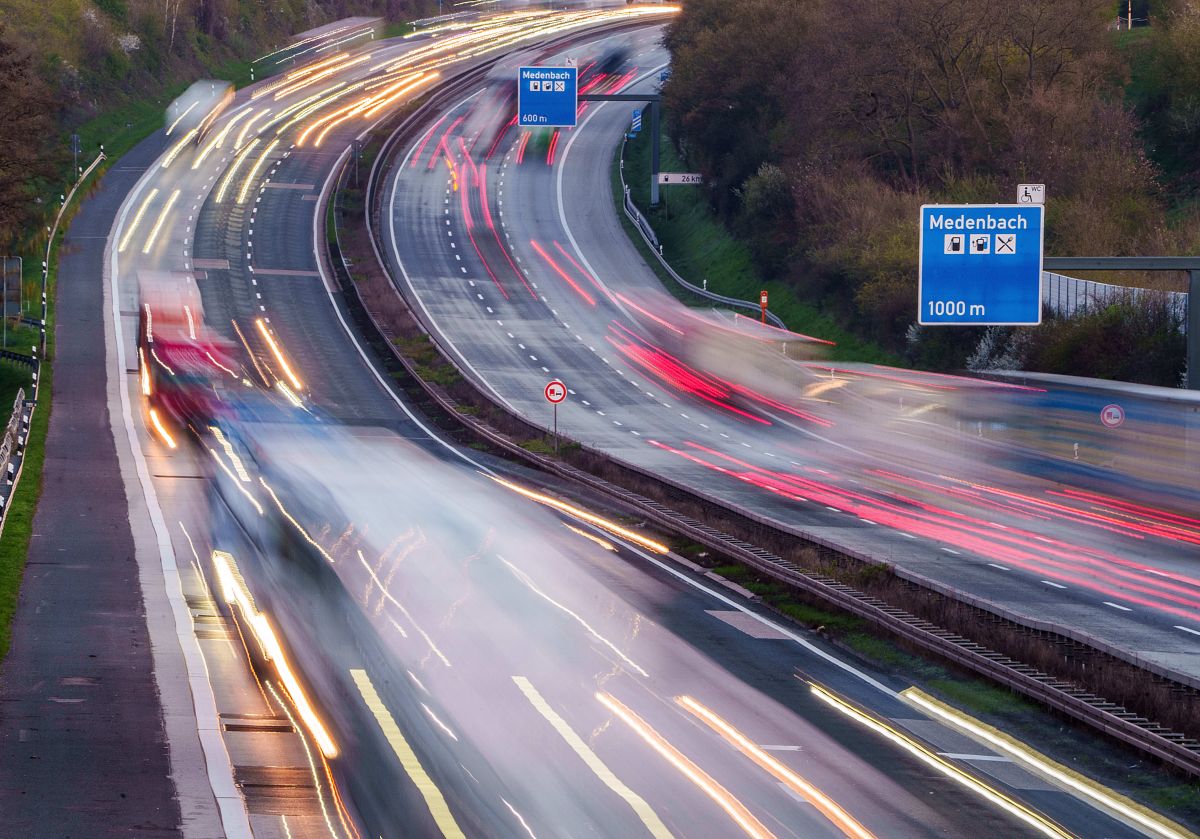
Traffic on the Autobahn. Photo: picture alliance/dpa | Andreas Arnold
Labelling requirements for AI-generated content
From August 2nd, companies that distribute content created predominantly with the aid of artificial intelligence must, in accordance with an EU regulation, label it this way.
The aim is to ensure transparency regarding whether the content was created exclusively by a human or whether AI was used to edit texts, social media posts, images, video or audio files.
“Companies that fail to comply with the new rules face fines of up to €35 million or seven percent of their global annual turnover,” says the European Consumer Centre Germany (EVZ) on its website.
Regional transport tickets rise in cost
Public transport passengers in some parts of Germany will pay more for local and regional transport from August 1st, as a number of transport associations introduce annual fare increases.
Among those raising prices are the Mitteldeutscher Verkehrsverbund (MDV), which covers the Leipzig-Halle region, the Karlsruher Verkehrsverbund (KVV) and Marego in the Magdeburg area.
LISTED: All the ways to get cheap Deutsche Bahn tickets this summer
A3 Autobahn expansion set to finish
After six years of construction, a key section of the A3 in northern Bavaria is set to open on August 3rd.
The 76-kilometre stretch between the Biebelried and Fürth/Erlangen motorway junctions has been widened to six lanes. It should ensure a smoother flow of traffic on this major east-west route.
New school year begins
Pupils in Hesse, Rhineland-Palatinate and Saarland will return to school on August 10th, marking the start of the 2026/27 academic year in those states.
As usual, Germany’s school calendar varies by region, with seven different start dates for the new school year. Baden-Württemberg and Bavaria will be the last states to return, with classes beginning in the third week of September.
READ ALSO: Germany’s plan to protect young people from social media harm
Disclaimer : This story is auto aggregated by a computer programme and has not been created or edited by DOWNTHENEWS. Publisher: thelocal.de