
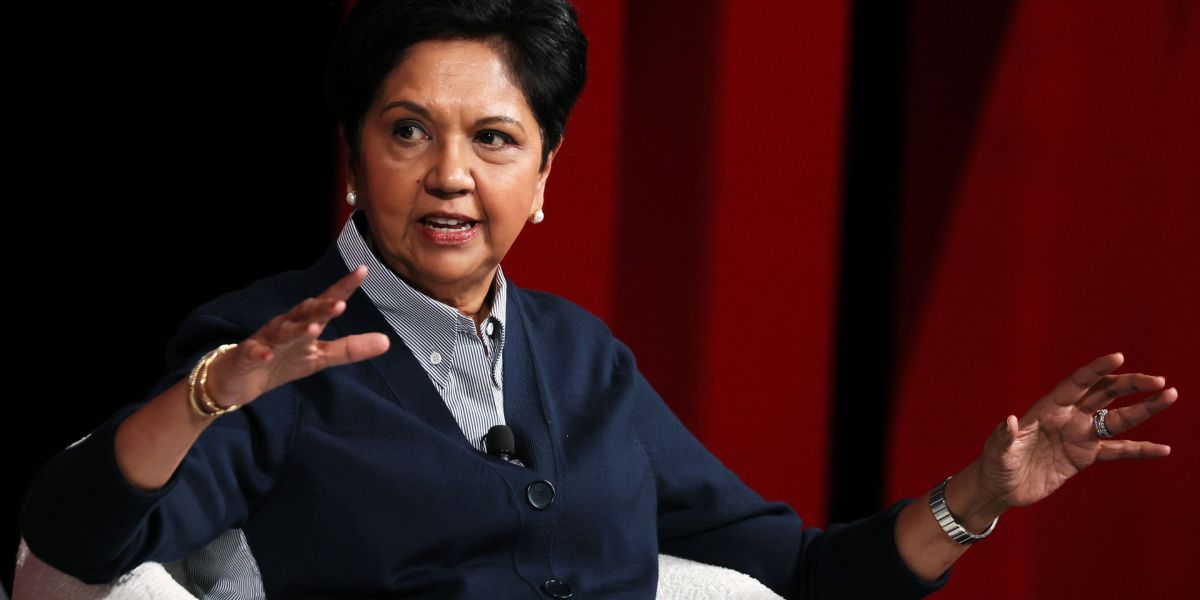
When former PepsiCo CEO Indra Nooyi arrived in the U.S. in the late 1970s to study graduate-level management at Yale University, she was a self-described “misfit” from India. Instead of adjusting to the rhythms of college nightlife, Nooyi was working the midnight-to-5 a.m. shift as a dormitory receptionist before heading to class each morning to pay for her degree.
“We worked our tail off because to us, we didn’t come there for the social life—we came there to study and to work hard and to move ahead,” Nooyi recalled in a July interview with former U.S. Secretary of State Condoleezza Rice, recalling the experiences of her and her fellow classmates from developing countries.
“So the goal we had was very, very clear: study, work hard, get great grades, and somehow land a job,” she added. “That’s all the objective was at that time.”
Paying for an Ivy League degree wasn’t easy, either. At the time, annual tuition was equivalent to about $20,000 in today’s dollars (a far cry from the six-figure tuition costs of today), and her parents told her they couldn’t help her out financially. But eventually, that relentless work ethic inside and outside of the classroom paid off.
“When we got consulting jobs or investment banking jobs, people looked at us and said, ‘Hey, these are brainiacs,’” Nooyi said. “Respect just went up—purely because of the hard work and all the efforts we put in…People realized that this was a grueling experience for us, and they respected us for that.”
Looking back, the overnight shifts and long hours were part of a larger belief as an immigrant: Success wasn’t guaranteed in America, but opportunity was.
“I remember back in the old days people would say they thought the streets might be paved with gold. Maybe they weren’t paved with gold, but they were paved with the possibility of ambition,” she said.
Today, Nooyi has more than a dozen honorary degrees—including from NYU, Duke, and Yale—and sits on the board of Amazon, Honeywell, and Philips. Her net worth is estimated to be roughly $340 million, according to Forbes.
Becoming a leader is like practicing for the Olympics, according to former PepsiCo CEO Indra Nooyi
After graduating from Yale in 1980 with a degree in public and private management—a program that predates the school’s MBA—Nooyi began working her way up the corporate ladder. She worked in various management and strategy positions at companies like Johnson & Johnson, Boston Consulting Group, and Motorola before eventually landing at PepsiCo in 1994. By 2001, she was named chief financial officer, and by 2006, CEO.
At the time, women led only about 2% of Fortune 500 companies—and she faced an uphill battle against those questioning if she was up for the challenge.
But she largely proved her naysayers wrong. During her tenure, which lasted until 2018, sales grew 80%, and Nooyi was named the most powerful woman in business by Fortune five years in a row.
And despite her accomplishments, Nooyi said leadership wasn’t an innate gift, but a skill developed over decades of observation, practice, and experience.
“Leadership requires you to have people wanting to follow you—wanting to follow you with passion, wanting to follow you until you fall off the edge of the earth,” she told Rice. “If you can evoke that kind of passion in people, then you’re a real leader.”
The journey climbing the ladder and becoming a respected manager is akin to training for elite competition, Nooyi added.
“It’s a lifelong process,” she said. “You have to watch, experience, practice, be put in situations where you have to follow leaders, and then you have to have people follow you.
“It’s literally like practicing for the Olympics or some sort of sport. Leaders are made through a very tough process, if you want to call it that, over many, many years.”
Nooyi’s advice for aspiring leaders is to study those already in the role—and note their successes, failures, and the ways they react to both.
“Watch leaders. Follow them. Look at the mistakes they make and how they recover from them. Look at how they shape agendas and make people follow them wherever they go,” she said. “Look at all their habits, then learn from that and see how you can become a leader too. Go for it.”
Like Nooyi, CEOs of Walmart and Nvidia got their start in humble entry-level jobs
Nooyi isn’t the only Fortune 500 CEO whose path to the corner office began with a modest paycheck. Long before leading some of the world’s largest companies, many executives worked entry-level jobs to help pay for school—experiences they now credit with shaping the way they lead.
Former Walmart CEO Doug McMillon first joined the retailer as a teenager, unloading trucks at a distribution center during summer breaks. Later, while earning his MBA at the University of Tulsa, he returned to Walmart as an assistant manager.
“My first time with Walmart was just to make money during the summertime to help pay my way through school,” McMillon said during a 2017 interview at Duke University’s Fuqua School of Business. “And I didn’t mean to be there very long at all.”
Instead, he kept volunteering for new opportunities, steadily climbing the ranks while gaining firsthand knowledge of the business from the ground up. He became Walmart’s CEO in 2014, and passed on the reins to John Furner in early 2026.
Similarly, Jensen Huang spent his teenage years working at Denny’s as a dishwasher and busboy. Decades later, the Nvidia CEO still points to those jobs as reminders that no work is beneath a leader.
“No task is beneath me,” Huang told Stanford students in 2024. “I used to be a dishwasher. I used to clean toilets. I cleaned a lot of toilets. I’ve cleaned more toilets than all of you combined. And some of them you just can’t unsee.”
A version of this story was published on Fortune.com on July 6, 2026.
More on careers
Disclaimer : This story is auto aggregated by a computer programme and has not been created or edited by DOWNTHENEWS. Publisher: fortune.com




