
PEBBLE BEACH, Calif. — Rocco Mediate is honest about his Ryder Cup future.
He doesn’t have one.
Mediate knows his chances of a U.S. Ryder Cup team roster spot ended long ago — around the moment Tiger Woods’ final putt dropped in the Monday playoff of the 2008 U.S. Open. He never played on an American Ryder Cup team. Never competed for the stars and stripes. Never felt the pressure over a 6-footer to extend your match. And maybe that’s for the best.
“I would have been the antichrist,” he says with a grin.
But Rocco knows golf. He’s played professionally for more than three decades, and has been obsessed with sport’s history and traditions for just as long. He might not know what it feels like to be inside the team room, but he knows that success and failure in golf are decided in unusual ways. And this week, at the PURE Insurance Championship out in Pebble Beach, he has some ideas on how the Americans can turn things around after consecutive Ryder Cup losses despite what many view as a talent advantage.
“I think it’s overblown, overdone, and overanalyzed completely,” Mediate told GOLF on Saturday afternoon at Pebble. “First of all, the Ryder Cup is an exhibition. Okay, it does not matter in the history of the sport. Enjoy it. Make jokes. Have a great time with the guys.”
Mediate says he’s been amazed to witness the growth in the spectacle of the Ryder Cup over the last two decades. At the same time, he’s been amazed by the lack of innovation from the American side over the same period.
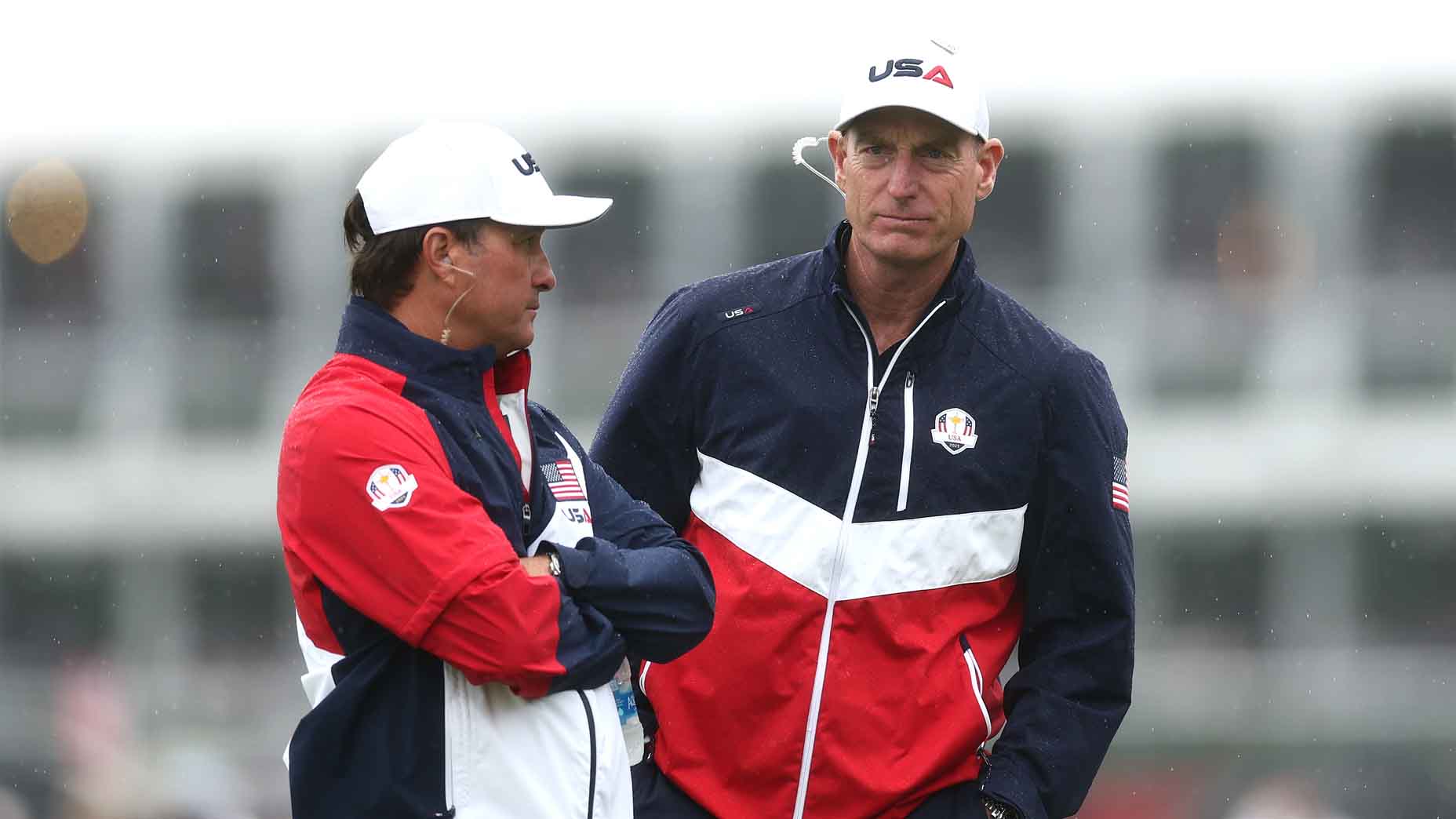
“We keep having the same captains, same ones. Find someone else, do something else, change it up. But they’re not gonna,” Mediate said. “Love Jim Furyk. Love the guys. Love them — but change something up. Same assistant captain. Same everything.”
But not everybody shares Mediate’s sense of fire and brimstone. Among the players in the field at Pebble this week is Justin Leonard, who is moonlighting as an assistant captain for Jim Furyk’s squad next fall in Ireland. Leonard said he and Furyk have already gone to great lengths to innovate the American Ryder Cup approach, investing in new stats-and-research teams, a new points system and developing new plans to improve the continuity between U.S. team play events. At the center of the new U.S. strategy is the goal of building a “program” — catching up to the Europeans’ sense of continuity and consistency between events.
“We’ve changed our stats and data analysts and we’ve changed our points structure too, and trust me, a lot of time and effort and phone calls went into those decisions,” Leonard told GOLF. “The PGA of America wants us to come up with a little better playbook, so that there’s more continuity from team to team, beyond just having similar players and all that stuff.”
Of course, one early test of that new gameplan will take place next week in Chicago, where the U.S. team will gather again for the biennial playing of the Presidents Cup. Many Ryder Cup critics have suggested that the Presidents Cup, which is operated by the PGA Tour rather than the PGA of America, represents a major missed opportunity for American team golf, serving as an impediment between team golf settings as opposed to a continuation between them. Leonard was quick to point out that while he has no formal capacity at the Presidents Cup, the experience could prove helpful for Ryder Cup leadership in other ways.
“The fact that Jim [Furyk] is there, Keegan [Bradley] is there, and Brandt [Snedeker] has been around the teams and Webb [Simpson] as well,” Leonard said. “You know, I’m sure there’ll be some things, some good things that we’ll take from next week to get things going in a better direction.”
While the Presidents Cup will provide a rare data point on team golf performance to American Ryder Cup leadership, there could be even more to learn from the players on the other side of the ledger. More than three decades’ worth of Ryder and Presidents Cup experience was on display at Pebble Beach this week, and among that crew, there was no shortage of ideas about the recent run of American struggles.
“Europe’s been underdogs historically, and that group coming together — they grew up together and played a lot of golf together and competed together, so maybe they’re a little bit tighter,” said Henrik Stenson, owner of five Ryder Cup appearances from the Euros, with a grin. “Maybe team USA played more college golf and are trying to beat each other up more than the Euros — I don’t know — but clearly there’s been a good team spirit from team Europe for many times.”
Stuart Appleby, owner of five Presidents Cup starts for the Internationals, suggested the problem might be less about American disagreement and more about European cohesion.
“The U.S. team has got a lot of desire to win, that’s nice, but you’ve got to get out of your way,” Appleby said. “The Europeans, they want to win just as bad, but they have the warrior mentality. They’re totally divorced from the outcome.”
But the unifying theory among those who spoke was simple: The harder the U.S. tries to squeeze success out of its team golf appearances, the more elusive that success will become.
“If I’m the captain, I’m not in a cart riding around. I’m going to sit in the locker room, watch it on TV, maybe have a Diet Coke,” said Mediate. “I’d tell them, ‘Guys, listen — pair yourselves up. If you don’t like the clothes, play in your own clothes.’ It shouldn’t make a difference in your life. It should just be fun.”
Mediate isn’t expecting calls from U.S. leadership anytime soon, and he’s pretty sure he won’t be on the PGA of America Christmas card list, either. But after back-to-back lackluster Ryder Cup performances and back-to-back closer-than-expected Presidents Cups, the only bad ideas are the ones left unsaid.
“People will say, ‘That’s the dumbest thing,’” Mediate said. “But then you’ve got to remember, ‘Wait a minute — this isn’t working.’”
Disclaimer : This story is auto aggregated by a computer programme and has not been created or edited by DOWNTHENEWS. Publisher: golf.com





