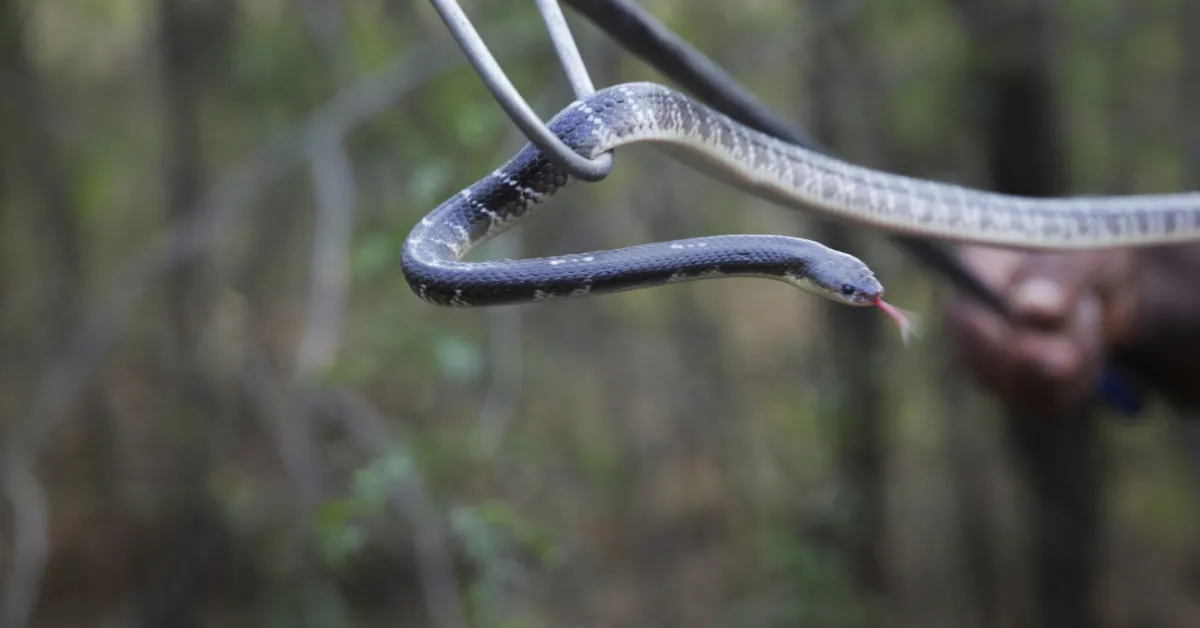
This National Wildlife Week, we look at the many ways human choices shape our relationship with wildlife — from what we grow and believe to what we consume and how we understand animals. Through four stories, the series explores everyday conflicts and connections, and the people finding more thoughtful ways to share space with wildlife.
On a rainy day, a snake does not know that the dry place it has found belongs to a human being.
It may be a garage, a storeroom, a pile of construction material, a drain, a garden, a car bonnet or the space beneath a bed.
If its usual shelter is filled with water, the animal is simply looking for somewhere else to survive.
That is one reason snake encounters become more common during India’s rainy months.
Last monsoon, such encounters ranged from apartment buildings to university campuses. In Agra, rescuers reportedly attended more than 100 snake-rescue calls between June and mid-July, while snakes were also reported inside car bonnets and chicken coops in Kashmir.
The sightings may make for startling photographs. But the scale of the problem is difficult to measure because many bites never enter the formal healthcare system, according to the Government of India’s NCDC Standard Treatment Guidelines for Management of Snake Bite. It notes that many victims initially approach traditional healers and are not registered at hospitals.
A new 2026 study published in PLOS Medicine by researchers associated with the Liverpool School of Tropical Medicine estimates that between 2.1 million and 7 million people may be envenomed by snakes globally each year.
Its modelling places India among the countries carrying the largest burden, with estimates of hundreds of thousands of cases and an upper estimate of about 1.3 million snakebites a year.
India’s death toll is also substantial.
Earlier research based on nationally representative mortality data estimated about 58,000 snakebite deaths a year between 2000 and 2019. A 2022 Nature Communications analysis estimated 51,100 snakebite deaths in India in 2019 alone, while noting considerable uncertainty around the figures.
The numbers vary because snakebite remains underreported.
But in India, snakebite is simultaneously a wildlife issue, a public-health problem and a question of how people build and inhabit landscapes.
The Better India looked into public-health data and spoke to Baiju Raj, Director of Conservation Projects and Senior Wildlife Biologist at Wildlife SOS, to understand why these encounters happen, why some become fatal and why even a centuries-old belief about milk can put snakes at risk.
When rain changes the map
Snakes are ectothermic animals, meaning that their body temperature is regulated largely through their surroundings. Weather, temperature and water therefore influence where they can shelter and move.
“When it is sunny, snakes move towards cooler places. That is how their body thermoregulation works,” Raj explains. “When it rains, whether it is the monsoon, a sudden shower or an unprecedented flood, it can completely disrupt the snake’s surroundings.”
A burrow, crevice or patch of vegetation that was safe yesterday may be flooded today.
“They have to move away from the water and find land or some kind of shelter,” he says.
That shelter can be anywhere that offers protection. This is why the idea that a snake has somehow decided to “invade” a house can be misleading.
“It’s not necessarily the snake’s mistake. The problem is that we are sometimes inviting them,” Raj says.
“Wherever you have garbage, unused materials or things that have been lying in one corner for years, rats are likely to move in,” he adds.
“If you have rats in a car, for example, the smell of rat urine can become extremely strong,” he explains. “Snakes can detect that smell and may move towards the area because they associate it with a potential food source.”
That means the problem is not confined to villages or mud houses.
“Snakes are not necessarily forest animals that live only in the jungle, like tigers or leopards. Wherever they find suitable shelter and a place where prey such as rats are available, they can survive.”
Can we check if the snake is venomous or not?
The first mistake after seeing a snake is to find out what it is, Raj warns. Several species can look similar, and approaching an animal to obtain a better view can turn an encounter into a confrontation. So, what is the ideal first response when one sees a snake?
“We always tell people not to go near the snake,” Raj says. “Observe it from a safe distance and keep track of where it is moving.”
If it can be done without approaching the animal, a photograph may be useful.
“Our rescuers often ask people to send us a photograph,” he says. “Even if it takes an hour for the rescuer to reach the location, a photograph may allow us to identify the snake and tell the person whether it is a rat snake or another harmless species.”
What should not happen is an attempt to catch it.
Over 100 snake rescues this monsoon: Why #WorldSnakeDay matters more than ever! 🌧
This #WorldSnakeDay, Wildlife SOS is raising awareness about the sharp rise in human-snake conflict, especially during the monsoon. In June and early July alone, our teams responded to over 100… pic.twitter.com/4h6jMJrMHQ
— Wildlife SOS (@WildlifeSOS) July 16, 2025
Videos of trained rescuers can create another problem: making snake handling look easier than it is.
“It is the experience of the rescuer and the way they handle the situation that makes the difference,” Raj explains. “A snake can still be dangerous even when it appears calm.”
The safest response is therefore distance, observation and a trained rescue service where one is available.
Now the response has changed
When organised snake rescue was still developing in Delhi, he recalls, people often called the police when a snake appeared. By the time a trained rescuer reached the location, the animal could already have been killed.
That response has not disappeared entirely. But awareness and access to trained rescuers have changed what happens in many encounters.
“Wildlife rescue has come a long way from that situation,” Raj says. “People are now willing to wait for two or three hours for a trained rescuer to arrive.”
Awareness has also spread beyond social media.
“There are still many people who do not use social media and depend on newspapers,” he says. “They see photographs and reports about rescue work, save the numbers and call when they encounter a snake.”
A snake that is not cornered or handled unnecessarily is less likely to be provoked into defensive behaviour.
But avoiding a snake is only one part of the problem. The other begins when a person is bitten.
The real emergency
Snakebite envenoming is treatable, but treatment is time-sensitive.
The WHO has identified access to effective treatment and stronger health systems as central to reducing snakebite deaths. Its global strategy aims to halve snakebite-related deaths and disability by 2030.
India’s National Action Plan for Prevention and Control of Snakebite Envenoming, launched in March 2024, similarly focuses on surveillance, healthcare capacity, emergency services, antivenom access, training and community awareness.
But the problem is that the people at greatest risk may also be the furthest from timely treatment.
/filters:format(webp)/english-betterindia/media/media_files/2026/09/30/fsc-12-2026-09-30-19-34-19.png)
For a person bitten in a remote village in India, the hospital might exist somewhere in the district. So whether the person can reach a facility with trained staff and appropriate treatment quickly enough is the concern.
“The most important thing is reaching a hospital on time,” Raj says. “You cannot waste time after a snakebite.”
That is why snakebite cannot be reduced to a story about snakes.
It is also a story about roads, transport, health facilities, awareness and data.
Awareness is important because we have the myths
There is a belief that snakes drink milk. But snakes are not milk-drinking animals.
“Snakes are reptiles, and they cannot digest milk,” Raj says. “They are carnivores. They feed on other animals; milk is not part of their natural diet.”
So why might a snake appear to drink milk?
“If you keep a snake without water for 10 or 20 days and then place it in a liquid, it may consume that liquid because it is extremely dehydrated,” Raj explains. “It is responding to the availability of fluid, not specifically choosing milk; it can consume soft drinks also.”
“The snake is looking for fluid because it is dehydrated, but milk can harm it because it is not something the snake is equipped to digest,” Raj says.
Don’t let it slide…
The 2026 PLOS Medicine study notes that snakebite data remain scarce and uneven across countries, and that modelling is necessary because many cases are never captured by formal systems.
For India, the challenge is therefore twofold.
People need to know how to avoid dangerous encounters and seek treatment quickly. At the same time, snakes need not be treated as intruders simply because they have crossed an invisible human boundary.
We need to understand why they happen, reduce the conditions that bring snakes unnecessarily close to people, leave wildlife handling to trained rescuers, discard myths that harm animals and make sure that when a venomous bite does occur, medical treatment is not delayed.
Sources:
Standard treatment guidelines-Management Of Snake Bite: By Ministry Of Health & Family Welfare Government Of India
Snake Bite First Aid: The Dos and Don’ts: Wildlife SOS
Disclaimer : This story is auto aggregated by a computer programme and has not been created or edited by DOWNTHENEWS. Publisher: thebetterindia.com