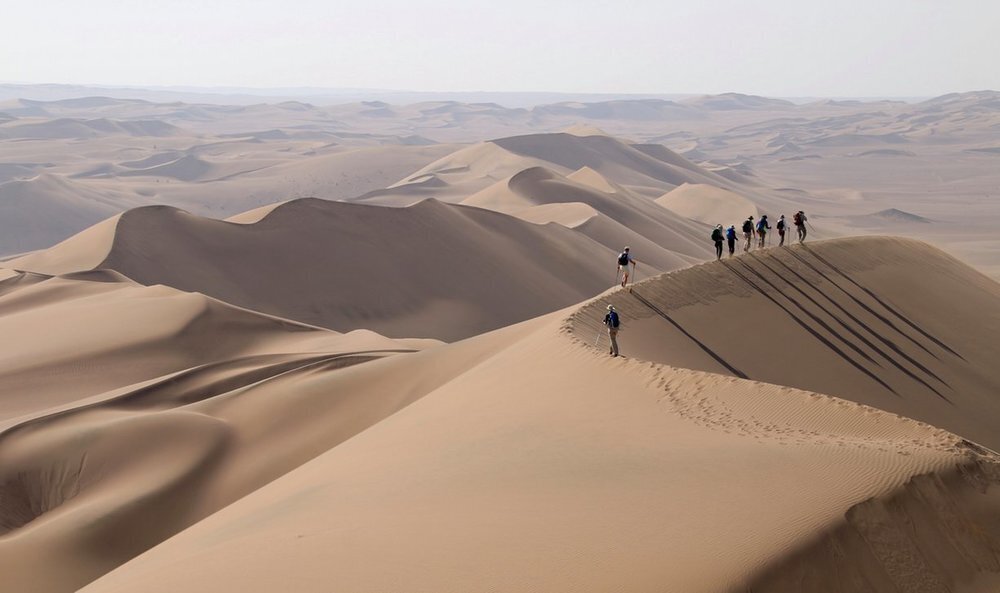
TEHRAN – Experts have highlighted the potential benefits of establishing a UNESCO Global Geopark in Iran’s Lut Desert, saying the initiative could promote sustainable tourism, create local jobs and strengthen protection of the region’s unique geological heritage.
The issue was discussed at a specialized meeting on the Lut Desert, part of a series of seminars on Kerman studies held at Shahid Bahonar University of Kerman.
Speaking at the meeting on Thursday, Ebrahim Mohammadi, a faculty member at the The Graduate University of Advanced Technology (GUAT) in Kerman, discussed the province’s tourism potential, with a particular focus on the Kaluts of Shahdad, a striking landscape of eroded earth formations in the Lut Desert.
Mohammadi said Kerman province is home to 10 properties inscribed on UNESCO’s World Heritage List and covers an area larger than the combined territories of 115 countries. He didn’t, however, mention that some of those UNESCO sites are shared with other nearby provinces.
Despite its vast size and exceptional range of natural, geological, historical, cultural, religious and spiritual attractions, the province attracts only about 0.7% of Iran’s tourists, although it accounts for around 11% of the country’s territory, he said.
Mohammadi, who holds a doctorate in paleontology, outlined several potential benefits of securing Global Geopark status for the Lut Desert.
He said the designation could strengthen the desert’s international profile and bring its important geological sites under a more integrated management framework.
It could also encourage sustainable geotourism, support the development of scientific and nature-based tourism routes, and persuade visitors to spend more time in the region by offering a wider range of experiences.
According to Mohammadi, the initiative could generate employment and strengthen the local economy by creating opportunities for tour guides, traditional accommodation providers, transport services, handicraft producers and other local businesses.
He also emphasized the importance of expanding scientific research and education, particularly in geology and geomorphology, while increasing local communities’ participation in protecting the region’s natural heritage and benefiting from tourism.
Elsewhere in his remarks, Mohammadi suggested that a geopark could help improve conservation across the Lut Desert by establishing stronger management links among its prominent geological sites and reducing damage caused by uncontrolled tourism and inappropriate use of natural resources.
Developing a unified tourism destination would also help promote the Kaluts of Shahdad alongside other geological attractions through complementary routes and visitor experiences, he added.
The initiative could further strengthen Kerman’s international tourism brand, raise awareness of its natural and geological assets, and expand scientific and international cooperation.
Mohammadi also stressed that sustainable development in the region would depend on directing tourism toward environmental protection, distributing its economic benefits among local communities and adopting scientific and participatory management practices.
He also highlighted the need for a comprehensive conservation and tourism plan, systematic documentation of geological sites, public education and cooperation between responsible institutions and local residents.
The meeting also addressed the historical importance of traditional water-management systems in Shahdad, a settlement on the edge of the Lut Desert.
Mohammad Barshan, director of Kerman province’s Qanat Center, discussed the origins and age of Shahdad’s qanats and their role in supplying water for agriculture and sustaining human settlement in the arid region.
Qanats are traditional underground water channels that transport groundwater to the surface, allowing communities to obtain water in areas where rainfall is scarce.
Drawing on years of research and practical experience with qanats, Barshan emphasized their significance in the development of settlements and civilizations.
“Digging a qanat is an epic, a great epic of replacing death with life,” he said, describing the ancient water systems as closely linked to the development of civilization among communities across Iran.
Barshan also discussed the qanats of Shahdad, stressing the central role of water in the rise and decline of civilizations.
“Civilizations are formed with water and disappear with water,” he said.
The discussions highlighted the potential for combining geological conservation, scientific research and the preservation of traditional water-management heritage to support sustainable tourism and local development in Kerman province.
AM
Disclaimer : This story is auto aggregated by a computer programme and has not been created or edited by DOWNTHENEWS. Publisher: tehrantimes.com