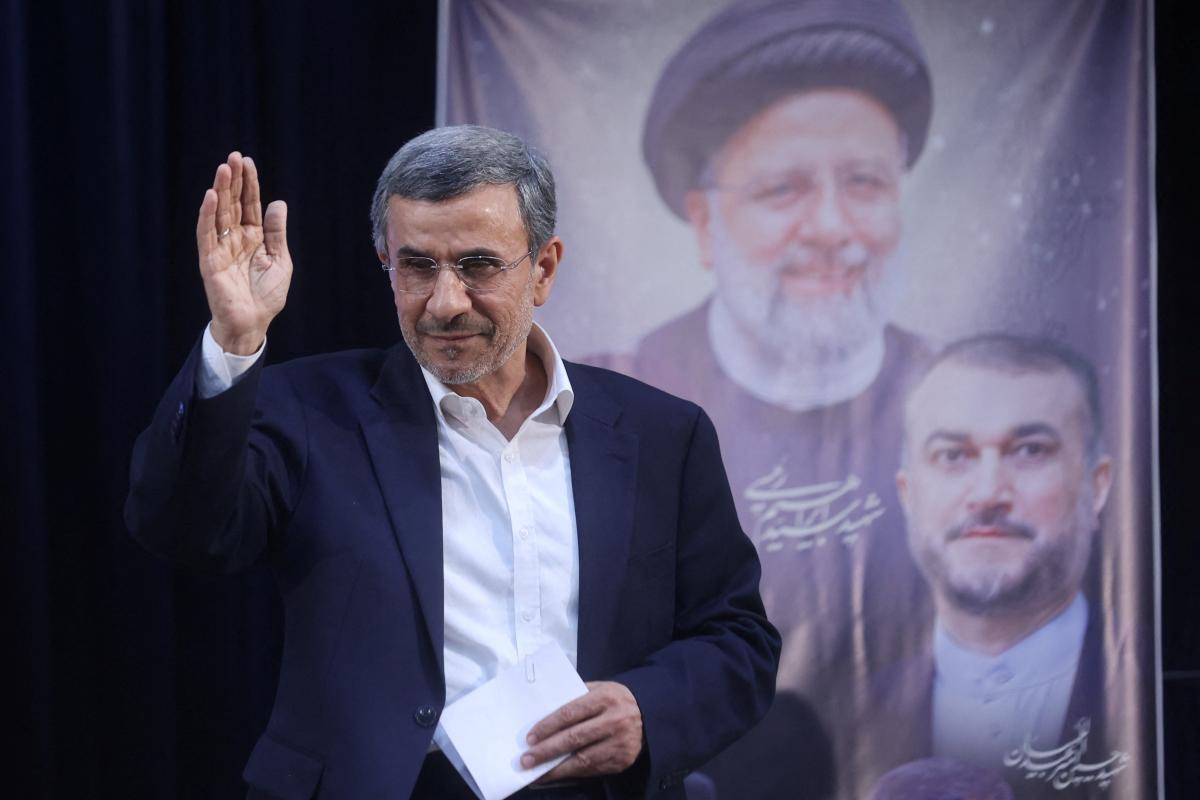
An explosive New York Times report claims US and Israeli officials explored a shocking possibility of elevating former far-right hardliner Iranian President Mahmoud Ahmadinejad as Iran’s new leader.
While both Washington and Jerusalem refrain from denying the story, experts told The Post there’s likely more to the story.
“This story is like Swiss cheese — with a lot of holes,” Beni Sabti, an Iran expert at Tel Aviv University’s Institute for National Security Studies, told The Post, casting doubt on key elements of the reporting.
The report, published Tuesday, suggested a Feb. 28 strike on Ahmadinejad’s home “had been designed to free him from house arrest” — not kill him.
But Sabti said the idea of the deeply anti-Israel former president would be so unreasonable to the Jewish state that it casts doubt on the idea that Washington and Israel could have wanted him to fill a leadership vacuum in a post-regime Iran.
“Israel would never want Ahmadinejad to be the leader because since 2005, he brought out again that anti-Semitism of [Tehran] and said that famous sentence, ‘Israel must be wiped out of the map of the world.”
“He did a lot of anti-Semitism conferences, and the competition of cartoons against Jews and antisemitic short movies, things like this,” he added.
The report claimed Ahmadinejad was even in on the plan to some extent, but “became disillusioned with the regime change plan” following the strike on his home that injured him.
Asked for responses to the report, neither the White House nor the Israeli prime minister’s office would confirm or deny the allegations.
“From the outset, President Trump was clear about his goals for Operation Epic Fury: destroy Iran’s ballistic missiles, dismantle their production facilities, sink their navy, and weaken their proxies,” White House spokeswoman Anna Kelly said in response to The Post’s question.
“The United States Military met or exceeded all of its objectives, and now, our negotiators are working to make a deal that would end Iran’s nuclear capabilities for good.”
Ahmadinejad biographer and Iranian politics professor Meir Javedanfar on X suggested the story could have been a face-saving “disinformation campaign initiated by those that tried to assassinate him.”
“This is an assassination attempt gone wrong. It failed. So now disinformation is being used to create chaos within the ranks of the Islamic Republic of #Iran,” he wrote.
If the claim that Israel and the US aimed to free him with the strike is true, it is more likely they considered him a possible “usable” figure because of his estrangement from Iran’s current clerical establishment, Foundation for Defending Democracies Iran program senior director Behnam Ben Taleblu said.
“At first glance, this sounds like a harebrained scheme, but we have to remember that Ahmadinejad was one of the few presidents who caused significant grief to [former Supreme Leader Ali] Khamenei,” he said.
“That doesn’t justify installing him, but it might help explain why some foreign intelligence services may have been interested in using him as a political shift against the regime, particularly in a period of wartime.”
Ahmadinejad, who served as Iran’s president from 2005 to 2013, began as a supporter of Khamenei, but “left power on the hard right against” him, Taleblu said.
“By the end of his second term, Ahmadinejad’s hybrid populism-nationalism-Islamism posed a real ideological and class-based challenge to the Islamic Republic,” he said.
But the idea that he could be repositioned in any Western-backed transition plan is largely rejected, even among regional analysts who track Iran’s fractured political landscape.
The Times account relies heavily on unnamed officials and described deliberations, a detail that has fueled questions about how hypothetical these scenarios were versus how operational they became.
Some regional analysts noted that while scenario-planning is routine in defense and intelligence circles, it does not necessarily indicate active policy direction — a distinction critics say the report may blur.
“Empowering Ahmadinejad doesn’t gain anybody anything, it simply introduces more hiccups or more challenges or problems in an already very complex situation,” Taleblu said.
Critics say the biggest question is not what scenarios were discussed — but how seriously they were ever meant to be taken.
Disclaimer : This story is auto aggregated by a computer programme and has not been created or edited by DOWNTHENEWS. Publisher: nypost.com