
Medical experts are warning against a new and controversial “rib recontouring” procedure, which they say is dangerous and under-researched, after a group of Australian influencers travelled to Bali to receive the treatment.
Former Married at First Sight contestant Rebecca Zacharia, Monique Morley and Carly Ellen all posted to social media last week about visiting Bali-based company Snatched Waist.
On Zacharia’s post announcing she had decided to undergo the procedure, she disclosed it was “gifted” by Snatched Waist. The company did not respond when approached for comment by this masthead.
Rib recontouring is a relatively new development in plastic surgery. So, what is it and is it safe?
What is rib recontouring?
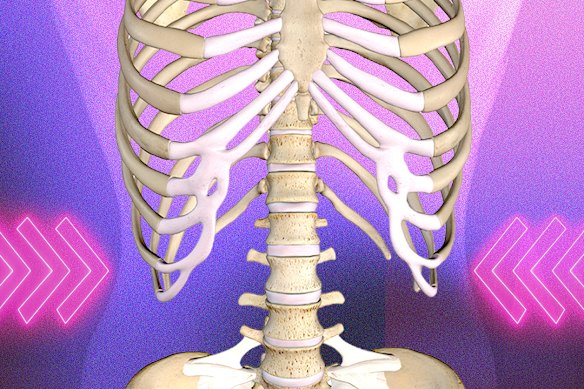
Rib recontouring, sometimes referred to as rib remodelling, is a cosmetic procedure that involves fracturing the lower ribs without severing them and repositioning them to manipulate the size of the waist.
There is no standardised rib recontouring procedure. Snatched Waist follows the most widely publicised and studied approach, the RibXcar method, developed by Peruvian plastic surgeon Dr Raul M. Manzaneda.
For the RibXcar procedure, the ribs are accessed via a puncture to the skin and a specialised instrument, called a piezotome, uses high-frequency vibrations to weaken the bone. The piezotome is inserted and guided by ultrasound throughout the procedure.
Once the bone is sufficiently weakened, the surgeon will apply manual pressure to create a monocortical fracture, which only affects the outer layer of the bone. The ultrasound is used to confirm the fracture has taken place, as well as the absence of a pneumothorax (air leaking into the space between the lungs and chest wall) or haemothorax (blood in the space between the lungs and chest wall).
The ribs are then repositioned to reduce the width of the waist.
After the procedure, patients are required to wear a compression garment or corset for several months while the ribs heal in their new position.
The procedure is performed under general anaesthesia and generally takes one to two hours.
Dr Justin Perron is one of the few Australian surgeons to be trained in the RibXcar method.
He’s yet to perform it, but says most of his inquiries have come from transgender patients seeking body contouring as part of their gender affirmation process, and people with scoliosis who have asymmetry in their back and want to balance their rib cage appearance.
“I was incredibly sceptical when I first heard of this procedure,” he says. “It’s actually pretty straightforward and not what people think it is.
“We’re not taking bones and completely separating them. It’s a controlled fracture.”
Is rib recontouring safe?
Surgeons who have trained in RibXcar, like Perron, say it has one of the best safety profiles of the aesthetic procedures available.
“This still has the lowest risk profile compared to every other procedure that I do,” Perron says. “Bleeding is a highly rare event for this. Infection doesn’t really happen and Menzaneda hasn’t shown any data that any patients have had needed re-operation. He hasn’t seen any malunion, where bones don’t heal properly, or nonunion, where bones don’t heal at all.”
This method of rib recontouring is a relatively new advancement, meaning literature is still emerging.
The studies that have been done offer optimistic outcomes – high patient satisfaction, a low-risk profile – but the long-term clinical data is limited compared with other aesthetic surgeries, such as rhinoplasty and breast augmentation.
And most of the research into the procedure has Manzaneda as a co-author, creating a conflict of interest.
A recent review of the literature concluded that “despite promising results in some cases, the lack of long-term studies and randomised clinical trials limits the ability to draw definitive conclusions regarding the efficacy and safety of these procedures”.
“Surgical procedures are meant to be developed slowly, carefully, thoughtfully with data backing their safety and their efficacy,” says Professor Anand Deva, head of plastic surgery at Macquarie University, who is concerned by the nature of a blind procedure.
“There are a lot of vital structures that could be damaged, particularly by something that’s done through a small incision. I did general surgery before plastic surgery and one of my mentors used to say, ‘A lot of bad things happen with a small incision.’ … The idea of a minimally invasive operation around these vital structures is just another accident waiting to happen.”
The lack of long-term data makes people such as Brian Oliver, professor of pneumology at the University of Technology Sydney, wary of making any conclusive statements yet, though he says: “If people were to have dramatic changes in their rib contour (especially if other ribs are changed), I can’t see how lung function wouldn’t be affected.”
Those curious about the procedure should exercise caution, as some companies, like Snatched Waist, claim on their website it’s safe because it “exclusively targets the lower ribs – the lowest two pairs of ribs that are not connected to the sternum or other ribs … these are isolated skeletal structures with no vital organs, major blood vessels, or nerve bundles in the treatment area”.
But experts warn this isn’t entirely true.
“Ribs are surrounded by intercostal nerves (nerves between the ribs), so complications can result in pain or discomfort,” says Dr Jason Girkin, postdoctoral researcher at the University of Newcastle and the Hunter Medical Research Institute.
Dr Ricky Sia agrees, saying that the lower ribs still play a role in respiratory mechanics, helping to protect organs, like the kidneys and spleen.
“The lower ribs aren’t purely cosmetic structures,” says Sia, the vice president of the Cosmetic Physicians College of Australasia.
“Published data on rib reshaping procedures point to real complications – including collapsed lung, nerve injury, infection and poor bone healing – occurring in a meaningful minority of cases. The literature itself notes that the longer-term effects on breathing mechanics haven’t been well studied.”
Perron says the biggest risks of the procedure are haemothorax and pneumothorax, and adds that people with low bone density, existing lung problems, a history of non-compliance (unlikely to wear the corset diligently post-procedure) or screen positive for body dysmorphia are bad candidates for rib remodelling.
“My rule of thumb is: if I can’t see the problem, I’m not operating,” Perron says.
Make the most of your health, relationships, fitness and nutrition with our Live Well newsletter. Get it in your inbox every Monday.
From our partners
Disclaimer : This story is auto aggregated by a computer programme and has not been created or edited by DOWNTHENEWS. Publisher: www.smh.com.au