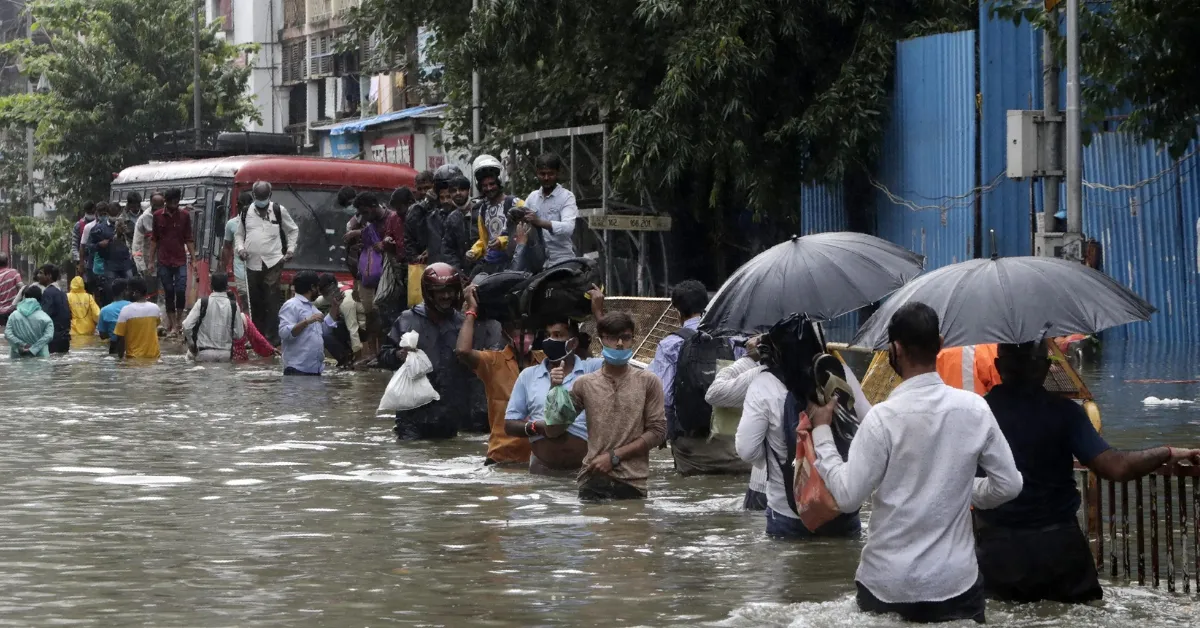
You leave home on a perfectly ordinary morning. An hour later, the road outside is underwater. Cars are moving slowly, two-wheelers are stranded, and people are rolling up their trousers to cross the street.
It can feel strange. How can one hour of rain turn a familiar road into a river?
The answer lies in how fast the rain falls and what happens to it once it reaches the ground.
On 24 June 2026, parts of Mumbai received more than 300 mm of rain in 24 hours. South Mumbai recorded 248 mm, making it the city’s wettest June day in more than a decade. Several low-lying areas were waterlogged, disrupting roads and public transport.
A city street, however, can flood even on a day that breaks no rainfall record.
Here is why.
1. Rain can fall faster than drains can carry it
Think about pouring water into a sink. If you pour slowly, the drain can carry the water away. Pour too quickly, and water begins to collect in the basin.
A city works similarly.
Mumbai’s stormwater drainage system was designed to handle rainfall of around 25 mm per hour in many areasurb, while some newer systems and upgraded drains can handle higher intensities. During exceptionally heavy downpours, rain can reach the streets faster than the drainage network can carry it away.
That difference matters.
If 50 mm of rain falls over several hours, the drainage system gets time to carry the water away. If much of it falls within a short spell, a huge volume reaches roads and drains almost at once.
Researchers studying Mumbai’s flooding have repeatedly identified rainfall intensity as one of the major factors behind sudden urban flooding.
2. The city has replaced soil with concrete
Now imagine two surfaces. Pour water onto soil, and some of it sinks underground. Pour the same amount onto a concrete road and almost all of it runs somewhere else.
Cities are covered with roads, footpaths, rooftops, parking areas and buildings that absorb very little rainwater. As Mumbai has expanded, more open ground has been replaced by hard surfaces that send rainwater flowing across the city instead of allowing it to seep into the soil.
Research on Mumbai’s flood risk has found that large areas of the city have become impermeable. This increases surface runoff, meaning more rainwater reaches drains and low-lying areas instead of soaking into the soil.
So when heavy rain arrives, the city is effectively trying to move a huge amount of water through a limited number of channels.
3. Wetlands, rivers and open land help hold water
A city does not rely only on pipes and drains. Rivers, creeks, wetlands, ponds, open ground and other low-lying areas can temporarily hold or carry rainwater. When they shrink, become blocked or are surrounded by dense construction, the city loses some of that breathing room.
Mumbai’s history of development has put pressure on several such natural systems.
The Mithi River, for example, plays an important role in carrying stormwater towards the sea. But its catchment has also experienced extensive construction and changes in land use. That means the river and drainage network have to deal with runoff from a heavily built-up landscape.
Researchers have therefore looked at Mumbai’s flooding as a combination of rainfall, land-use change, drainage capacity and the city’s geography rather than as a rainfall problem alone.
/filters:format(webp)/english-betterindia/media/media_files/2026/08/12/mumbai-flooding-after-rain-2026-08-12-16-03-25.png)
4. Every drain has a limit
Even a well-maintained drainage system has a limit.
Imagine a narrow pipe carrying water from a large tank. If the tank suddenly releases more water than the pipe can handle, the water has to wait somewhere.
That is basically what happens during very intense rainfall. Mumbai’s stormwater network was built in stages over many decades. Parts of the system are old, while newer infrastructure has been added to deal with changing conditions.
In 2026, Western Railway undertook drainage work around the Matunga-Dadar section after identifying problems including inadequate water-carrying capacity, a choked and ageing culvert and restrictions in the Dadar-Dharavi nala.
This is why two streets receiving the same rainfall can experience very different levels of flooding.
One may have a clear drainage path. Another may have a bottleneck nearby.
5. Then there is climate change
This is where the bigger climate story comes in.
Warm air can hold more water vapour. Scientists commonly estimate that the atmosphere can hold about seven percent more moisture for every one degree Celsius of warming. This does not mean rainfall everywhere automatically increases by seven percent. Instead, a warmer atmosphere has a greater capacity to hold moisture, which can provide more water for intense rainfall when the right weather conditions come together.
That matters for cities like Mumbai.
Studies involving Indian researchers have found changes in extreme rainfall patterns and have examined how climate change can increase the risk of very heavy rainfall events over urban areas.
But there is an important caveat. Climate change is not the only reason for Mumbai floods.
/filters:format(webp)/english-betterindia/media/media_files/2026/08/12/mumbai-flooding-after-rain-2026-08-12-16-08-11.png)
Mumbai has always experienced intense monsoon rainfall. Natural variations in the monsoon, weather systems, tides, and local geography all affect flooding. Climate change is better understood as an amplifier. A warmer atmosphere can make extreme rainfall more intense, while the way the city is built determines how much of that water becomes a flood.
In other words, climate change can influence how hard the rain falls. Urban planning determines what happens after it hits the ground.
So how does a street flood so quickly?
Put all of these pieces together.
- A heavy rain cloud arrives.
- More water falls in a short period.
- Concrete and asphalt prevent much of it from soaking into the ground.
- The runoff rushes towards drains, rivers, and low-lying areas.
- The drainage system reaches its limit.
- Water begins collecting on the road. And suddenly, the street is flooded.
This is why an hour of heavy rain can sometimes be more disruptive than several hours of lighter rain. It is not just the amount of water. It is how quickly the water arrives and how quickly the city can get rid of it.
How can Mumbai cope better?
The answer cannot be ‘build bigger drains’.
Mumbai needs several layers of protection working together.
/filters:format(webp)/english-betterindia/media/media_files/2026/08/12/mumbai-flooding-after-rain-2026-08-12-16-05-35.png)
That includes maintaining and upgrading stormwater drains, improving flood-prone bottlenecks, protecting wetlands and natural waterways, creating more surfaces where rain can enter the soil, and using real-time rainfall and flood warnings to give people time to avoid dangerous areas.
There are already efforts in this direction.
In 2024, IIT Bombay launched a Mumbai Flood Monitoring initiative designed to provide information on extreme rainfall and flooding in the city. Such systems can help authorities understand where water is accumulating and respond better.
Research has also found that interventions such as pumping stations and underground storage can reduce flooding at particular hotspots.
Mumbai cannot stop the monsoon. But it can prepare for the way rain is changing, and make it easier for every drop to find somewhere safe to go. So the next time your street floods after an hour of rain, remember it is not just a story about a lot of water falling from the sky.
It is a story about rainfall intensity, concrete, drains, rivers, soil and a warming atmosphere, all meeting in the same place at the same time.
Disclaimer : This story is auto aggregated by a computer programme and has not been created or edited by DOWNTHENEWS. Publisher: thebetterindia.com