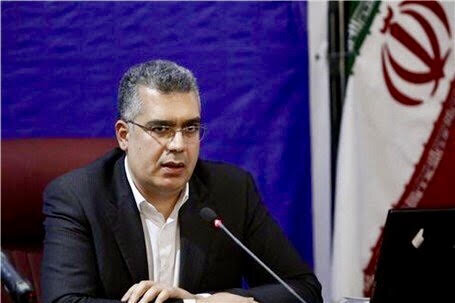
TEHRAN- The head of the Trade Promotion Organization (TPO), referring to the effects of trade restrictions and a 34 percent drop in the weight of the country’s foreign trade in the first six months of this year, said: At the same time, part of exports is still being carried out by sea, and another part through corridors and land and rail routes. He also called rumors about the closure of some of the country’s borders incorrect.
According to ISNA, Mohammad Ali Dehghan Dehnavi, head of the Iran Trade Promotion Organization, at a press conference on the 30th National Export Day ceremony and honoring national exemplary exporters, which will be held on October 21, stated: Given the importance of economic and trade diplomacy in the current situation, appropriate cooperation has been established with the Ministry of Foreign Affairs in the field of trade diplomacy, because to resolve the problems caused by restrictions and blockade, we need this area to be highly active. Talks with neighboring countries, important trade partners, and friendly countries are essential so that we can make greater use of our communication capacities and partially replace the capacities that have been lost. Good measures have been taken in trade diplomacy, and major steps have been taken that have largely improved the problems.
The head of the Iran Trade Promotion Organization, referring to the effects of trade restrictions and the maritime blockade on the country’s foreign trade, said: Despite the decline in trade weight, the use of alternative transport routes and import management has kept a significant part of foreign trade going. Given the country’s special conditions, public release of the details of trade statistics comes with considerations, but reviewing the available statistics can provide a picture of the foreign trade situation.
He said that about 75 percent of the weight of the country’s foreign trade last year was carried out by sea, adding: The bulk of these exchanges took place through the Persian Gulf and the Sea of Oman; therefore, maritime restrictions affected a large part of the country’s exports and imports.
Dehghan Dehnavi, referring to foreign trade statistics in the first half of this year, said: Estimates show that the weight of the country’s foreign trade has decreased by about 34 percent. However, part of exports is still carried out by sea, and another part through corridors and land and rail routes.
He continued: The use of alternative routes has increased transport costs, because land and rail transport are more expensive than sea transport even under normal conditions. In addition, increased demand for road and rail routes has led to congestion at some borders.
The head of the Iran Trade Promotion Organization, referring to the difference between the decline in export weight and value, stated: While the weight of foreign trade has decreased by about 34 percent, the drop in export value has been about 20 percent. This difference shows that goods with higher unit value have been able to bear higher transport costs and their exports have continued.
He explained: Paying $50 in transport costs per ton may make the export of low-value goods uneconomical, but for goods worth several thousand dollars, bearing such a cost is more feasible. For this reason, part of the goods whose exports have stopped have lost their economic justification due to increased costs.
Dehghan Dehnavi also spoke about the import situation, saying: The weight of the country’s imports has decreased by about 20 percent. A significant part of imports consists of essential goods, which, despite their lower unit value, account for a large share of import volume. A review of the statistics shows that essential goods have been supplied well. At the same time, the value of imports has decreased by about 35 percent, which indicates a greater decline in import value than in weight.
The head of the Iran Trade Promotion Organization, referring to the policies of the Ministry of Industry, Mining and Trade in import management, stated: From the beginning of this year, restrictions were imposed on the import of some goods, and for some other goods, including production machinery, demand management was put on the agenda so that foreign exchange resources would be allocated to essential needs and raw materials. This approach caused the decline in import value to be greater than the decline in weight; meaning less foreign exchange was consumed, while imports of essential goods and raw materials continued.
Dehghan Dehnavi, stating that the country’s foreign trade has been managed under current conditions, said: This does not mean the situation is desirable; a decline in exports and imports imposes costs on the economy and can affect economic activities and production.
Referring to the fact that about 85 percent of the country’s imports consist of raw materials and intermediate goods, including machinery, he added: A decline in imports of these goods affects production; therefore, we are trying to continue supplying them by using alternative resources and routes. We hope that with facilitating measures and greater support for exports, part of the declines created will be compensated in the rest of the year and the sustainability of the country’s foreign trade will be maintained.
In another part of his remarks, the head of the Iran Trade Promotion Organization referred to the importance of developing non-oil exports and stated: The 29th of Mehr every year is designated as National Export Day so that, while honoring exemplary exporters, an opportunity is provided to express their issues, problems, and solutions, as well as to create national consensus among government bodies and the private sector for the development of non-oil exports.
He said that the Iran Trade Promotion Organization, as the main custodian of this event, has tried in recent years to hold the National Export Day ceremony in the best possible way, adding: The purpose of holding this ceremony is to declare support for the country’s exporters and provide a basis for expressing problems and finding solutions for export development.
Dehghan Dehnavi, referring to the initiative of holding National Export Week since last year, said: Since export development is a diverse issue and various bodies influence it, all relevant sectors must participate to achieve this goal. Accordingly, this year, from today until Tuesday next week, seven working days have been dedicated to the issue of exports, and programs have been planned for each day.
The head of the Iran Trade Promotion Organization, referring to the dedication of the first day of these programs to the issue of infrastructure and trade corridors, stated: Trade corridors have always been important, but this year, due to the conditions that have arisen for the country and the issue of the maritime blockade, they have become more important.
He continued: In recent months, much has been done to make corridors that can compensate for restrictions created in other sectors more active. The Ministry of Roads and Urban Development and other responsible bodies have made great efforts in this regard. The program related to infrastructure and trade corridors will be held with the presence of the Minister of Roads and Urban Development at the Islamic Republic of Iran Railways, and a memorandum of understanding will also be introduced in this program to make the continuation of the path, especially in the rail sector, smoother.
Referring to the programs of the coming days, he said: On Tuesday, the issue of value-creating trade with the export of knowledge-based goods and services will be pursued, and the Vice Presidency for Science, Technology and Knowledge-Based Economy has been invited to this program. This year, we have tried to hold more programs in partner agencies so that, while appreciating their actions, the message is conveyed that all agencies have come to support the development of non-oil exports. On Wednesday, the issue of exporting technical and engineering services will be pursued with the presence of companies exporting these services and representatives of the Ministry of Roads and Urban Development and the Ministry of Energy.
He said that export management companies are among the important tools for the country’s export development, stating: For Saturday next week, a program has been planned with the cooperation of the Tehran Chamber of Commerce so that the issue of export management companies and their capacities is given attention. On the same day, the issue of legislation and an export leap will also be raised, and with the presence of the heads of some parliamentary commissions, legislative issues in the field of exports will be examined so that the parliament’s support for export development is also considered.
Referring to the program for Sunday next week, he said: On this day, the issue of facilitation in exports will be pursued, and exporters who have fulfilled their foreign exchange obligations on time will be honored. Exports play an important role in the country’s economy due to their impact on GDP and employment. Fulfilling foreign exchange obligations and repatriating export earnings, alongside export activity, is a worthy action, and on this occasion, with the presence of regulatory officials, companies that have had exemplary performance in fulfilling their foreign exchange obligations will be appreciated.
He continued: On Monday, the issue of associations and trade events in the field of exports will be pursued with the cooperation of the Iran Chamber of Commerce and with the presence of associations and the Export Confederation, so that the ground is provided for greater activity by private sector associations in exports. Tuesday is dedicated to trade diplomacy, and this program will be held with the participation and presence of representatives of the Ministry of Foreign Affairs. During these seven days, a diverse range of executive bodies, peer organizations, public sector institutions, and representatives of the private sector and chambers of commerce will participate in holding the National Export Day programs.
According to him, the message of these programs is that, given the country’s special need for foreign exchange generation this year, all agencies will cooperate to help the private sector, remove obstacles, and grow the country’s exports so that the losses caused by war and blockade are compensated to a large extent. The main ceremony of National Export Day will be held on Wednesday next week, the 29th of Mehr, and we will try to hold this ceremony with the presence of the president and according to the procedure of previous years.
The head of the Iran Trade Promotion Organization then presented a report on the process of selecting exemplary exporters and said: This process began several months ago in the Trade Promotion Organization, and after the call was announced, companies that applied to be selected as exemplary exporters participated in this process. The selection of exemplary exporters is carried out based on specific guidelines; in total, 365 companies registered in this process, and after reviews, 275 files were finalized because some applicants did not complete their files or did not meet the necessary conditions to obtain the required points.
Dehghan Dehnavi continued: One of the positive actions this year was making the process of selecting exemplary exporters systematic, such that the selection was carried out without the interference or personal taste of individuals and based on scored criteria. Finally, 43 individuals or legal entities were selected as national exemplary exporters, and 13 companies were selected as national distinguished exporters.
The head of the Iran Trade Promotion Organization, explaining the criteria for selecting distinguished exporters, said: Distinguished exporters are exporters who have been selected as exemplary exporters in five consecutive periods. Medal-winning exporters are also companies that have obtained the distinguished title for three consecutive periods; however, this year no company qualified for this category. Alongside exemplary and distinguished exporters, in other sections, including export management companies, cooperative companies, free zones, provinces, and the printing and packaging field, selected parties will be introduced as exporters worthy of appreciation, and a government organization will be introduced as an exemplary export-supporting organization for the first time; an organization that has had the greatest role and help in the field of exports in its area of activity will be introduced in this section.
In another part of his remarks, the head of the Iran Trade Promotion Organization emphasized the role of the media in promoting export culture and stated: We ask media figures and journalists to participate in informing about National Export Day and the programs planned during these seven days so that the concept of exports, its role, and its position in the country are elevated more than before and the private sector becomes more interested in this field.
He said that exporters enjoy a distinct position among private sector activists, adding: A producer who supplies their product inside the country performs a valuable activity; but a producer who can offer their product to global markets shows that their product has the necessary quality to be sold outside the country and that they have the knowledge, information, and technology needed to be present in global markets. Therefore, a producer who has export capability gains a higher position from this perspective compared with other producers.
Comparing the position of exporters and importers, he stated: If a trader or businessman is an exporter, they have a different position in terms of value creation for the country’s economy compared with an importer. Buying goods, despite its importance, is not difficult by itself, because there are many sellers in the world who offer goods, but selling goods in global markets requires marketing and trade skill. Imports also have their own importance and position in terms of supplying the country’s needed goods, consumer goods, and raw materials, but they cannot have the position of exports.
He said that exports must be considered as the driving engine of the economic sector and a factor for directing and advancing production, adding: Greater support must be provided for exports, and conditions must be created so that exporters can develop their activities in global markets.
MA
Disclaimer : This story is auto aggregated by a computer programme and has not been created or edited by DOWNTHENEWS. Publisher: tehrantimes.com