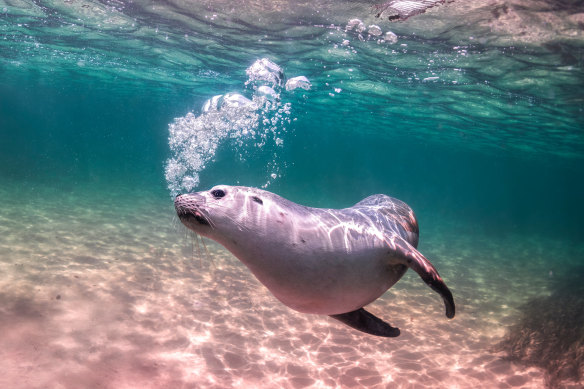

Endangered sea lions living along Western Australia’s coastline are under the threat of extinction, scientists warn, as concern grows over two confirmed cases of the highly contagious bird flu.
Several environment groups have called on the federal government to establish an additional fund for national wildlife resilience – $200 million over the next two years – to help protect the estimated 12,000 Australia sea lions remaining in the wild, and other species, from the disease.
Until the two confirmed cases – one in a giant petrel and the other in a brown skua, both found near Esperance – mainland Australia and New Zealand were the only places on earth free from the virus.
Australian Marine Conservation Society campaigns director Alexia Wellbelove said bird flu’s spread posed a real extinction risk to Australian sea lions, pointing to other instances globally where it had “caused carnage”.
In South America, 30,000 sea lion pups died in just six months, and more than 13,000 elephant seal pups on Heard Island, about 4000 kilometres south-west of Perth, died in late 2025 and early 2026.
“This news is an alarming confirmation that Australia is not immune to the threats of bird flu – it is news we have been expecting but hoping not to receive,” Wellbelove said.
“There is … the potential for this virus to be catastrophic for Australia’s unique wildlife and threatened species.
“Marine mammal populations have been decimated by H5 bird flu and with the virus now having arrived on Australia’s mainland, it is time to take greater action to protect our wildlife populations.”
Wellbelove said it was “essential that preparedness plans are put into place urgently to protect this and other threatened marine species”.
But she also said more was needed, pointing to the calls for a $200 million funding boost.
Invasive Species Council policy director Carol Booth said the funding would be a “no-regrets investment” for the federal government.
“This is a genuine wildlife emergency, and it must be treated as such with emergency funding to increase efforts to protect wildlife populations,” she said.
On Monday, the nation’s chief veterinary officer Beth Cookson said while there was currently no indication the disease had spread to other populations, there had been a lift in the number of reports coming through the emergency animal disease hotline.
She said she had been advised by WA’s chief veterinary officer Michelle Rodan there were no indications of mass mortality in the state.
“We would expect a baseline level of deaths in wild populations at any time,” Cookson said.
“What we’re trying to do now, in the early days of the investigation, is to understand that what’s being reported through the public hotline is associated with that normal baseline, or whether there has been any indication of spread.
“I have no information that would suggest that there is a suspect laboratory result or a situation of multiple mass mortalities that would indicate a high level of suspicion, that’s all I can say at this stage.”
Cookson said authorities were prioritising the investigation of the two reported birds to see whether there was any evidence the disease had spread to other susceptible species.
“So far, we don’t have any indication that it has spread to other populations, but that’s the first step that we need to take to establish whether these two individual migratory seabirds that have tested positive have been able to spread it to other birds,” she said.
Bird Life Australia has also requested a $200 million fund.
Its director and ornithologist Mandy Bamford told Radio 6PR the two detected cases were in birds that had likely migrated from Heard Island or Antarctica.
She said the total seal population on Heard Island had been 17,000, with just 4000 now remaining, so the mortality rate was high.
“Seals are particularly susceptible so terribly, terribly sad,” Bamford said.
“They’re they’re all on the beach next to each other. It’s a particular problem with these colonially nesting species, like colonial birds, but also mammals.
“They’re they’re all around each other, they’re they’re drinking out of the same water, and they might scavenge on dead things along the shore, but it’s mostly proximity, unfortunately.”
Aside from Australian sea lions, “our black swans are very much at risk, and a number of our other waterbirds including pelicans,” Bamford said.
She said Esperance was isolated, which was a good thing for wildlife and poultry farms, with chickens also highly susceptible – but it was also a disadvantage as detecting cases was harder.
“We found two birds, but it’s a very remote coastline so that doesn’t mean it’s the only two birds – that’s the question that we’re watching for,” she said.
WA Agriculture Minister Jackie Jarvis said there were currently no signs of mortalities among the state’s black swan population.
“If someone saw a sick or dead black swan, we would encourage them to report it,” she said.
“There is a vaccine available that can be used, but can only obviously be used in contained environments.
“There are certainly plans in place, whether it’s with black swan or little penguins or other birds that are of high value to West Australians.
“It might be that we have colonies that we protect in a sanctuary zone.”
Jarvis said CSIRO was working on vaccines, but as yet they haven’t been tested on all Australian wildlife.
“Any vaccine will usually take two doses, which is why it can’t be used on a broad scale,” she said.
“I want to be really clear: we will not be using vaccines on a large scale for wildlife. It’s just simply not possible.”
 Holly Thompson is a journalist with WAtoday, specialising in education and the environment.Connect via X or email.
From our partners
Disclaimer : This story is auto aggregated by a computer programme and has not been created or edited by DOWNTHENEWS. Publisher: www.smh.com.au