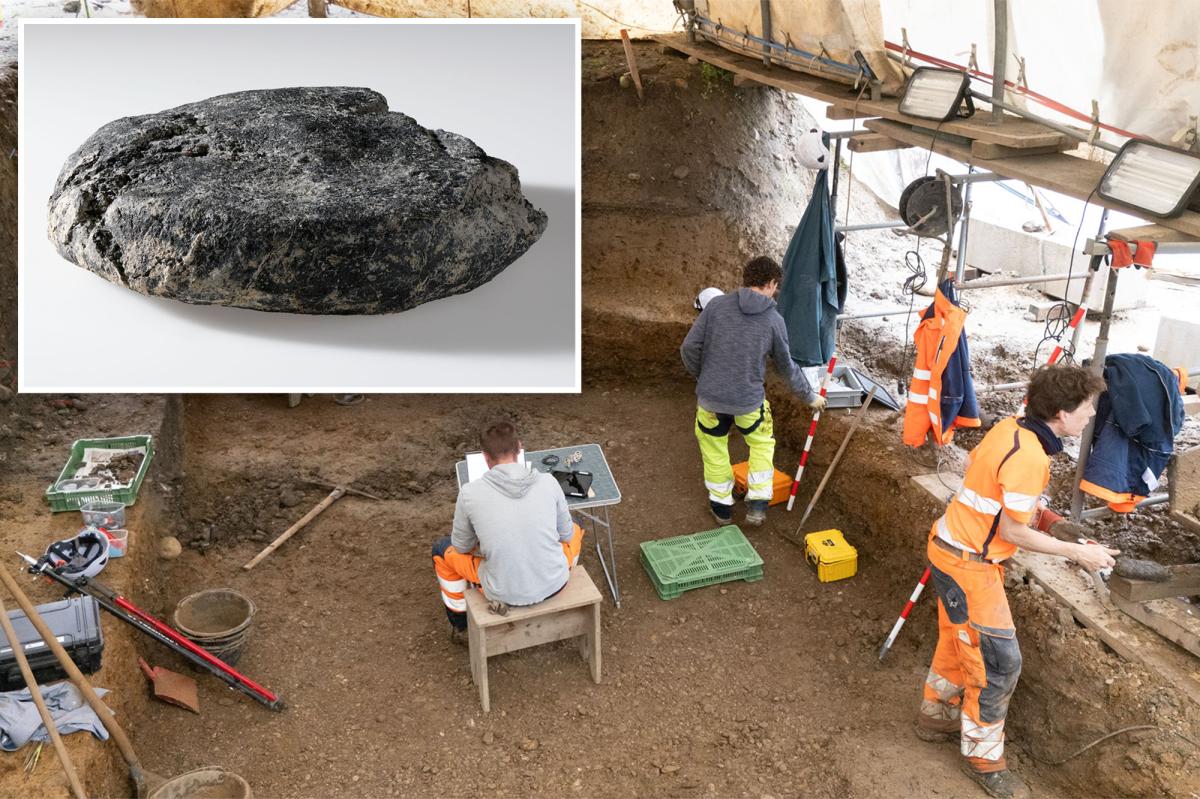
Officials recently uncovered a charred 2,000-year-old Roman bread loaf — the first of its kind ever found in Switzerland.
The bread was found during an excavation in the Swiss town of Windisch, according to a translated release from the Canton of Aargau.
The excavation, which took place ahead of a large residential development, began last August, though officials did not announce the bread discovery until April.
The artifact was found on the grounds of Vindonissa, a major Roman legionary camp.
Officials described the bread as a “charred, round object that attracted the attention of the excavation team during the uncovering work.”
“The object was recovered as a block together with the surrounding earth and immediately brought to the restoration laboratory of the Cantonal Archaeology,” officials said, as the release noted.
“A first visual inspection by an archaeobotanist of the Integrative and Scientific Prehistoric Archaeology at the University of Basel showed that it is, with great probability, a charred Roman bread.”
The piece of bread measures 10 centimeters in diameter and about three centimeters thick. Further tests are planned at a laboratory in Vienna to determine what the bread was made of.
The release noted that Roman bread discoveries are “extremely rare,” and described it as Switzerland’s “first Roman bread.”
“They are only preserved if they are burned, as for example, breads in the bakery of Roman Pompeii,” said the Canton of Aargau’s statement.
“The discovery of the first Roman bread in Switzerland once again underlines how significant the Vindonissa site is for archaeological science.”
Archaeologists also found evidence of an early fortification system — along with buildings, tools and metalworking evidence that could help determine when the site evolved into a permanent legionary base.
“Elsewhere, there are indications of craft activity from the time of the younger legionary camp: a striking number of metal tools together with blacksmithing waste, but also spearheads and projectile points,” the release stated.
“A large, carefully constructed clay oven lies directly within the walls of the older camp and shows that the zone directly behind the camp wall was probably already used for commercial activities in the early period of Vindonissa.”
Though the find is extraordinary, it’s not unheard of, prior research has indicated.
Last year, Turkish officials announced the discovery of a 5,000-year-old bread loaf, baked during Turkey’s Bronze Age.
Some of the 5-inch-wide loaves appear to have been torn away before it was buried around 3,300 B.C.
Turkish archaeologists also found a 1,200-year-old loaf of burned bread bearing the image of Jesus Christ last year.
The ancient loaf was found at the Topraktepe archaeological site, once the ancient city of Eirenopolis.
Disclaimer : This story is auto aggregated by a computer programme and has not been created or edited by DOWNTHENEWS. Publisher: nypost.com