
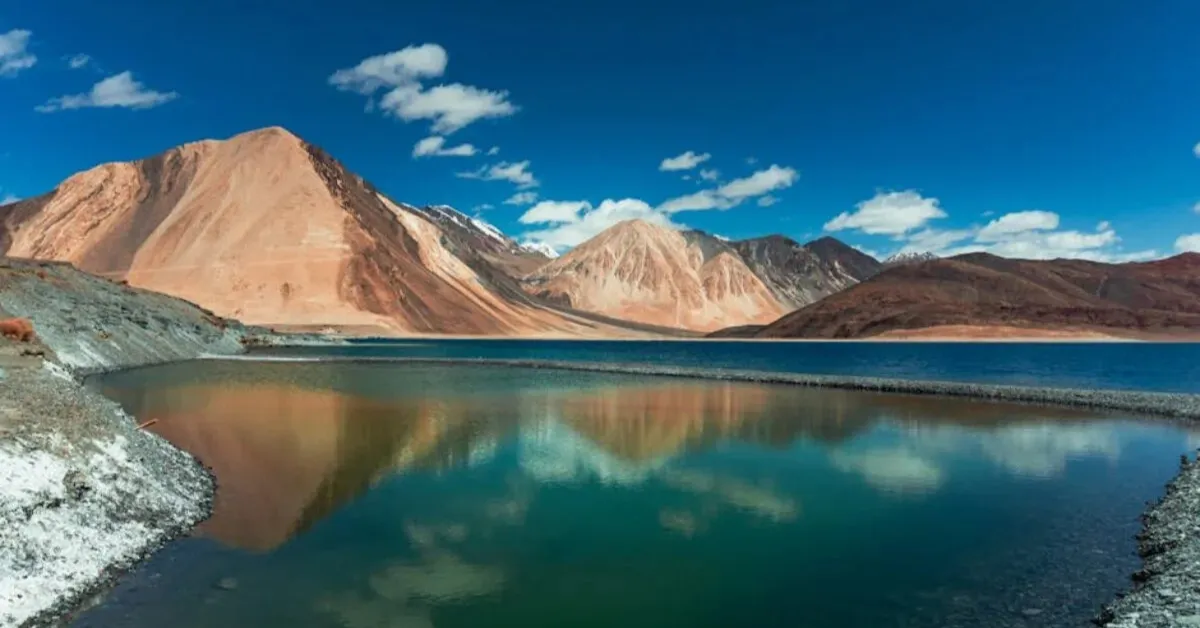
Picture this: you are standing in a village in Leh in February. Snow is everywhere — on the rooftops, packed into the mountain slopes, gleaming off every surface for as far as you can see. You are, to every outward appearance, surrounded by water.
And yet, come June, your fields will be dry.
This is the maddening reality of life in Ladakh, one of the highest, coldest, and driest inhabited places on earth. It is a land that receives more snow than most of India can imagine — and almost no rain.
The Himalayas stand between Ladakh and the monsoon like a bouncer at a door, turning away 90% of the moisture that the rest of the subcontinent takes for granted.
So what happens to all that snow? It melts. Fast. And it runs — straight downhill, through rocky channels, past fields not yet ready for planting, and gone.
By the time a Ladakhi farmer’s crop actually needs water, spring’s great snowmelt is a distant memory.
For centuries, communities here have performed an almost impossible balancing act — timing every agricultural decision around the brief, unpredictable window when water actually flows.
Too soon, the ground is still frozen. Too late, the streams have already dried. Miss the window, and the harvest fails.
Now, a new project is attempting to do something that sounds almost too simple: slow the water down. Catch it. Hold it. And release it when it’s actually needed.
The name says it all
Him, translates to snow and Sarovar, means lake. Put them together and you get the philosophy of the entire project in four syllables.
Project Him Sarovar, launched on 10 April 2026 by Lieutenant Governor Vinai Kumar Saxena, is not trying to make it rain in Ladakh, or reverse the retreat of its glaciers, or fight climate change head-on. It is doing something far more pragmatic: it is trying to buy time.
Specifically, to take the water that arrives too early — in the form of snowmelt — and delay its disappearance until the moment it’s needed most.
The method? Fifty small water bodies, built across Leh and Kargil districts, are designed to trap snowmelt at the source. Not a single grand dam. Fifty modest, carefully placed ponds and retention structures, each one acting like a pause button on water that would otherwise vanish.
It sounds almost underwhelming. Fifty ponds in a region the size of Portugal? But the elegance is in the physics. Water that pools stays. Water that stays seeps into the ground, raises the water table, feeds springs, and trickles out slowly over weeks — which is exactly the tempo that farming in Ladakh requires. You don’t need a reservoir the size of a small sea. You need the right small pond in the right place at the right time.
Why has no one done this before?
They have, actually — just not at this scale, or with this kind of institutional muscle behind it.
Ladakhi communities have historically used a network of channels called kuls to redirect glacial melt into their fields. It is an ancient, intricate, community-managed system that has sustained agriculture at altitude for centuries.
But kuls depend on predictable glacial flow. As glaciers retreat — and they are retreating, some of Ladakh’s ice bodies shrink by metres every year — that flow becomes erratic. The old system is working on an assumption the landscape no longer guarantees.
/filters:format(webp)/english-betterindia/media/media_files/2026/05/04/3-2026-05-04-14-43-12.png)
Him Sarovar is, in a sense, a 21st-century supplement to this centuries-old logic. Instead of redirecting water that’s flowing, it holds water that’s fleeing. Instead of ancient stonework channels, it uses engineered retention structures.
And instead of village-level management alone, it brings in the Indian Army, the Indo-Tibetan Border Police, and the Border Roads Organisation — institutions that know how to build things in terrain where most contractors would refuse to even park their trucks.
That coalition is not incidental. At altitudes where the air is thin, the ground is frozen half the year, and the nearest supply depot might be a day’s drive over a mountain pass, you need partners who can actually operate.
The army and the BRO have spent decades figuring out exactly how to do that.
The water table trick
Here’s the part that most people find surprising when they first encounter it: the most important thing these water bodies will do isn’t irrigate fields directly.
It’s what they do underground.
When a small pond fills with snowmelt and sits there for days or weeks instead of rushing off downhill, something quiet and powerful happens: the water percolates. It seeps through the soil and rock beneath, slowly, steadily, recharging the groundwater table.
/filters:format(webp)/english-betterindia/media/media_files/2026/05/04/2-2026-05-04-14-44-13.png)
Springs that had slowed to a trickle begin to flow again and the soil holds more moisture. Vegetation takes root in places that were previously bare. And all of that green cover — grass, shrubs, small trees — holds even more moisture, creating a feedback loop where water begets more water.
This is what officials mean when they describe the project’s aim of creating “green and blue assets.” Blue: the water bodies themselves. Green: the ecological recovery that follows. The pond is the beginning of the story, not the whole of it.
Ladakh’s water problem is ultimately an ecological one. Glaciers are withdrawing. Permafrost — the deep frozen layer that locks moisture in the soil — is thawing.
Springs that communities have relied on for generations are weakening. A project that only addresses irrigation ignores all of this. Him Sarovar is betting that small water bodies can trigger ecological recovery that outlasts the project itself.
The question everyone is asking
Can fifty pounds actually make a dent?
It’s a fair question. Ladakh covers over 59,000 square kilometres. Fifty water bodies, however well-placed, are not going to transform the entire landscape. Critics of such projects often point out that small-scale interventions can feel good without being large enough to matter.
But scale isn’t always the right metric. The point of Him Sarovar is not to replace Ladakh’s glaciers. It is to demonstrate, in specific communities and specific valleys, that water security is achievable without waiting for a technological miracle or a reversal of climate change.
Each of those 50 water bodies will serve a particular cluster of farms, a particular set of families, and a particular local ecosystem. At that granular level, the impact is not small at all.
And if it works — if the ponds refill groundwater, revive springs, enable planting windows to extend, and give communities some breathing room against increasingly erratic snowfall — the model scales.
Himachal Pradesh, Uttarakhand, Sikkim, Arunachal Pradesh: every high-altitude state in India faces some version of the same crisis. The lesson of Him Sarovar, if it delivers, travels.
What it means to store the sky
There is something poetic about the idea at the heart of this project that is worth sitting with for a moment.
/filters:format(webp)/english-betterindia/media/media_files/2026/05/04/avantika-featured-image-template-12-2026-05-04-14-50-01.png)
Snow is essentially stored water. When it falls on a mountain and stays, it is nature’s own reservoir — holding precipitation from the cold months and releasing it slowly through the warm ones.
Glaciers are the long-term version of this: frozen water accumulated over centuries, metering itself out over time.
What climate change is doing, in Ladakh and across the Himalayas, is disrupting that storage system. Snow falls and melts faster, and glaciers shrink. The natural delay between precipitation and availability, the delay that agriculture depends on, is collapsing.
Project Him Sarovar is, at its core, an attempt to rebuild that delay artificially. To do what the mountains once did on their own: hold water in place until it’s needed. To store the sky.
It won’t be enough, on its own. Nothing will be, if warming continues at its current pace. But in the meantime, in a place where people are farming at 3,500 metres above sea level in one of the world’s most extreme environments, a well-placed pond full of saved snowmelt is not a small thing. For the families who depend on it, it could just be everything.
Sources
‘Project Him Sarovar launched in Ladakh‘: by Drishti IAS, Published on 17 April 2026
‘Project Him Sarovar: Centre’s push for year-round water security in Ladakh‘: by Anubhuti Vishnoi for Economic Times, Published on 13 April 2026
Disclaimer : This story is auto aggregated by a computer programme and has not been created or edited by DOWNTHENEWS. Publisher: thebetterindia.com



