
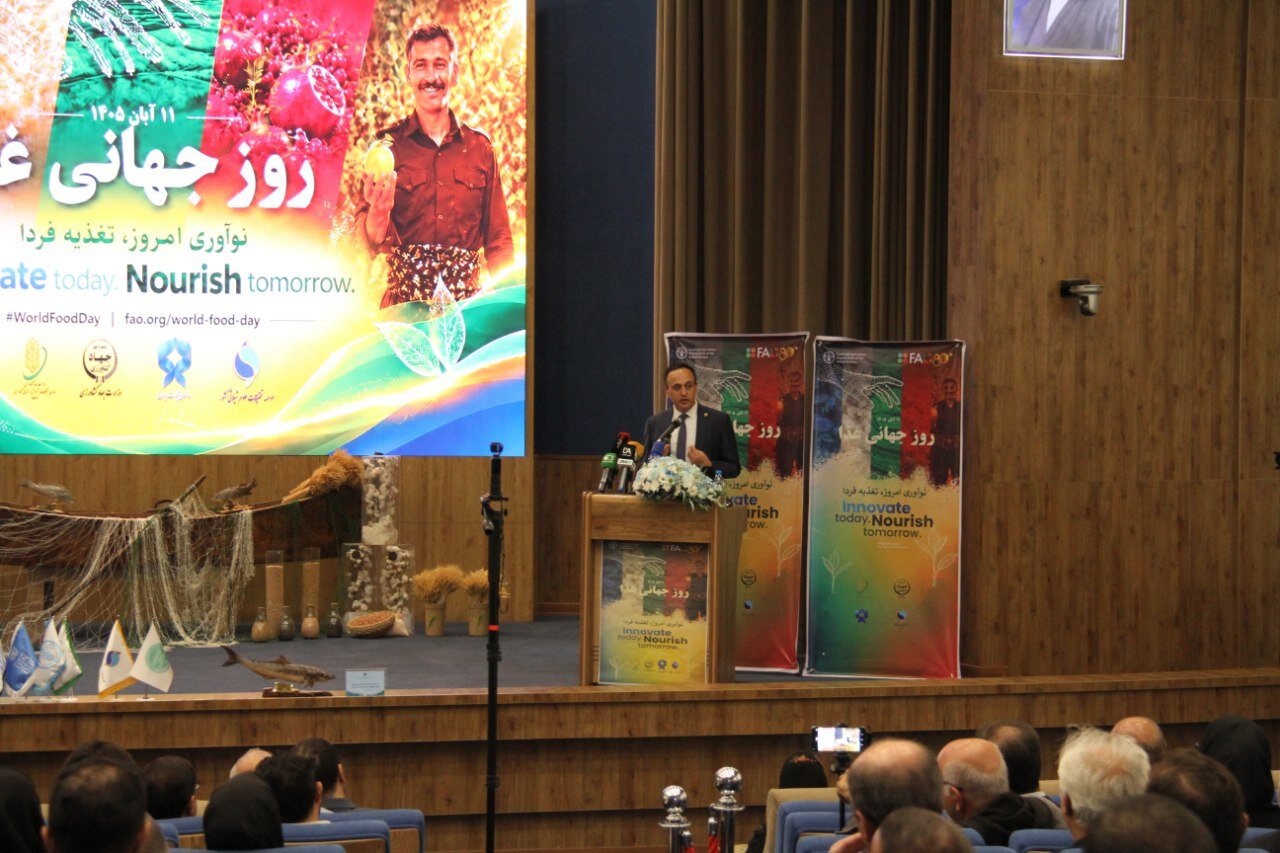
TEHRAN – The Food and Agriculture Organization of the United Nations (FAO) has called for strengthened innovation and collaboration to advance food security, sustainable agriculture and resilient livelihoods, marking World Food Day 2026.
An event hosted by the Agricultural Research, Education and Extension Organization (AREEO) and the Ministry of Agriculture Jahad (MAJ) brought together representatives of government institutions, researchers, producers, development partners, young people and media representatives to celebrate World Food Day under the global theme, “Innovate today. Nourish tomorrow.”
In his address, FAO Representative in the Islamic Republic of Iran Farrukh Toirov emphasized that innovation must translate scientific knowledge and practical experience into solutions that improve livelihoods, strengthen food systems and protect natural resources for future generations.
“Global agriculture has achieved remarkable progress. FAO data show that cereal production reached approximately 3.1 billion tonnes in 2024, 27 percent more than in 2010. Yet, the challenge is to translate these gains into reliable access to safe, nutritious and affordable food for every household,” Toirov said.
The FAO Representative stressed that food security extends beyond food production, encompassing availability, access, utilization and stability, with long-term sustainability and meaningful participation reinforcing these dimensions.
Toirov underscored the importance of developing locally appropriate solutions to water scarcity, climate variability, soil degradation and limited arable land.
He emphasized the importance of combining the country’s traditional agricultural knowledge with modern science, technologies and approaches to responding to complex environmental challenges.
“Traditional knowledge and practices are valuable foundations. They embody innovative solutions to the challenges of the past and offer experience in managing difficult environments. We should continue innovating, as our ancestors did, drawing on traditional knowledge while developing new solutions to address emerging issues,” he said.
He called for innovation that enables producers to improve water-use efficiency, protect ecosystems and strengthen resilience through healthier soils, improved irrigation scheduling, reliable water accounting, early warning systems and the practical application of weather forecasts and satellite information.
FAO is exploring these approaches in cooperation with the Government of the Islamic Republic of Iran, including through its work in the Lake Urmia basin. The initiative seeks to identify and pilot innovative solutions combining underground irrigation systems with smart agriculture tools and applications, while integrating remote sensing, accurate forecasting and digital information systems to support more efficient irrigation and the sustainable recovery of the basin.
The Representative also highlighted the importance of research and monitoring in fisheries and aquaculture to address changing water temperatures, water quality and ecosystem health.
FAO cooperation supporting sustainable agriculture and livelihoods
FAO’s cooperation with Iran encompasses a range of initiatives supporting climate resilience, sustainable resource management and agricultural productivity. These include integrated pest management for date palms, conservation of endangered indigenous livestock breeds, climate-smart and nutrient-dense crops, agricultural water management in the Urmia Lake Basin.
Toirov highlighted the essential role of MAJ, AREEO, universities and research institutions in connecting scientific research with agricultural extension services and helping producers identify solutions that are technically appropriate, affordable and effective under local conditions.
Referring to FAO’s Blue Transformation vision, he called for responsible development of fisheries and aquaculture through improved aquatic animal health, handling, preservation, traceability and market access, supported by sustainable management of natural resources.
Emergency assistance to support fisheries and aquaculture livelihoods in Hormozgan
The FAO Representative also highlighted the importance of supporting communities affected by crises and strengthening their capacity to recover.
FAO has recently launched a new project entitled “Emergency Assistance for the Early Rehabilitation of Fisheries and Aquaculture Livelihoods in Hormozgan Province”.
The project aims to support conflict-affected fishing communities in restoring essential livelihood capacities and strengthening food security. Planned activities include assessing priority needs, developing practical contingency and service-continuity measures, strengthening local capacities and preparing costed recovery priorities informed by specialist assessments.
The initiative is expected to generate evidence to guide assistance, practical preparedness and continuity plans, stronger local skills and recovery planning inputs for follow-up action.
The Representative noted that innovation in recovery also involves combining technical assessments, community knowledge and preparedness to strengthen resilience and support communities in building back better.
Concluding his address, Toirov outlined three priorities for advancing innovation across Iran’s agricultural and food systems.
The first is to connect innovation with resilient productivity and a stronger rural economy by bringing research, extension, water management and early warning systems closer to producers’ daily decisions, while strengthening local value chains, employment and incomes.
The second is to connect innovation with affordable healthy diets through improved storage, processing, transport and markets, reducing food losses and supporting vulnerable households while sustaining producers’ livelihoods.
The third is to ensure inclusive innovation by enabling women, young people and small-scale producers to shape solutions and benefit from opportunities throughout the agricultural value chain.
Disclaimer : This story is auto aggregated by a computer programme and has not been created or edited by DOWNTHENEWS. Publisher: tehrantimes.com




