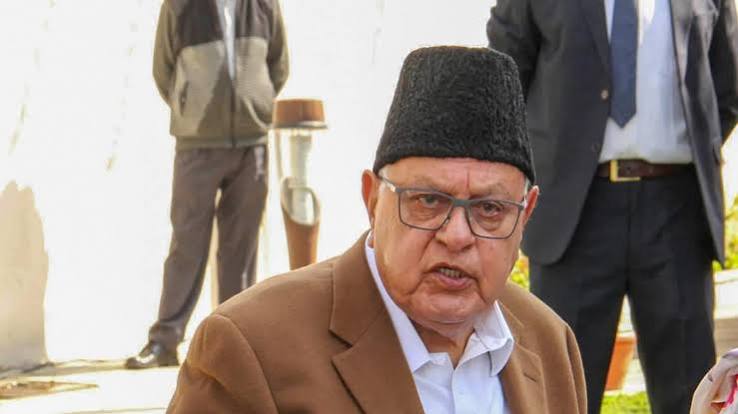
To mistake provocation for treason is to misunderstand Kashmir. Farooq Abdullah often deserves criticism for his words, but India needs to win over its regional voices, not drive them away.
Farooq Abdullah has perfected the art of being simultaneously exasperating and indispensable. At an age when most political veterans retreat into ceremonial irrelevance, the National Conference patriarch continues to provoke and unsettle. His latest assertion that Pakistan’s persistent internationalisation of the Kashmir question is “saving us”, coupled with his suspicion of New Delhi’s intentions, has invited accusations of being “anti-national” and “seditious”. The outrage is understandable. Reducing a complicated political career to a single incendiary remark is not.
Mr Abdullah’s statement was hardly a model of political discretion. To suggest that Pakistan, whose history of sponsoring militancy and destabilising Kashmir is well documented, is somehow protecting Kashmiris is both ungracious and dangerously misleading. A leader of his stature should know the difference between acknowledging international attention and implying gratitude to a neighbour whose actions have inflicted immense suffering on the Valley. His simultaneous insistence that Kashmiris have never disavowed their Indian identity complicates the charge against him, but does not erase the recklessness of his rhetoric.
Yet Farooq Abdullah has never been a politician of immaculate consistency. He is a flamboyant contrarian, a secularist comfortable singing bhajans and a regional leader who oscillates between national affirmation and denunciation of the Centre. His instinct is to speak to his constituency’s anxieties, sometimes illuminating genuine grievances, sometimes obscuring them through theatricality. He can be infuriatingly imprecise about his words, regardless of their consequences. But unpredictability is not proof of disloyalty.
The larger question is whether every provocation by a Kashmiri leader must become a referendum on his patriotism. Mr Abdullah has repeatedly affirmed Jammu and Kashmir’s place within India, invoking the legacy of Gandhi, Nehru and Maulana Azad. This is the central tension of his politics, i.e., he claims India as a constitutional home, while challenging what he perceives as its treatment of Kashmir. Whether one agrees with his diagnosis or not, the distinction matters.
The ‘Idea of India’ cannot mean uncritical applause for the government of the day. Nor can it demand that regional politicians suppress every grievance to establish their national credentials. A plural republic must accommodate dissent without converting it into a loyalty test. Otherwise, patriotism becomes a performance measured by political conformity rather than commitment to the constitutional order.
There is an inconvenient irony in the denunciations emanating from the ruling establishment. The BJP-led National Democratic Alliance governed with Abdullah’s National Conference as an ally. His son, Omar Abdullah, served as Union minister of state for external affairs from 2001 to 2002 under the Vajpayee government. These facts do not grant Farooq immunity from scrutiny. They expose the convenience with which political respectability is bestowed upon regional leaders when their support is useful, and questioned when their rhetoric becomes inconvenient.
The BJP’s alliance with the People’s Democratic Party offers an even sharper illustration. In 2015, the ideological adversaries formed a coalition government under Mufti Mohammad Sayeed and subsequently Mehbooba Mufti. The arrangement collapsed in June 2018 when the BJP withdrew support. Political engagement with a party accused by critics of accommodating separatist sentiment was evidently not incompatible with governance, until circumstances changed.
The lesson is not that Farooq Abdullah, Mehbooba Mufti or other regional leaders should be spared criticism. Their rhetoric can be irresponsible and their political calculations opportunistic. Mr Abdullah should be challenged directly — how does Pakistan’s diplomatic posturing translate into tangible protection for Kashmiris? What justifies his distrust of Delhi? Can he distinguish advocating Kashmiri rights from lending credibility to a hostile neighbour’s geopolitical agenda? Such questions are more democratic than simply branding him a traitor.
Kashmir’s regional politicians occupy a space that national parties cannot easily replicate. They speak the language of local anxieties, historical wounds, identity and alienation. They can translate disaffection into constitutional politics, or, if persistently delegitimised, lose their ability to persuade those who feel unheard. This is not appeasement, but strategic engagement. Alienating these intermediaries may satisfy the national appetite for denunciation while weakening the democratic links that bind Kashmir to India.
India’s sovereignty is not so fragile that every intemperate sentence by an elected politician threatens it. A confident constitutional democracy distinguishes objectionable speech from demonstrable disloyalty, and dissent from criminal conduct. Accountability must be proportionate, evidence-based and consistent, not calibrated to partisan outrage.
Farooq Abdullah is neither beyond reproach nor beyond redemption. His remarks deserve a searching rebuttal and a clear explanation. But the answer cannot be to erase the political space he occupies. Kashmir’s integration requires more than territorial control; it demands political trust, constitutional credibility, and a sense of belonging that survives disagreement.
The ultimate test of the ‘Idea of India’ is not whether Farooq Abdullah always speaks wisely. He plainly does not. It is whether India can challenge his excesses while recognising the citizen, politician and constituency behind them. To win Kashmir’s confidence, India must do more than silence its enfant terrible. It must give him, and those he represents, compelling reasons to believe that their future lies within the republic.
Disclaimer : This story is auto aggregated by a computer programme and has not been created or edited by DOWNTHENEWS. Publisher: deccanchronicle.com