
Despite some giant strides – more fuel-efficient aircraft, an ever-improving safety record, cheaper airfares in real terms – the aviation industry has pressed the pause button in some ways that matter.
A Boeing 787-10 flies no faster than a Boeing 707 did in the 1960s. With a few notable exceptions such as the Anglo-French Concorde, jet-powered passenger aircraft have not changed much since the de Havilland Comet, the world’s first jet passenger aircraft, which entered service in the 1950s.
Back then, the expectation was that air travel would become faster and smoother, but instead many routes are actually slower than they once were because airports, skies and aircraft themselves are more congested. Here’s a rundown of some of the air travel innovations that were supposed to be here by now, but aren’t.
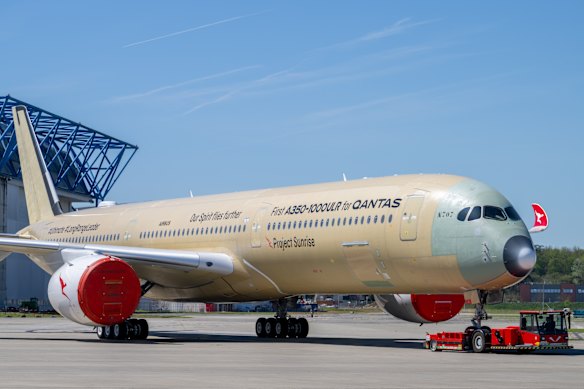
Qantas’ Project Sunrise faces another delay
Qantas has just announced another delay in its Project Sunrise flights, the non-stop service linking east coast Australia with London and New York. A dream of Qantas chiefs for almost a decade, the Sydney-London flight will be the world’s longest scheduled non-stop flight when it finally takes off.
Sign up for the Traveller newsletter
The latest travel news, tips and inspiration delivered to your inbox. Sign up now.
The national carrier was expecting to take delivery of the Airbus A350-1000ULRs specially designed for the routes in October, with scheduled services to begin early in 2027, but delays attributed to supply chain issues have pushed back the delivery date. The first of these ultra-long-range aircraft is now expected to arrive in April 2027. The start-up date for Project Sunrise services is now November of that year.
What happened to supersonic flight?
Concorde was supposed to be the precursor of a brave new world of aviation that would whisk passengers from Melbourne to London in 16 hours. Instead, it became a glamorous trophy-cabinet product for celebrities and CEOs. Tickets were wildly expensive, its fuel consumption was enormous, bans on sonic booms over land strangled its routes and crippling operating costs ensured Concorde survived as a flagship vanity project, and never as a viable revenue earner.
Following Concorde’s retirement in 2003, there have been moves to build a new generation of quieter, cheaper and more fuel-efficient supersonic aircraft such as the 55-seat Overture jet that Boom Technology is developing and the Lockheed Martin X-59 QueSST, but obstacles remain.
The sonic boom generated by supersonic aircraft limits them to overwater routes. The jet engines that power these aircraft use far more fuel than conventional turbo-fan jet engines, and they fly higher in the troposphere, where jet engine emissions have a greater environmental impact. Unless a supersonic aircraft was permitted to fly over Europe and North America, there is not sufficient demand to make it viable for any aircraft manufacturer to build a supersonic aircraft. Not even Elon Musk flies in a supersonic executive jet, and that’s a telling fact.
Sustainable aviation fuels
Finding a plentiful, economical and efficient non-carbon-based aircraft fuel is probably the greatest challenge for the aviation industry. The holy grail is a zero-carbon fuel, and while large commercial aircraft have flown using sustainable aviation fuels (SAF), which are produced from used cooking oil, agricultural residues or synthetic carbon, these are not zero-emission fuels since they produce carbon.
Although they produce less carbon than existing jet fuel, SAFs are not available in quantity, or at a cost that makes them a realistic alternative. Several airlines are now using SAF-blended jet fuel, although with a price of two to five times the cost of fossil fuel, most limit it to a small percentage of their total consumption.
Hydrogen is another potential fuel for jet engines. Engines powered by hydrogen produce zero emissions, using the most abundant element in the universe, but hydrogen must be cooled to -253°C to make it liquid, massively increasing its energy density and making it a practical jet engine fuel, and that is decades away from realisation. Barring a giant leap in battery technology, large, long-haul aircraft will never take to the skies using electric power.
Non-stop flights often take longer these days
While automated check-in and e-passports have sped up processing times for passengers at many airports, other aspects of air travel lag well behind. Security checks mean passengers take longer to get from the check-in desk to the boarding gate. Once there, boarding times are typically longer since aircraft are usually flying with more passengers. Also, there are more aircraft in the air, and that often means flying in a holding pattern waiting for clearance to land.
Many travellers now find themselves waiting at the baggage carousel for anything up to 30 minutes before their luggage arrives, and there are some petty frustrations that just should not be happening. Arriving at Sydney’s international terminal, I’ve waited as long as 15 minutes after the seat belt sign has been switched off for the air bridge to dock with the aircraft – a world record.
The exception is flying time between some long-haul city pairs. Back in the 1970s, a Boeing 747 jumbo jet operating from Melbourne to Paris required two stops for refuelling. The current Airbus A350 and Boeing 787 aircraft that now dominate long-haul international routes require only one intermediate stop between Australia and Europe.
The glamour has departed, and it’s not coming back
Pre-World War II, air travel was fancy, expensive and posh. Passengers lounged around in armchairs, sat down to duck a l’orange cooked by a chef and they puffed cigars afterwards.
When Boeing’s jumbo jet heaved itself into the skies, there were bars on the top deck where blokes in flares and floral body shirts chatted up mini-skirted women with beehive hair.
While flying is much more accessible than it was back then, it’s not much fun. As for the glamour of taking to the air, that went out with propellors.
Even in most business class cabins these days, comfort is the go with track pants and T-shirts to the fore. Come sleep time, and there’s often a snorer who sounds like he snorted a tuba. It’s deeply disappointing.
 Michael Gebicki is a Sydney-based travel writer, best known for his Tripologist column published for more than 15 years in Traveller. With four decades of experience, his specialty is practical advice, destination insights and problem-solving for travellers. He also designs and leads slow, immersive tours to some of his favourite places. Connect via Instagram @michael_gebickiConnect via email.
From our partners
Disclaimer : This story is auto aggregated by a computer programme and has not been created or edited by DOWNTHENEWS. Publisher: www.smh.com.au