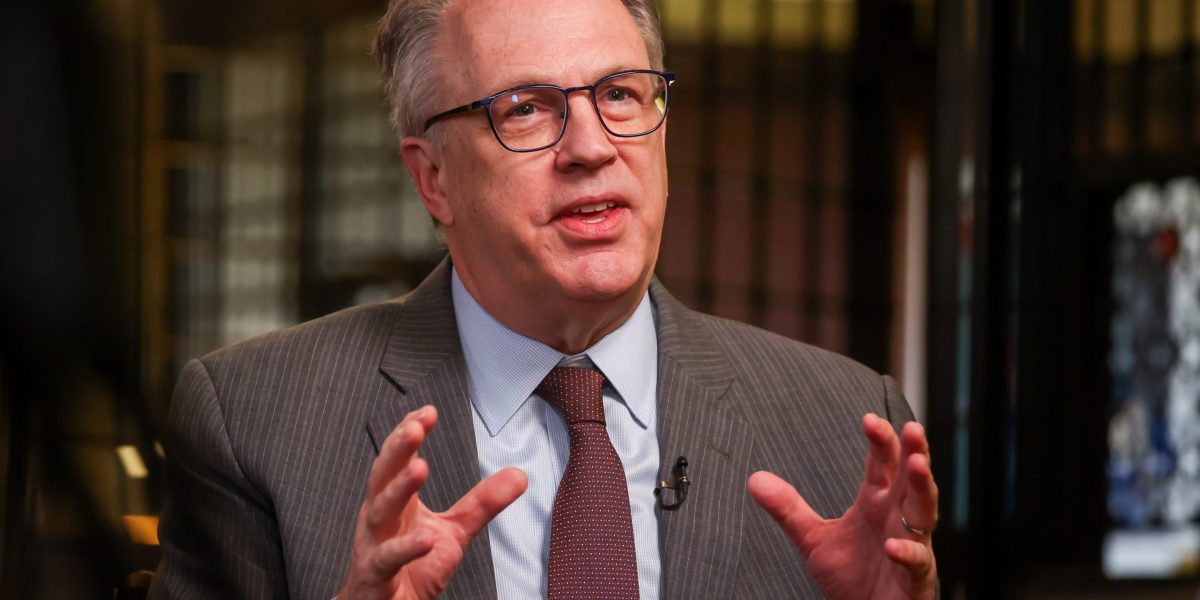
Federal Reserve Bank of New York President John Williams said that among the drivers of inflation in the US, he’s most focused on demand driven by artificial intelligence. And if that demand persists, it could force the central bank to raise interest rates.
“If this creates a sustained impulse to demand relative to supply in inflation, I do think that’s the kind of situation where you don’t look through this,” Williams said Thursday during an event organized by the New York Fed. If inflation ends up being more persistent and meaningfully higher than his baseline forecast, he said, “then monetary policy would need to respond to that.”
“On the other hand, if it isn’t and things play out in a more benign way, I do think monetary policy is, and continues to be, well positioned,” he said.
As he monitors inflation, Williams said if the Fed’s preferred gauge of underlying price pressures — the so-called core version of the personal expenditures price index — comes in at a monthly pace of 0.2% over the second half of 2026, that would suggest inflation is on track to return to the Fed’s 2% annualized target.
“A rate of core PCE of two-tenths a month in the second half of this year, that would be consistent with my view of a disinflationary process that’s continuing,” Williams said. “If it’s higher than that, that would be a sign of inflation a bit more persistent.”
The Fed has kept its benchmark rate steady this year, but support for rate hikes is growing among officials. Nine policymakers penciled in at least one quarter-point hike in 2026 in their latest set of economic projections submitted at their June gathering. At the same meeting, a few participants saw a case for raising interest rates, according to minutes released Wednesday.
Read More: Fed Minutes Show ‘a Few’ Officials Saw Case for June Hike
The minutes revealed that policymakers had discussed how they would want to respond to various scenarios for future inflation.
Williams said the exercise, and the details provided by the minutes, captured a “collective reaction function,” referring to the framework through which the central bank thinks about the economy and how to respond to certain conditions. “It shows the richness of these scenarios,” he said.
Chairman Kevin Warsh has touted the need for a new approach at the Fed, announcing task forces to review the central bank’s communications, balance sheet and inflation models as well as to study key issues such as productivity and data sources. The task forces would have around six months to deliver a set of suggested changes, the new chairman said.
The New York Fed chief, who is also vice chair of the Federal Open Market Committee, said the task forces were a “unique and timely” opportunity to think about key areas for the central bank. “It’s a pretty aggressive timeline of trying to get those reports back to us,” Williams added.
Disclaimer : This story is auto aggregated by a computer programme and has not been created or edited by DOWNTHENEWS. Publisher: fortune.com