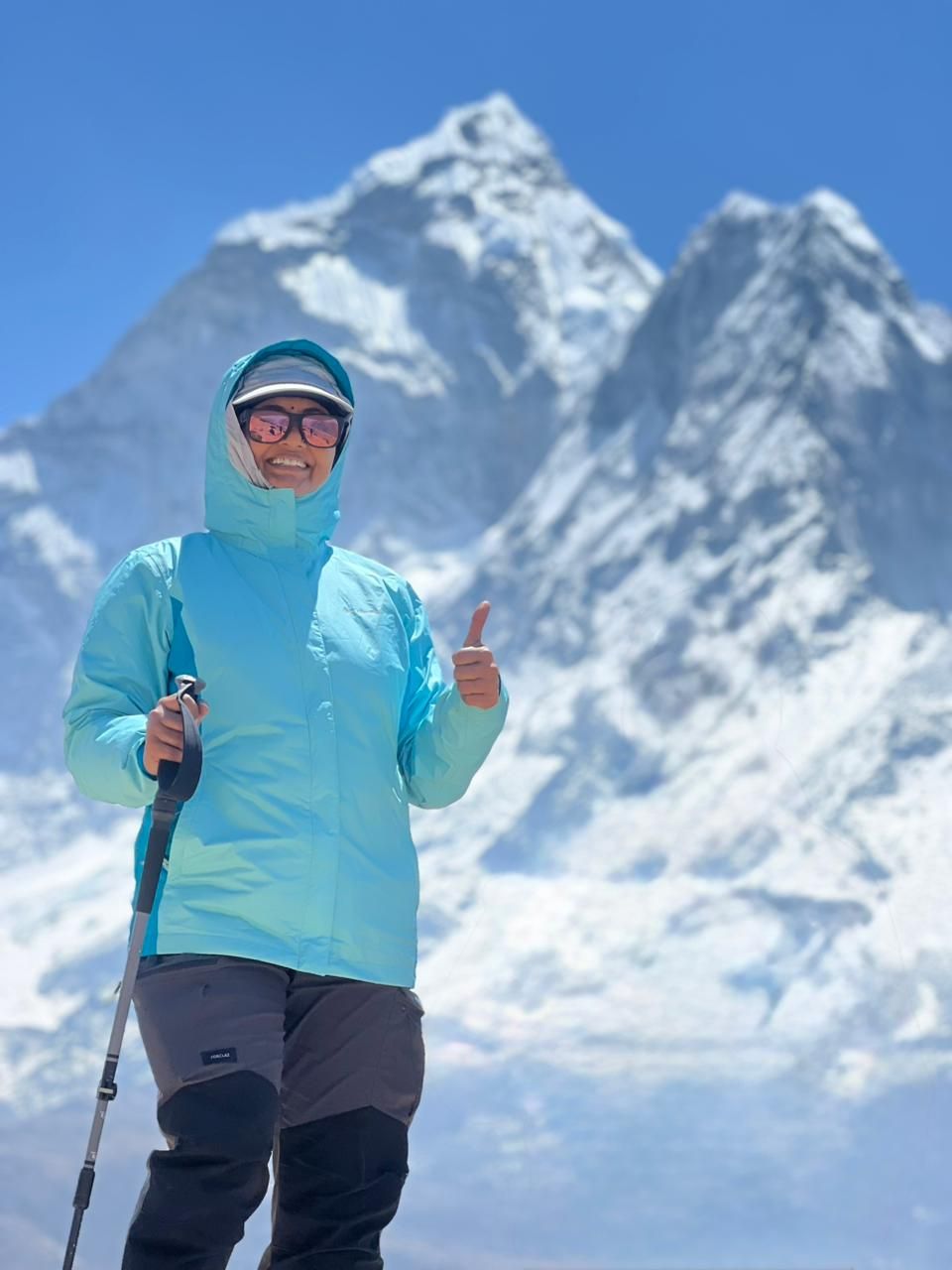
As a child, I once heard someone on the radio talking about how, when they died, they wanted their ashes scattered over the Himalayas. I remember thinking, What must it be like up there, that a person wants to go even in death? I wanted to see it while I was still alive,” shares Jyoti Ratre, who was 55 when she broke the record of being the oldest Indian woman to summit Mount Everest in 2024.
Born in Bhopal, Ratre first saw the snow-capped peaks of Himachal Pradesh’s Dhauladhar range in 2017—an encounter she describes as “love at first sight”. Soon after, with minimal training, she completed the Pin Parvati Pass trek, also in Himachal Pradesh. “It was 5,300 metres. I thought if I worked on my fitness, then I could do Everest.”
Ratre’s first attempt was in 2023. A week before she set out, a stomach ache took her to the doctor, where she discovered a severe urinary tract condition that required immediate surgery. “You usually need full anaesthesia for it, but I opted for a localised shot so I could make a quick recovery,” she says. “In my heart, the desire for Everest was so strong that everything else felt small. In India, women think life ends at 50. I wanted to prove to them that that’s when it starts.” The next morning, she was in Kathmandu. Three days later, the climb began.
During the summit push, Ratre’s team was hit by an unexpected storm and forced to turn back to Camp 4, the final base where climbers rest before attempting to reach the summit. When they arrived, one of her companions was missing—he’d lost his way in the storm. “He was unconscious when the Sherpa found him late at night,” she recalls. “I had a choice then. I could either wait and attempt the summit the next day or save my companion’s life. I thought, if I raise the flag tomorrow and he dies, I won’t be able to forgive myself.” Ratre had been just 600 metres from the goal she had spent six years chasing but she knew no peak was worth a human life. She made the call to let her guide descend with her companion, staying back at Camp 4 for two days until he returned for her. “My dream did not come true, but I was happy with my decision,” she says. In May 2024, she finally stood atop the tallest mountain in the world. “I used to cry when I reached a summit. But with Everest, I think I blacked out. I didn’t feel anything. I didn’t feel happy or sad. I just can’t express it in words.”
Disclaimer : This story is auto aggregated by a computer programme and has not been created or edited by DOWNTHENEWS. Publisher: vogue.in