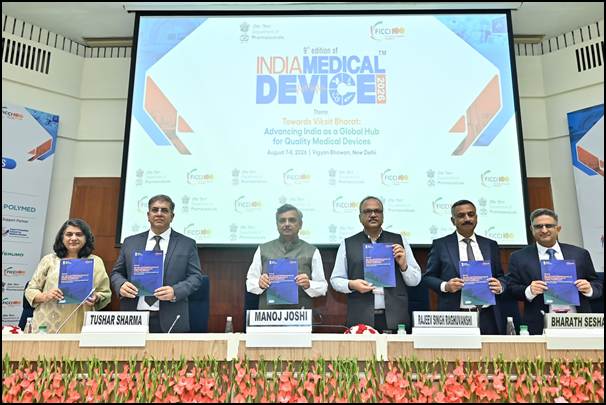
The white paper calls for risk-based maintenance standards, certification of service engineers and wider use of digital monitoring to support India’s expanding medical equipment base.
India’s medical device market could reach US$250 billion by 2047, but sustaining the sector’s expansion will require stronger systems for servicing, maintenance, calibration and lifecycle management of medical equipment, according to a new white paper by the Federation of Indian Chambers of Commerce and Industry (FICCI) and DUA Consulting.
The white paper, Service and Maintenance of Medical Equipment in Indian Healthcare – Towards a Safe, Reliable and Sustainable Medical Device Maintenance Ecosystem, was released during the inaugural session of the ninth edition of India Medical Device 2026, organised by the Department of Pharmaceuticals in association with FICCI in New Delhi.
According to the report, India’s medical device sector, estimated at around US$14 billion in the white paper, could expand to US$30-50 billion within this decade and reach US$250 billion by 2047.
The projections are linked to factors including rising healthcare demand, adoption of advanced medical technologies, government support for domestic manufacturing and India’s efforts to strengthen its position in the global MedTech industry.
The report notes that initiatives including the Production Linked Incentive (PLI) Scheme and the Strengthening of Medical Devices Industry Scheme have supported domestic manufacturing capabilities. It argues, however, that manufacturing capacity alone will not be sufficient to build a sustainable medical device ecosystem.
As medical equipment increasingly supports diagnostics, emergency care, surgery and advanced treatment, the report calls for greater attention to equipment performance throughout its operational lifecycle. Effective servicing and maintenance can help improve equipment reliability, reduce downtime, extend useful equipment life and optimise healthcare investments, it said.
A key recommendation is the creation of a risk-tiered hybrid maintenance framework aligned with the Central Drugs Standard Control Organisation’s (CDSCO) medical device classification system. Under the proposed approach, maintenance requirements would vary according to the risk category of a device rather than follow a uniform model across equipment types.
The white paper also recommends developing a national certification architecture for medical equipment service engineers and strengthening technical training to build specialised maintenance capabilities.
Other proposals include encouraging new commercial models for equipment maintenance and rationalising the fiscal framework to support compliant servicing practices.
Digital technologies are another component of the proposed framework. The report recommends greater adoption of predictive maintenance, digital monitoring and lifecycle-management systems to identify potential equipment problems earlier, improve reliability and reduce downtime.
The recommendations come as policymakers and industry stakeholders discuss how India can move beyond import substitution and deepen domestic value addition in medical devices. Speaking at India Medical Device 2026, Department of Pharmaceuticals Secretary Manoj Joshi also called for stronger component manufacturing, innovation in advanced medical technologies and greater integration of India into global value chains.
The white paper positions equipment maintenance as part of the broader infrastructure required for India’s MedTech ambitions, arguing that expansion of manufacturing and procurement needs to be accompanied by systems capable of keeping medical technologies safe, reliable and operational throughout their lifecycle.
Disclaimer : This story is auto aggregated by a computer programme and has not been created or edited by DOWNTHENEWS. Publisher: biovoicenews.com