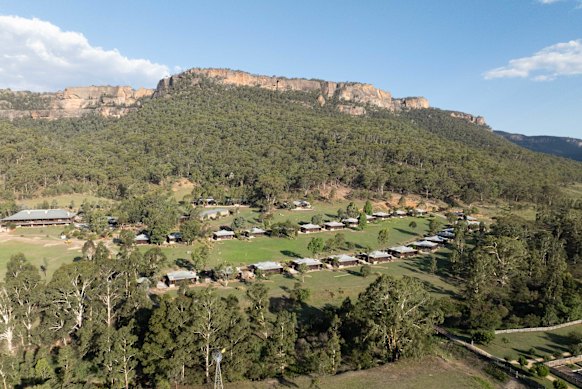

A battle is brewing over the skies of the Blue Mountains, with local councils, residents and bushwalkers warning a helicopter tourism proposal by an ultra-luxury resort risks transforming one of Australia’s most protected wilderness areas into a “fly-in, fly-out playground” for the global rich.
The Emirates-owned One&Only Wolgan Valley resort – a secluded 40-suite retreat tucked deep within a valley north of Lithgow – has applied to the NSW government to operate up to 105 weekly helicopter flights transporting guests to and from Sydney Airport, to avoid the hassle of lengthy road journeys.
The proposal has sparked strong opposition, with critics fearing the plan could send helicopter noise shuddering through Wolgan Valley and the surrounding World Heritage-listed zone.
Emirates, which has invested more than $50 million in recent upgrades to the retreat, says the aviation plan has become necessary after a landslide severed Wolgan Road – the resort’s main access route – in 2022, forcing a temporary closure of the resort in 2023.
But with reopening now slated for mid-2026, management is increasingly looking to helicopter transfers as a transport option for guests.
The only overland access to the resort is via a rugged, unsealed four-wheel-drive track known as the Donkey Steps.
The proposed flight frequency more than quadruples the long-standing cap of 14 weekly helicopter trips. Even after Wolgan Road is restored, the resort wants approval for a permanent increase to 50 flights a week.
More than 100 submissions have been lodged with the Department of Planning, with some residents estimating helicopters could pass over their properties every 20 minutes during peak periods.
Blue Mountains Council described the proposal as a “radical transformation” of the resort’s operations that lacked a “social licence” from the community.
“The proposal essentially creates a fly-in, fly-out resort, with the potential for ongoing impacts across the Blue Mountains,” council chief executive Rosemary Dillon wrote.
Farmer Michael Coates, whose family has lived in the Wolgan Valley since the 19th century, said the proposal risked undermining the appeal of the region.
“We’ve got alternative access routes that were put in four years ago, so you don’t need helicopters running through what is otherwise a quiet rural valley,” Coates said.
“The whole idea of the resort is to give guests a bush experience – how does putting people in helicopters to make a flashy entrance fit in with that?”
Resort operators argue road disruptions could persist for years, making air transfers essential to safeguarding the retreat’s future and the 100 jobs it supports.
Planning documents note international travellers, who make up about 65 per cent of guests, face road journeys of more than four hours from Sydney Airport after long-haul flights.
Travel times have also worsened by the temporary closure on the Great Western Highway due to geological cracking, which has added 45 minutes to road journeys.
By comparison, a direct helicopter transfer takes about 50 minutes.
In a consultation letter sent to residents, general manager Tim Stanhope said expanded helicopter access was essential to the resort’s viability.
“Road access for resort guests is not reasonably feasible,” Stanhope wrote.
Acoustic modelling by the resort found helicopter noise would be “barely audible” at nearby homes and unlikely to create a significant environmental impact.
But the National Parks and Wildlife Service questioned whether assessments adequately considered the impact on threatened species, including wedge-tailed eagles, and has called for further biodiversity assessments.
The dispute comes amid broader anxiety over aviation noise ahead of the opening of the Western Sydney International Airport later this year. Blue Mountains Council has raised concerns over the cumulative impact of multiple flight paths and aviation noise across the region.
Blue Mountains state Labor MP Trish Doyle said the resort proposal placed a disproportionate burden on local communities for the benefit of a relatively small number of affluent visitors.
The Australian Climbing Association NSW also raised safety concerns, warning helicopter noise could interfere with communication between climbers on nearby cliff faces.
An Emirates spokesman said helicopter access would support resort operations, and guest transfers would also continue via the Donkey Steps using four-wheel-drive vehicles.
“Helicopter access is important for the resort’s smooth operations, but we would like to clarify that it is not a showstopper should we be unable to secure such an increase,” the spokesman said.
“We are in close dialogue with the valley community and National Parks on the final flight paths and flight frequency and we will re-evaluate our application accordingly.”
Blue Mountains resident Thomas Maschmeyer said the debate was emblematic of broader tensions over how to balance the region’s World Heritage values against high-end tourism.
“The Blue Mountains is a shared asset – ecologically, culturally and socially,” he said.
“Decisions about its future should reflect the interests of the broader community, not only the operational preferences of a single operator.”
The NSW Department of Planning is continuing to assess the proposal.
The Morning Edition newsletter is our guide to the day’s most important and interesting stories, analysis and insights. Sign up here.
 David Barwell is an urban affairs reporter for The Sydney Morning HeraldConnect via email.
From our partners
Disclaimer : This story is auto aggregated by a computer programme and has not been created or edited by DOWNTHENEWS. Publisher: www.smh.com.au