
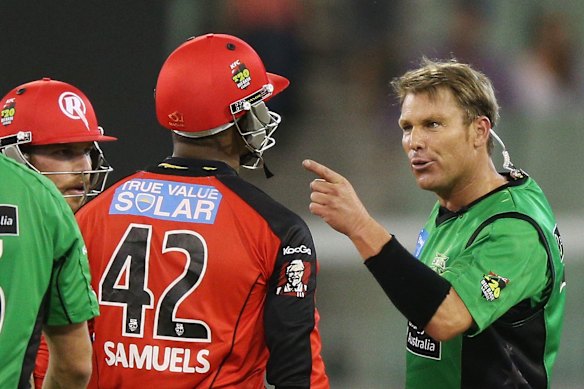

At their peak, the Melbourne Stars and Renegades fought a derby in front of more than 80,000 spectators at the MCG.
A 2013 derby dust-up on the field between Shane Warne and Marlon Samuels is part of the competition’s folklore.
And in 2019, the two clubs played off for the Big Bash League trophy at Marvel Stadium. As was typical, the Stars appeared to have the game sewn up before they surrendered in the closing overs to a Renegades fightback.
Now they look destined to join the likes of the Fitzroy Lions, Brisbane Bears, Illawarra Steelers and Adelaide Rams as merged or defunct sporting brands.
Cricket Victoria chief executive Nick Cummins, who spoke to this masthead after telling staff of the state association’s plan to retire the brands of the Stars and Renegades and merge the teams into one entity, is unapologetic about both the decision and its necessity.
“We’re not doing this for the love of anything other than accepting it as a financial necessity,” Cummins said. “We’re supporting Cricket Australia in what they believe are the steps that need to be taken to help Australian cricket.
“We don’t want to have our funding cut because that will cascade onto areas we regard as important, so we think we can create a new structure in the new world where we can continue to drive a really successful BBL team, and at the same time protect the things that matter.”
Just nine months ago, CV had been the most vocal opponent of selling stakes in BBL clubs because it wanted to protect the “things that matter,” as CV’s chair Ross Hepburn declared to a room full of cricket powerbrokers at CA’s AGM last October.
“CV is very supportive of the current strategic considerations to reset the BBL competition and strengthen the CA balance sheet,” Hepburn had said. “However we believe all other options need to be diligently canvassed before resorting to selling off member assets.”
But as Cummins recalled, the numbers being presented by CA’s financial forecasters got grimmer and grimmer until he and the CV board decided to change course. Early estimates of CA requiring around $90 million to balance the books in coming years blew out to somewhere closer to $400 million.
“The first phase when we didn’t want to sell at all was when we believed the gap was manageable,” Cummins said, “because we believed there were a whole lot of other ways where if we needed to find that money in the balance sheet that would be easily achieved.
“It then became clear that that figure is far larger, which then started to narrow down the things we could do.
“Once I’d made all the suggestions about expansion, selling a percentage in the league, and they were not producing the numbers they needed, and the reality of the sizes of the funding cuts we would be facing, we went ‘well OK’.”
That decision was made in the final two months of 2025, before conversations shifted to matters of transition. By Cummins’ estimate, CV was ready to go forward with plans to rebrand the Melbourne Stars and place the Renegades in “caretaker mode” ahead of selling the licence by February.
But objection to CA’s BBL sale plans by other states, namely NSW, Queensland and South Australia, slowed the process. It is important to note that those states still hold reservations about sale plans, even as CA rejig them to allow “self-determination”.
Senior figures in NSW and SA were shocked at CV’s decision on Tuesday night. Cummins, though, is unrepentant.
“If we want to sell 100 per cent of one of our teams, we as CV need to structure our organisation accordingly,” he said.
“We can’t have a group of people working for a team and then all of a sudden, that gets sold from under them to a different entity.
“What will happen, and we’re starting to see this happen, is staff will start leaving because there’s no certainty. So we needed to aggregate everyone into one team where they have certainty, and then make the other licence free so we can sell it to someone who can put their own stamp on it – name, colours and so on.
“The complication is one, we need a caretaker to look after the other team until it is sold. There’s still a CA board meeting and there’s the ACA negotiations, so there’s a couple of bridges that need to be crossed before the sale goes ahead.”
Cummins is candid in his admission that much about the merger and sale is still unknown.
Player contracts need to be migrated across to any new entities with the assent of the Australian Cricketers Association, and the CA board must still give final assent to the sale of the licence, which was technically leased to CV for a 30-year period in the early years of the BBL’s existence.
The decision to axe the Stars brand will go down poorly with the likes of longtime leader Glenn Maxwell and also the club’s voluble former president Eddie McGuire. Cummins argued that it will need to change to be a team identity for all Victorians.
One of the longstanding dynamics of the BBL is that the strongest team identities have tended to come from one team states: the Perth Scorchers being the leading example. Cummins wants the CV-owned Melbourne team to have that level of popularity.
“It’s important to us that the sponsors and the members and fans, they’re Cricket Victoria fans, so we want them to have somewhere to live,” he said. “So if they lost their team they don’t have to go, ‘So now who am I going to support’, we will provide them with a viable option.
“They can support the new [privately owned] team, but also have an option with strong links to Victorian cricket.”
Equally, Cummins made it clear that he had spoken in detail to CA about how to manage the sale and rebranding. He added, moreover, that he had informed other state chief executives of CV’s intentions.
“We’ve been trying to tackle the challenge of what do we do around the caretaker period, between when we’ve decided we want to sell that licence, and it actually going into the hands of the new owners because we need someone who cares about it.
“You can’t just have it sitting there, wasting away. So we’ve been working very closely with CA around that as well. That team is going to be trying to win the BBL.”
Though he and a group of other CEOs recently returned from a trip to India where they met with potential investors at a function hosted by the Raine Group in Mumbai, Cummins stressed that there was no shortlist of preferred candidates to buy.
“I think the most important thing to understand is that if we continue to operate under the uncertainty, we wouldn’t actually have any clubs left,” he said. “We can’t sell uncertainty to sponsors, we can’t sell uncertainty to players, we can’t sell uncertainty to staff.
“So we need to be able to give a very clear picture to people about what it’s going to look like. That became clear, so the delays have made that harder and harder, and now we’ve committed to this path and we want to see it through.”
When a wave of economic rationalism washed through the AFL and the post-Super League NRL in the late 1990s, a host of figures became synonymous with the merging or dissolving of clubs.
Then AFL boss Ross Oakley and commissioner Graeme Samuel were two in Melbourne, while Ken Arthurson and John Ribot were on the opposite sides of the Super League divide in Sydney.
By choosing to kill off the Stars and Renegades to keep one team for Victoria and leave one “clean” Big Bash League licence to sell to a private investor, Cummins seems destined for similar notoriety. But he is insistent that this is a question of survival.
“Of course, they’re 15 years old, both of them,” Cummins said when asked if he had any qualms about “retiring” the team names. “But the reality is if we were selling 100 per cent of one of them, chances are that their name was going to change.
“So as soon as we made the decision to sell 100 per cent, we were taking the decision to cede control of the name to someone else, and even if they didn’t change the Stars name or Renegades name, we wouldn’t own it anymore. It was much more emotional making the decision to sell at all, more so than the brand itself.
“But people can’t discount the fact that the people in the organisation, this is their job, they think about this brand every day and are very passionate, so it’s not an easy decision.”
News, results and expert analysis from the weekend of sport sent every Monday. Sign up for our Sport newsletter.
 Daniel Brettig is The Age’s chief cricket writer and the author of several books on cricket.Connect via X.
From our partners
Disclaimer : This story is auto aggregated by a computer programme and has not been created or edited by DOWNTHENEWS. Publisher: www.smh.com.au


