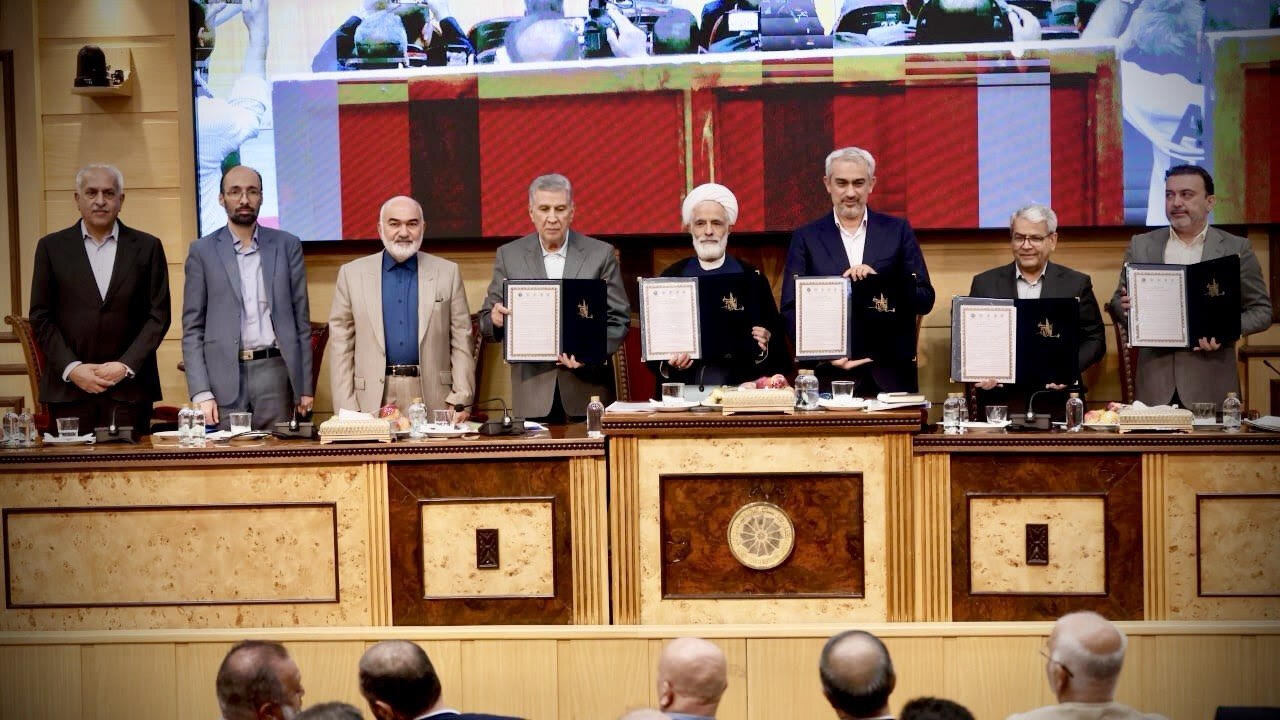
TEHRAN- The unveiling of a five-party memorandum of understanding among Iran’s Ministry of Economic Affairs and Finance, the Legal Deputy of the Presidency, the Ministry of Interior, the Office of the Government Board, and the Iran Chamber of Commerce, Industries, Mines and Agriculture took place during the 138th meeting of the Government-Private Sector Dialogue Council at the Iran Chamber.
Samad Hassanzadeh, Secretary of the Dialogue Council, praised the presence of ministers, deputies, parliamentarians, and officials and stressed that cooperation between the government and the private sector must continue in order to remove economic barriers. He said the memorandum was the result of a year of efforts and follow-up and could provide a basis for sustained cooperation and for pursuing the problems faced by economic actors.
He added that with continued cooperation and the presence of relevant officials, obstacles and ambiguities facing economic enterprises should be identified faster and addressed.
Hassanzadeh emphasized that the country’s economic problems cannot be solved by one institution alone. Advancing economic goals requires cooperation and coordination among different bodies, and the Iran Chamber is trying to play a more effective role alongside the government and other institutions in solving production and employment issues. He thanked various bodies, including the Ministry of Interior, the Judiciary, and other relevant organizations, and said that continued cooperation could remove part of the obstacles in the path of enterprises and the country’s economic process.
He described stability and predictability as the private sector’s main demand. Referring to one year of cooperation between the Iran Chamber and the Legal Deputy of the Presidency, he called it a constructive experience for raising, examining, and following up legal and regulatory challenges facing economic actors, with notable achievements in improving the business environment.
The President of the Iran Chamber stressed that the business environment is not the product of one institution’s decisions. It is shaped by laws, regulations, policies, executive procedures, and decisions of various bodies. Therefore, reform will be effective and sustainable only when these components are coordinated and create synergy.
He listed stability, transparency, coherence, and predictability as essential needs of economic activity. An economic actor must be able to assess the effects of decisions and regulations before facing them, and the private sector’s voice and field experience must be heard in policy-making and regulation. He said the Iran Chamber views the memorandum as a step toward strengthening national convergence in the business environment, reducing scattered decisions, and increasing coherence in policy-making.
He stressed that the importance of the memorandum is not limited to its signing; the post-signing stage and implementation of obligations matter more. A coordination working group must hold regular, targeted, and efficient meetings to pursue joint obligations continuously.
The five-party cooperation, he said, must become an effective mechanism for synergy in economic governance and continuous improvement of the business environment, visible in fewer barriers, greater confidence among economic actors, and a better business climate.
10 thematic axes and 16 joint strategic programs were defined under the MOU
Keyvan Kashefi, Deputy Secretary of the Dialogue Council, said that under the cooperation memorandum between the Iran Chamber and the President’s Legal Deputy, 10 thematic axes and 16 joint strategic programs were defined. Most were implemented over the past year and the current year. Actions included organizing scattered business-environment data, broadening economic actors’ access to laws and regulations, enabling private sector participation in drafting regulations, and preparing guidelines to clarify economic actors’ rights. In tenders, auctions, and government transactions, emphasis was placed on private sector representatives participating in regulation-drafting. By organizing economic associations, their specialized capacity was used in decision-making meetings.
Kashefi said improving the business environment requires coordination among government bodies and effective private sector participation. The bilateral memorandum was therefore expanded into a five-party cooperation. The Ministry of Economic Affairs and Finance joined because of its responsibility for the business environment, investment security, and financial and tax regulation; the Office of the Government Board joined because of its role in following up government policies and approvals; and the Ministry of Interior joined because of its responsibility for executive coordination in the provinces. The memorandum entered implementation on in mid-July, and pursues seven main axes: improving the business environment, strengthening stakeholder participation, effective implementation and refinement of laws and regulations, empowering private sector actors, technology development, and increasing transparency and access to information.
According to Kashefi, connecting government bodies, decision-making institutions, and private sector associations in legislation, licensing, governance, and implementation will improve coordination and economic processes.
Economy minister called the agreement a basis for strengthening government-private sector cooperation and improving business climate
Seyed Ali Madanizadeh, Minister of Economic Affairs and Finance and Chairman of the Dialogue Council, thanked the Chamber of Commerce and the Legal Deputy of the Presidency for pursuing the five-party memorandum.
He called the agreement a basis for strengthening government-private sector cooperation and improving the business climate. Referring to the high volume of laws, regulations, and bylaws, he said the government has somehow become a regulation-production factory, and much of this regulation creates new barriers instead of opening the hands of economic actors. Even regulations meant to facilitate economic activity may conflict or overlap with existing rules, increasing confusion.
He said the Chamber of Commerce, being present on the ground and directly involved with economic actors’ problems, can help improve the business environment and identify obstacles. The Legal Deputy of the Presidency, the Government Board Secretariat, the Ministry of Interior, and the Ministry of Economic Affairs and Finance are all related to laws and regulations and can help draft better regulations, refine laws, and remove conflicts. He stressed that cooperation must continue so practical measures are taken.
Majid Ansari, Legal Deputy to the President, praised the private sector’s role in supplying goods during the imposed war and called government-economic actor cooperation important for meeting society’s needs and increasing resilience.
He said the system’s general policies have always focused on the economy, but the private sector’s central role, reduced government ownership, and the exit of governmental and quasi-governmental bodies from economic activities have not been pursued as they should. In the Government of Consensus, these goals are to be pursued more seriously.
He said the President’s Legal Deputy’s mission is deregulation, facilitating the business climate, and reaching a desirable situation. The Iran Chamber’s follow-up made this cooperation operational, unlike many memoranda. However, other relevant bodies must participate. The Ministry of Economic Affairs and Finance welcomed this, and the Research Center of Parliament cooperated. With stronger synergy among chambers and related institutions, the path can move faster.
He noted there are about 90,000 regulations in the country, with new ones still being added, and expressed hope that follow-ups will remove obstacles and cumbersome factors facing the private sector. Implementation will be pursued through the Business Support Committee.
Mehdi Dousti, Deputy for Economic Affairs of the Interior Ministry, thanked the Chamber and the Legal Deputy for identifying and examining regulatory obstacles to production. He reported 228 titles of regulations and executive processes related to production in the provinces. Examinations showed a lack of unity of procedure among provinces: standards applied in one province are not applied in another. He said if removing obstacles requires provincial action, chambers of commerce and governorates will be used, and governors are ready to distribute work among provinces and solve existing issues.
Seyed Kamel Taghavinejad, Secretary of the Government Board, referred to the history of nationalization and the revision of Article 44 of the Constitution. He stressed the need to change policy-making and economic implementation. The Government Board believes in the private and cooperative sector and seeks to reduce government intervention, remove troublesome laws, and enable real public participation. He stressed moving beyond letters and non-operational memoranda and turning obligations into executive action.
The meeting then examined objections to collecting a separate amount equal to 12 per thousand of the customs value of imported goods under the Value Added Tax Law.
Ebrahim Naghdi, Deputy for Legal and Supervision of Iran Customs, said that under the executive regulations of the 1405 Budget Law, Customs is obliged to collect this amount from covered goods. Essential goods and medicine are exempt, and Customs has acted without personal interpretation based on the communicated decree.
Mohammad Reza Faroughi, Head of the Customs Commission of the Iran Chamber, said the legal basis for allocating import-duty resources to the Interior Ministry is Article 42 of the Law on Permanent Provisions of Development Plans, and in past years these resources were distributed from import duties. But in the allocation table, a new revenue line No. 1655 was created, and a separate allocation was considered for essential goods and medicine so Customs would not be indebted. He also noted that increasing the exchange rate basis for calculating import duties from 70,000 to 131,000 tomans raised concerns about higher import costs and extra burdens on importers.
He said Article 28 of the government decree on budget executive regulations may conflict with the legislator’s will, and the issue must be determined through legal authorities and Parliament. Resources from import duties must be distributed according to law, and this allocation issue is not new. Until last year, the legal basis had not changed; only a new revenue line was created. For essential goods and medicine, a separate allocation was made because their customs duty rate has generally been one percent.
He said despite the exchange rate basis increase, instead of reducing customs duties, an extra amount was collected. VAT remains 12 percent, but importers also paid another significant amount, which he called an extra overhead cost. If a new mechanism was intended, its provisions should have been explicitly included in the budget’s resource and expenditure tables.
Abbas Sufi, Vice Chairman of Parliament’s Civil Committee, criticized the implementation. He said the law is explicit: the 12-per-thousand amount must be separated from the beginning and paid to municipalities. These resources belong to municipalities and should not enter the treasury as general government revenue. Last year, meetings of the Civil Commission and Internal Affairs Commission emphasized payment to municipalities, and minutes were prepared. Reducing municipal resources can push municipalities to pressure the public and collect more tolls, so resources should not be reduced now.
He called for an immediate decision. Mohammad Asgari, Head of Parliament’s Agriculture Committee, raised three objections: the amount is not a customs duty, it should be considered in VAT calculation, and separate collection can raise the finished price of goods, especially agricultural products. He stressed precise implementation of the Seventh Development Plan with government, private sector, and responsible bodies. He noted agriculture’s capacities: 4.5 million beneficiaries, 25 percent of employment, and a role in food and national security.
Madanizadeh responded that implementing Article 42 was a major problem last year, with different legal bodies offering different interpretations. After summarizing views, a circular was sent to Customs to collect amounts from the same source and deposit them to municipalities.
The 1405 budget bill tried to fully determine the issue. In the budget, specific revenue and expenditure lines are foreseen; removing them means removing resources for municipalities. Changing collection could increase import costs for non-essential goods and affect finished prices. He said he supports the private sector, but executive bodies must implement the law. Objections should go through the Administrative Justice Court.
Ansari concluded that when there is disagreement within the executive branch over interpretation, the Legal Deputy’s opinion is binding for executive bodies. But after higher authorities and the Commission for Conformity of Approvals examine the issue, the Legal Deputy no longer comments. Since part of the collection has already occurred, stopping or changing it could have consequences. For final determination, one path is an inquiry from Parliament.
EF/MA
Disclaimer : This story is auto aggregated by a computer programme and has not been created or edited by DOWNTHENEWS. Publisher: tehrantimes.com