
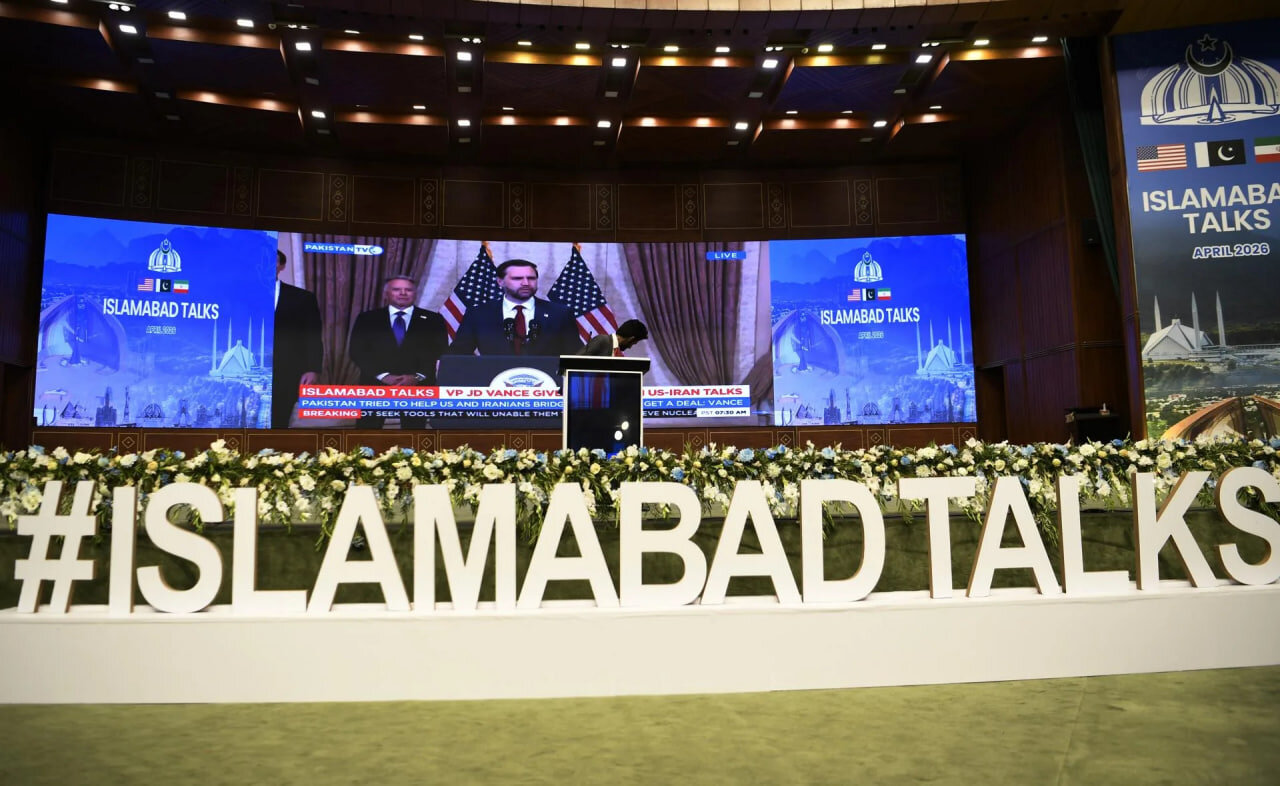
TEHRAN – The stalled negotiations between Iran and the United States remain at the forefront of global geopolitics, following Pakistan-mediated talks in Islamabad earlier this month that concluded without a breakthrough.
While Pakistan has intensified its diplomatic efforts to facilitate a second round of dialogue, progress remains elusive. Tehran maintains that the primary obstacle is Washington’s “excessive, unrealistic and unacceptable” approach, which fails to recognize the new realities on the ground.
The Islamabad meeting on April 11 occurred just days after a two-week ceasefire intended to halt the joint US-Israeli aggression that began on February 28. Although the truce was initiated after President Donald Trump initially accepted Iran’s comprehensive 10-point plan, he subsequently reneged on the agreement, imposing a naval blockade on Iranian ports. In a decisive display of sovereignty, Iran—which has maintained full control of the Strait of Hormuz since the conflict’s outset—closed the strategic waterway to all vessels affiliated with its adversaries.
The failure of the Islamabad talks can be attributed to five critical pillars of American intransigence:
The illegal naval blockade: The US naval blockade is not merely a provocation but a flagrant violation of international law. President Trump’s enforcement of this measure contradicts the fundamental principle of the “freedom of the seas” enshrined in the United Nations Convention on the Law of the Sea (UNCLOS). By attempting to choke Iran’s economy after a ceasefire agreement, Washington has demonstrated a bad-faith approach to diplomacy. Tehran rightly views this blockade as an act of war, justifying its defensive closure of the Strait of Hormuz to protect its national security.
The inalienable right to enrichment: Washington continues to demand that Iran cease all uranium enrichment on its own soil. This demand ignores Iran’s legal rights as a signatory to the Treaty on the Non-Proliferation of Nuclear Weapons (NPT). Article IV of the NPT explicitly guarantees the “inalienable right” of all parties to develop research, production, and use of nuclear energy for peaceful purposes. Iran’s insistence on domestic enrichment is a matter of scientific sovereignty that cannot be bargained away.
Sovereign control of stockpiles: The US insists that Iran’s stockpile of 60-percent enriched uranium—currently estimated at several hundred kilograms—must be removed from the country. Iran has firmly rejected this infringement on its territorial assets. From Tehran’s perspective, these materials are a testament to its indigenous technological prowess and serve as a vital guarantee against further Western “flip-flopping” on signed agreements.
A legacy of systematic mistrust: Iran’s mistrust of Washington is rooted in recent history and the latest aggression. The US launched a war against Iran in June 2025 and again this year, even while the two sides were ostensibly engaged in negotiations. Furthermore, the US military buildup continues unabated with the deployment of a third aircraft carrier, the USS George H.W. Bush, to the region. Trump’s intensified war rhetoric further proves that Washington prefers bullying over genuine diplomacy.
Netanyahu’s influence and domestic distractions: It is widely understood that Israeli Prime Minister Benjamin Netanyahu has been a primary architect of this conflict, egging on the Trump administration to avoid his own political demise. By fueling regional instability, Netanyahu seeks to divert attention from his financial corruption trials and the significant military blows Israel has suffered at the hands of Iranian forces and the regional resistance. Escalation serves as a shield to help him evade accountability for the security failures of October 7.
The reality of the severe blows
In response to the joint US-Israeli aggression, Iranian armed forces carried out 100 waves of missile and drone strikes against American bases in the Persian Gulf region and strategic sites in Israel during 39 days of war. The Trump administration has tried to play down the blows that the American military has received from Iranian retaliatory strikes. Despite the White House narrative, reports from the New York Times and NBC News suggest that Iran has delivered severe blows to the US military in the Persian Gulf. These admissions indicate that the Trump administration’s claims of neutralizing Iran’s military capabilities ring hollow.
Tehran remains open to talks, but only on the condition of mutual respect and the lifting of “pressure, threats, and blockades.” Foreign Minister Abbas Araghchi’s recent diplomatic tour to Pakistan, Oman, and Russia underscores this position. Following his meeting with President Vladimir Putin in St. Petersburg, Araghchi emphasized that Iran’s “red lines” are non-negotiable.
Even German Chancellor Friedrich Merz has acknowledged the shift in the balance of power, noting the lack of a clear American exit strategy. Merz observed that the Iranians are “obviously negotiating very skillfully” and are “clearly stronger than one thought.”
Ultimately, Iran’s military success and pragmatic diplomacy have forced the US to the table. As the wise and pragmatic actor in this theater, Iran has checked the Trump administration’s ambitions, proving that the era of unilateral dictates in the West Asia region has come to an end.
Disclaimer : This story is auto aggregated by a computer programme and has not been created or edited by DOWNTHENEWS. Publisher: tehrantimes.com



