
2.6 Seconds: Death in the Outback ★★★★★
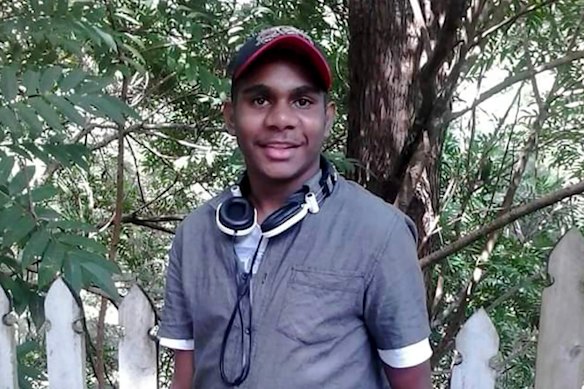
In 2019, in the remote outback community Yuendumu, a 19-year-old Warlpiri man, Kumanjayi Walker, was fatally shot by police constable Zachary Rolfe. It happened during a botched arrest just a few days after Walker had escaped from custody, threatened officers with an axe and returned to Yuendumu, which was already on edge after a spate of break-ins. Rolfe was charged with murder, almost immediately bailed and acquitted by a Northern Territory jury. All bar one of the 12-person jury was white.
That’s the broad outline of a tragic narrative, versions of which have played out many times before – in whole or in part – in Australia and elsewhere. It’s a story that is likely to elicit a host of reactions and conclusions on face value alone, its contours so familiar that specifics no longer seem to matter.
In 2.6 Seconds: Death in the Outback, director Darren Dale and writer Andrew Boe have crafted a masterful and epic documentary from the minutiae of the details. Their four-part documentary scrutinises with legalistic precision the events leading up to Walker’s death and the far-reaching fallout that followed.
It is a rigorous piece of journalism and a profound reckoning with how justice and policing had failed Walker and the wider community of indigenous Australians.
The documentary has been assembled from a wealth of sources; body-worn camera footage from police officers, courtroom testimonies, TV specials, a coronial inquest, as well as interviews by the filmmakers with witnesses, Walker’s family, reporters and authors. It offers up a view of the events that is simultaneously epic and deeply intimate.
Rolfe did not agree to be interviewed by the filmmakers, but his presence is stamped throughout the documentary. A key pillar of the story is how the paths of Rolfe – an overly confident and self-assured ex-army officer from an esteemed family in Canberra – and Walker – a vulnerable and troubled indigenous teen with myriad health issues – would cross with such dire consequences.
When Boe speculates on camera what might have been if they had met instead on a footy field, he’s tacitly acknowledging the complexity of policing in remote communities and the gulf between indigenous and non-indigenous Australia. Would an officer such as Rolfe, with a reputation for risk-taking and bending the rules, have been allowed to run a tactical response operation anywhere other than here? These are but some of the thorny questions that 2.6 Seconds poses.
It is at times confronting to watch, particularly in episode two, where body-cam footage and first-person recollections are used to reconstruct the night of the shooting. Episode four deals with the inquest, in which text messages, which were not presented to the jury in the murder trial, between Rolfe and other officers are brought to light. To say that the racist content of these exchanges is shocking is an understatement. But in neither case – and in contrast to many other true-crime shows – is there an exploitative element to these revelations. They are there to vividly illustrate institutional failures. Put simply, how can officers who hold such racist and disrespectful views of indigenous people be trusted to treat them with dignity and fairness?
Unlike some documentaries focused on social issues, there’s nothing vaguely polemical or doctrinaire in 2.6 Seconds. There’s no one spewing up prepared talking-points. Filled with detail, nuance and first-hand insights by people still reeling from what happened at Yuendumu, it avoids glib judgements and convenient assumptions to deliver what is arguably the most compelling social-justice documentary Australia has produced.
2.6 Seconds: Death in the Outback premieres at 8.30pm on Tuesday, November 10, on SBS and NITV and streams on SBS On Demand.
Want more TV? We’ve got you.
From our partners
Disclaimer : This story is auto aggregated by a computer programme and has not been created or edited by DOWNTHENEWS. Publisher: www.smh.com.au