Flood victim, 95, lived in Wetherspoons after her home was destroyed and died before she could return
-
Published
When neighbours hammered on Jean Powell’s door and evacuated her to safety because the nearby river had burst its banks and swamped her town, little did she know she would never return home.
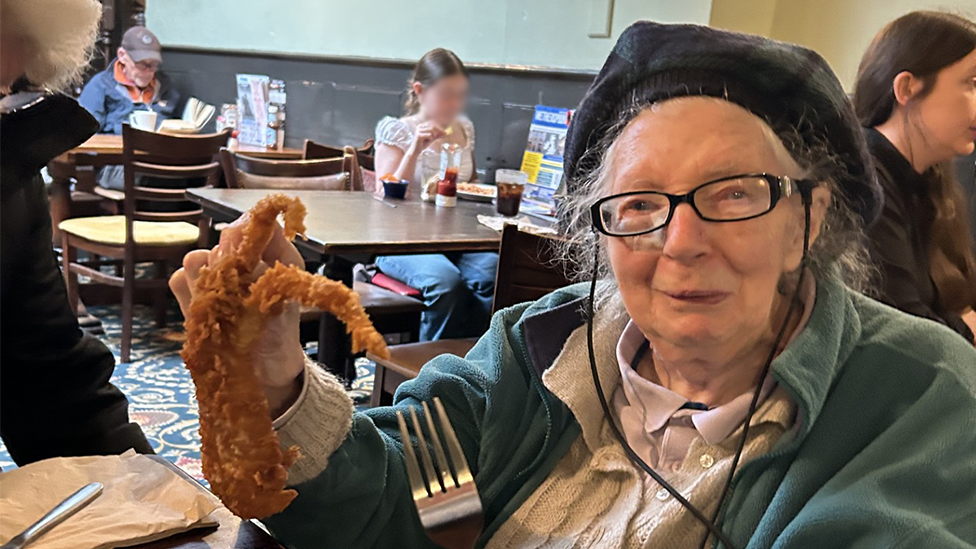
Jean sought a 10-month refuge at her local Wetherspoons but kept asking when she could go back to her flat, which was flooded when the River Monnow hit 18-times its normal level in south Wales last November.
But the 95-year-old never got to go back home and died in September – one of those who suffered a personal toll from the effects of being flooded.
“Jean used to say, when am I going home?” said friend and neighbour Wyn Smith. “All she wanted to do was come back home and we couldn’t fulfil that.”
To play this video you need to enable JavaScript in your browser.
This video can not be played
Jean was forced out of her home when the river hit record levels in the early hours of November 15 last year as a major incident was declared after almost a month’s worth of rain fell in 24 hours.
It has been officially described as a one-in-75-year event when the river flooded more than 400 properties in Monmouth during Storm Claudia – and overwhelmed the defences that were built 35 years ago to protect the centre of town.
Jean, like many in the small town near the Wales and England border, was rescued and after sleeping the night on her neighbour’s chair sought temporary sanctuary in Monmouth’s Wetherspoons as she had no close family to look after her.
“She was happy in the beginning because she was in town where she wanted to be,” recalled Wyn, who visited her friend staying in one of The Kings Head’s hotel rooms most days.
“The Wetherspoons staff were brilliant with Jean, they’d take her food and really looked after her.”

“We never thought she’d be there that long,” said Wyn. “It’s nobody’s fault, it took a long time to dry her home out. It had to be done properly.”
Residents have been with family, some are in rented accommodation, some have been in an Airbnb while another is in a care home.
Their story is typical of many in Monmouth who have been out of their home since Claudia struck – and that trauma and anxiety from the devastation of 12 months ago is never far from the surface.
“Some had been through the war and they said it upset them more than that. It was just awful,” said Wyn.
 Image source, Gillian Haycock
“But unfortunately it could happen again. There’s that fear. If they see water coming, it’ll freak them out. They need to feel at home and not worry about the weather.”
The Met Office estimates that with current levels of global warming, record-breaking wet winters have gone from once in 80-year events to once in 20-year events.
Wales’ environmental body has warned long-range forecasts indicate an increased likelihood of wetter, windier weather than usual this winter with Natural Resources Wales (NRW) saying people should prepare for “the unthinkable”.
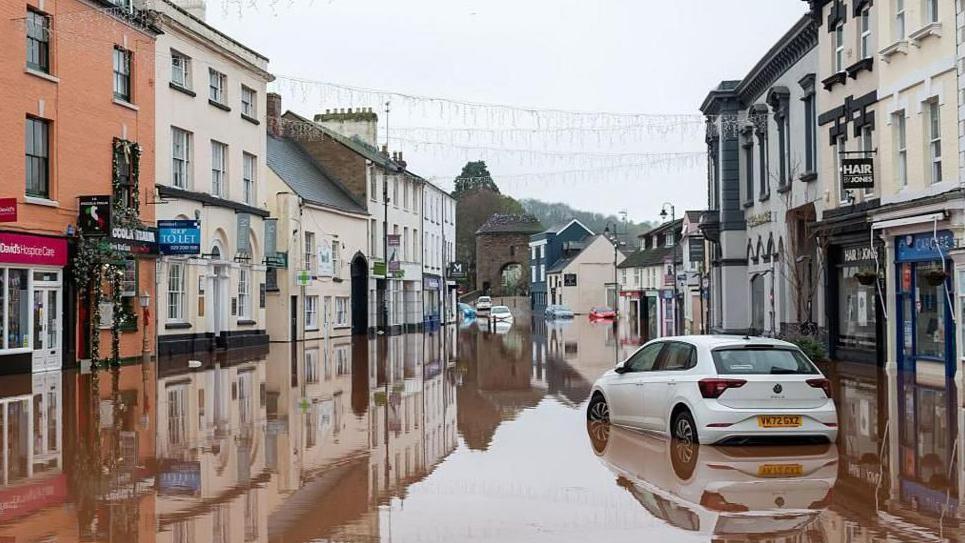 Image source, Getty Images
Apart from three nights at the local Premier Inn over Christmas when Wetherspoons was shut – where Jean had sandwiches from the nearby petrol station for Christmas dinner because she wanted to “remain independent” – she stayed above the pub in the town’s main square for almost 10 months.
“As time went on, living in one room was awful for her,” recalled Wyn, 70.
“When Jean got ill, it wasn’t a place for her to live. Her health deteriorated and she didn’t come back home, which is sad.”
Jean’s death will be acutely felt when the first displaced residents return to the Chippenham Court retirement complex she called home following its £1m refurbishment in the next few weeks.
To play this video you need to enable JavaScript in your browser.
This video can not be played
One in seven properties in Wales are at risk of flooding, including the Frost household on the other side of Monmouth where Emily says she and her young family will never recover from being evacuated on a lifeboat last year.
The mum-of-two breaks down as she recalls being woken by the coastguard telling her she’s got five minutes to evacuate her family as the floodwaters surge towards her end-of-terrace cottage.
“Opening the door, I completely freaked out to the lifeguard,” Emily told the BBC.
“They were waist deep in water and said our house was at risk. I just needed to get our boys, who were then aged three and five, and they’d be back with a raft. We didn’t have time to think about it.”
What was supposed to be a night of celebration for her and husband Jake’s 10th wedding anniversary, turned into a nightmare.
 Image source, Emily Frost
Emily and Jake didn’t take their boys when they returned home the following day where more than a foot of water had penetrated their home.
“There was sludge and mud everywhere,” she recalled.
“We didn’t bring the boys home for a good while because we didn’t want them seeing everything that they’d treasured had been destroyed.
“It was the toll it would take on them that worried us the most.”
The Frosts lived in rental accommodation nearby for six months as they ripped out the downstairs of their home and started again.
Emily and Jake, who had also been flooded in 2020, have seen their boys “playing floods” so know their children have been “trying to process” their ordeal.
 Image source, Emily Frost
“They couldn’t really understand why we weren’t able to go home or have their things” said Emily.
“Because it’s the time of year, even now when it rains they’ll ask “are we staying home, is it okay? Luckily they’re resilient as kids, but you still worry. People don’t recover, it’s something you’ll just live with.”
Environmental bodies estimate about 275,000 properties in Wales are at risk of flooding with another 400,000 in Scotland, while in England about 6.3 million properties – around 11.3m people – live in flood risk areas.
An official report said the River Monnow swelled to more than six-and-a-half metres after significant rainfall locally and upstream over the Black Mountains during a week where more than half-a-dozen Met Office rain warnings were issued.
Jennifer and Alan Morgan’s 18th Century cottage near the banks of the Monnow had two more doors to hang after a five-year renovation when Claudia struck and they had to start it all again.
 Image source, Jenny Morgan
“I’ve not slept well for a year as it’s been an absolutely living nightmare,” said Jennifer, 70.
“The flooding was awful and the renovation has been so stressful, it’s had a huge impact on us. We’re not anywhere near to going back home, we probably won’t be in until next summer.
“People might think because some of the shops and businesses are open that Monmouth is back to as it was before, but that’s not the case – and we’re proof.”
 Image source, Kim Kaos
The official Section 19 report, external into the flooding said flood warnings – where action is required as properties are in danger of flooding – were issued for all of Monmouth hours before the floods hit.
Wales’ highest state of flood alert – the “risk to life and significant disruption” severe flood warning – was issued by NRW for the northern part of Monmouth on the Friday evening.
The severe flood warning for the rest of Monmouth was issued at 03:31 on the Saturday morning – but that was more than two hours after its flood defences were breached and after shops and homes had been flooded.
Emily had signed up to NRW’s free flood alert service, external but went to bed because at midnight the rain had stopped and there was no water visible – half an hour before her young family were evacuated.
 Image source, Getty Images
“When it stopped raining everyone probably thought ‘oh well this has passed and we don’t need to worry’,” she said.
“Then the deluge of water just appeared from nowhere. It just shows how quickly it can change.”
The official report recommended a review of the timing of severe flood warnings throughout the Monnow catchment “to ensure adequate advance notice is provided for people to respond effectively.”
It also called for a review on the “uptake and understanding” of the flood warning service for those who live and work near the River Monnow.
NRW has said it reviews their “response, recovery and flood warning thresholds” after every serious incident to “identify lessons”.
Of the one in seven properties in Wales classed as being at risk of flooding, NRW said less than a third of those eligible to receive flood warnings to their phone or email were currently signed up.
 Image source, Geograph | David Medcalf
NRW argues Wales’ geography makes it particularly vulnerable – with a vast coastline and “fast-responding” rivers which can fill at speed as rain runs off steep terrain in places like the south Wales valleys.
The official report also recommended a review into whether Monmouth town centre defences are fit for purpose.
“We’re looking at our flood modelling and if there’s anything else that can be done,” said Sara Pearson of NRW.
“We’re seeing flooding that we’ve never experienced before and with climate change that’s set to increase. We can’t prevent flooding, but we can help minimise the impact.”
The Welsh Government has said it is spending almost £1.4m in flood risk management in Monmouthshire, including £700,000 of NRW funding for works at nearby Skenfrith.
“We have made £85m available this year to Natural Resources Wales and local authorities for flood and coastal erosion schemes across Wales,” the government said in a statement.
NRW have said they’ve done work to clear rivers while the local council insist they’ve got more workers out clearing ditches, gullies and drains.

“We know how serious this is and how worrying it is for people,” said Catrin Maby of Monmouthshire council.
“If it was only down to drain clearance we wouldn’t need to worry. We need to look at the engineered defences again, we need to look at how we manage the land, we need to allocate sufficient resources into drainage and clearing those drains.”
Insurance companies in the UK paid out £565 million to help homeowners recover from storms and floods in 2025 – and Emily’s home is one of them with flood defence measures in place like flood gates and flood doors after advice from Flood Mary, external.
“I feel safer,” added Emily. “I’ll still be very apprehensive when you get the flood alert, it’s whether you’re gonna go back to that time or not.
“But you don’t feel safe, which you should do in your own house.”
More top stories
-
-
Published3 hours ago

-
-
-
Published11 hours ago

-
-
-
Published6 hours ago

-
Disclaimer : This story is auto aggregated by a computer programme and has not been created or edited by DOWNTHENEWS. Publisher: newsrss.bbc.co.uk