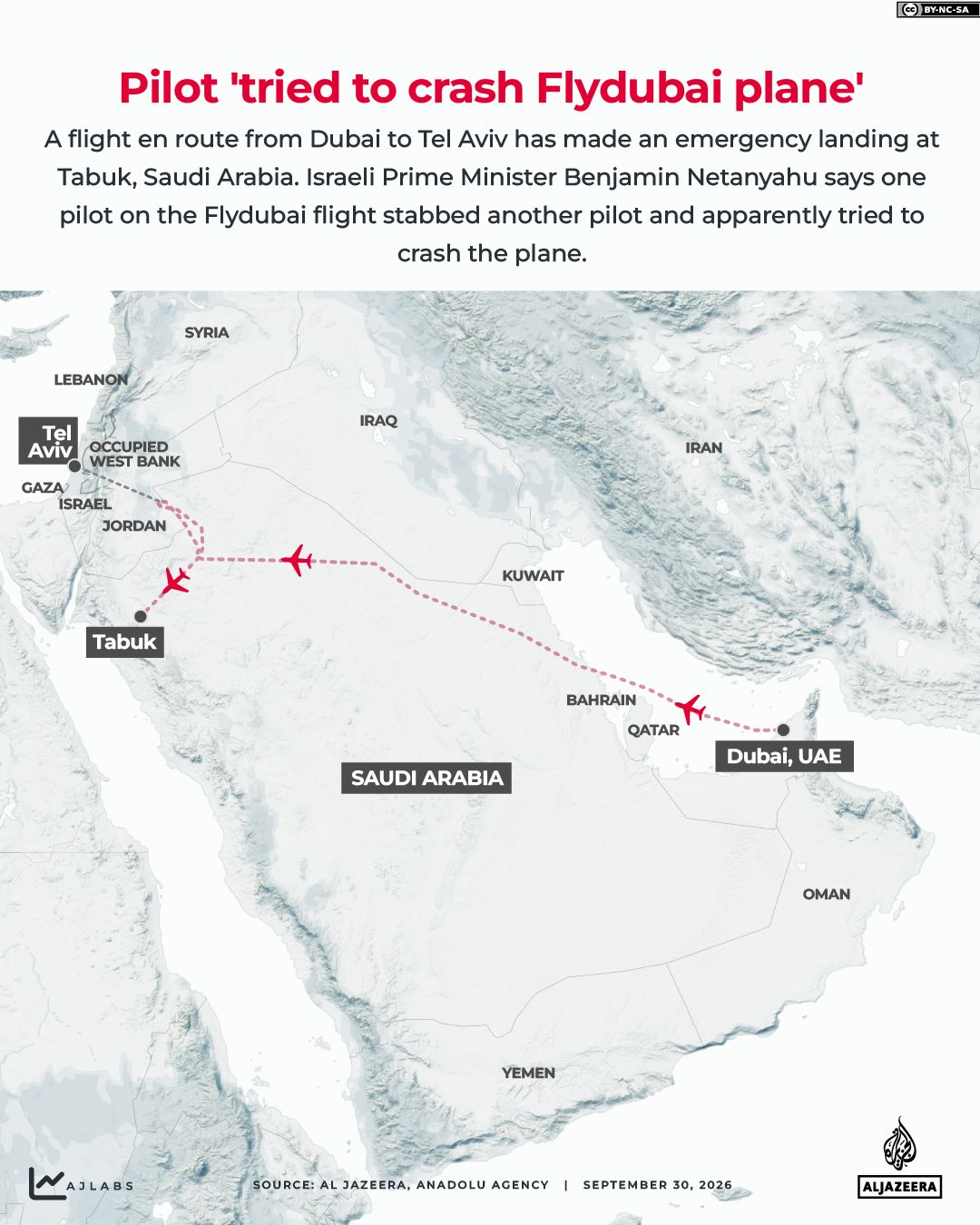
On Wednesday morning, a co-pilot aboard a Flydubai plane stabbed the captain in what is believed to have been a foiled attempt to crash the flight with more than 170 people on board, en route from Dubai to Israel’s Tel Aviv.
As the plane plunged, within a minute, to half its altitude amid the commotion as it approached Jordanian airspace, the captain managed to unlock the door to the cockpit, and a group of passengers and crew members stormed inside and overpowered the attacker, who was reportedly attempting to damage the controls.
The aircraft also emitted an emergency distress signal during the incident.
Another pilot on board managed to take control of the aircraft and land it safely in Saudi Arabia’s Tabuk.
While the United Arab Emirates, the airline’s host country, has begun an investigation into what happened, Saudi authorities are questioning the co-pilot who allegedly attacked the captain. The attacker was also injured and is now in Saudi custody. Israel’s Prime Minister Benjamin Netanyahu said the country would follow the investigation and “possibly participate”.
Israel has claimed the incident on board the plane, the majority of whose passengers were Israeli, was a “terrorist” attack and an attempt to crash the aircraft.
Meanwhile, the incident on board Flydubai flight FZ1073 has raised a host of uncomfortable questions in the civil aviation industry, chief among them: how safe is a commercial aircraft when one of its own pilots turns violent?
How has aviation changed since the terrorist attacks of 9/11?
Twenty-five years ago, the September 11 attacks on the United States, which killed nearly 3,000 people, changed the civil aviation industry.
Advertisement
That day, al-Qaeda-affiliated hijackers took control of four commercial planes as they were in the air, crashing two into the twin towers of New York’s World Trade Center on Manhattan island, and another into the Pentagon. A fourth crashed in Pennsylvania after passengers overwhelmed the hijackers.
The attacks transformed aviation security, which stepped up its focus on preventing unauthorised access to aircraft flight decks, as well as strengthening security and boarding procedures within airports.
Within months, the International Civil Aviation Organization (ICAO) had overhauled the global aviation rules, extending security measures for domestic flights and introducing bulletproof, reinforced cockpit doors, personnel vetting and airport identity checks.
The most consequential physical change was the reinforced, lockable cockpit door, designed to resist forcible intrusion, followed by a mandatory 100 percent screening of checked baggage.
Airports increased employee screening, baggage and cargo security, and aircraft protection, while ICAO introduced mandatory security audits to assess how countries were implementing the new global standards.
In 2015, Germanwings Flight 9525’s first officer Andreas Lubitz locked the captain out of the cockpit and deliberately flew the Airbus A320 they were piloting into the French Alps, killing all 150 people on board.
France’s BEA determined that the aviation industry’s medical-certification system had failed to prevent a pilot experiencing a serious mental disorder from operating with a licence.
Following that incident, the European Union Aviation Safety Agency (EASA) temporarily recommended that at least two authorised people remain in the cockpit at all times. But the following year, the EASA moved the rule to a risk-based approach only, allowing airlines to adopt equivalent safeguards based on operational risks.
The Germanwings incident also triggered broader measures in Europe: from 2018, airlines were required to conduct psychological assessments before pilots began flying and introduce psychoactive substance and alcohol testing.
Some flights also carry air marshals – or “in-flight security officers” – who are generally covert, armed law-enforcement officers placed on selected flights depending on a country’s threat assessment.

How secure are cockpit doors?
Cockpit doors are made to be particularly difficult to penetrate, as standard. On modern commercial aircraft, the cockpit door is built to be a heavy-duty composite structure mounted inside a reinforced frame, and electronically controlled, designed to resist forcible intrusion and penetration by small firearms. The cockpit door can usually only be opened from the inside.
Advertisement
On Boeing 737 aircraft, the flight-deck access system normally remains in AUTO mode during the flight, keeping the reinforced cockpit door locked. Cabin crew can ask pilots to grant them entry through the access system.
ICAO standards require that such doors can be locked or unlocked from either pilot station.
An emergency keypad also allows crew to initiate an emergency entry sequence to enter the cockpit. If a functioning pilot does not cancel the emergency request, the system would permit emergency access, but only after a built-in delay.
These systems are designed to keep an attacker out of the cockpit – not to stop a threat already inside it.
On the Flydubai flight on Wednesday, the Indian pilot who had been stabbed reportedly managed to open the cockpit door during the attack, which “enabled passengers and crew to overpower the attacker – preventing a catastrophic midair disaster”, Israel’s Prime Minister Benjamin Netanyahu, who hailed the captain as a “hero”, told the media.

What happens once a pilot raises the alarm?
It depends on the type of emergency in the aircraft. Under ICAO procedures, a crew can declare an emergency by radio using the signal “MAYDAY”.
In cases of medical or technical issues, pilots use the transponder code 7700 to alert air traffic control that they need to land as soon as possible, said Saj Ahmad, chief analyst at StrategicAero Research, a London-based aviation consultancy. “Often, passengers are oblivious to this as there’s no need for alarm,” he added. This is the code that the Flydubai craft emitted as it was descending sharply, according to the flight monitoring service Flightradar24.
If the emergency is an attack or hijacking, the aircraft can transmit transponder code 7500, which flags the flight to air traffic controllers as being subject to unlawful interference, added Ahmad. “The crew can also communicate the nature of the threat and their intentions in plain language,” he said. The Flydubai craft switched to this code a few minutes after issuing the first code, according to flight data.
If code 7500 is the input, air traffic control is alerted to an “interference with the flight or a possible hijack in progress, and often ATC will divert other jets away so that the squawking jet can land”.
Flydubai’s 7700 emergency warning was sent at 5:28 GMT, followed by 7500 at 5:35 GMT, according to FlightRadar24, leading to the initial reports of a possible hijacking of the flight en route to Israel.
The cabin crew’s duties in such emergencies cover pilot incapacitation and security threats, including protecting the flight deck and communicating with the operating pilot.
But the nature of violence in or near the flight deck can vary, Ahmad said, as “often the strategy is to open the door so that other crew members can assist”.
Violence between the pilots inside the cockpit leads to a worst-case scenario, he said: “Where both pilots are unable to fly, the consequences are pretty self-evident if no one is flying the airplane.”
Advertisement
The Flydubai aeroplane was ultimately safely landed by two other pilots who were on board. That is the equivalent of lightning striking once, Ahmad suggested. “It is frightening to think of what the outcome would have been if those additional pilots were not there to take control.”
What checks do pilots undergo?
Before being granted a Class 1 medical certificate necessary for their licence, pilots undergo an aeromedical assessment covering vision, hearing, cardiovascular and neurological health, and other conditions that could cause sudden incapacitation.
Aviation security rules also require background checks for all personnel who have unescorted access to security-restricted areas.
“Frequency of health checks varies, but standard health checks like height, weight, blood pressure, psychological testing, psychometric testing, as well as fitness, are minimum evaluations that all pilots undergo, as well as drug and drink testing,” said Ahmad of StrategicAero Research.
After the Flydubai incident, Ahmad said that “Israel will probably insist on specific nationalities for flight crew going forward” as well.
Israel has already said it will ramp up security checks on pilots flying into the country. “Every pilot that is going to be flying into Israel, we are going to know the pilots’ identities, know who they are, and do some type of security check,” Doron Spielman, a spokesperson for the Israeli Prime Minister’s Office, said.
“I can see Israel demanding details of flight crews before a flight even departs, with full and even more invasive security checks and ensuring pilots who fly there are from nations where diplomatic relations with Israel exist,” Ahmad told Al Jazeera.
“This sort of cross-vetting isn’t usually a thing, but after this Flydubai incident, it makes sense now to explore whether wider sharing of pilot details and backgrounds to other aviation regulators in other countries could be standardised to further advance safety measures,” he added.
Pilot-on-pilot violence is not completely unheard of. There have been punches thrown, collars grabbed and arguments. But a co-pilot stabbing his captain in mid-flight in an attempt to seize the aircraft is an extraordinarily rare form of aviation security incident, analysts said.
Disclaimer : This story is auto aggregated by a computer programme and has not been created or edited by DOWNTHENEWS. Publisher: aljazeera.com