The Republicans have built up a huge cash reserve that they hope will rescue them in the final days of the midterm election campaign. But Democrats have their own financial advantages.
Des Moines, Iowa: Although he has been dead for seven years, Jeffrey Epstein has become a central figure in the US midterm elections.
In the Midwestern state of Iowa, Democratic attack ads accuse Republican members of Congress Zach Nunn and Ashley Hinson of protecting paedophiles by blocking the release of the so-called Epstein files.
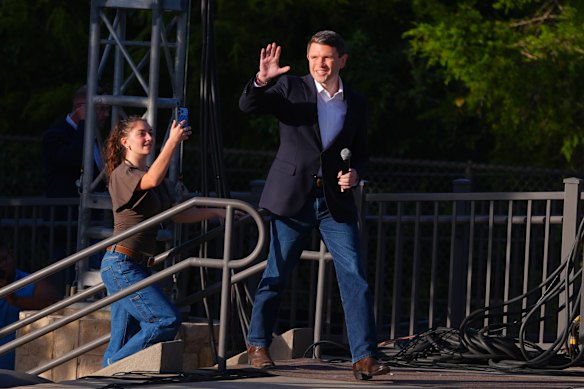
Both eventually voted to release the files after US President Donald Trump gave the OK. Hinson, who is in a tough race for the US Senate, hits back at Democrat Josh Turek in her own ad.
“Men like Epstein who hurt children – they’ll have to answer to God,” she says. “But men who lie about it to win an election? They’ll have to answer to you.”
Epstein fuels dozens of TV ads across the country. But it’s not just him. On Wednesday night in Des Moines, during a Dolly Parton tribute show, the late news and Jimmy Kimmel Live!, most of the commercials on the ABC are election ads. Ads for the Senate, governor, House of Representatives, state attorney-general, and state Senate races. There is little respite.
It is easy to see how this midterm election is on track to be the most expensive in US history. AdImpact, which tracks advertising spending, forecasts that $US11.6 billion ($16.4 billion) will be spent on ads alone in the 2025-26 election cycle – surpassing the $US11.2 billion spent in the 2024 presidential election. Spending on aired and future reservations crossed the $US10 billion mark last week.
With Democrats striving to take control of the US Senate and Republicans desperate to cling on, races for that chamber have accounted for more than 60 per cent of ad spending aired so far. As well as aligning with the biggest population centres, the expenditure shows which contests the parties believe are tightest.
As of October 16, AdImpact said more than $US452 million had been spent on ads for the Senate race in Ohio, where Jon Husted (who replaced JD Vance in the seat) is in a tough battle against Democrat Sherrod Brown.
Meanwhile, $US342 million was spent in Texas, where James Talarico has a real chance of becoming the first Democrat elected to the US Senate from that state since 1988, $US205.8 million was outlaid in Michigan, and $US204.2 million in Maine.
The figures don’t include primaries and run-offs. Across the entire 2025-26 election cycle, more than $US500 million has been spent on the Texas Senate race, and it is set to pass the 2024 Ohio Senate race as the most expensive non-presidential election ever.
Keeping track of fundraising and spending is a complex business, as candidates’ campaigns operate alongside political action committees (PACs) run by party headquarters or outside groups and individuals.
The Republican Party enjoyed a massive cash advantage coming into the midterms. Its central PAC for Senate races had roughly $US100 million more in the kitty than the Democrats’ equivalent at the end of June, and the House fund about $US50 million more.
The Republican National Committee had a healthy $US130 million in the bank. Meanwhile, the Democratic National Committee was broke. Last year, it used its Washington headquarters to secure a $US15 million loan. It was only this month that it again had more cash on hand than debt.
“It’s hard to imagine how an organisation like the DNC could not raise money when you have President Trump in office, but that is what it is,” said Morgan Jackson, a Democratic strategist based in North Carolina.
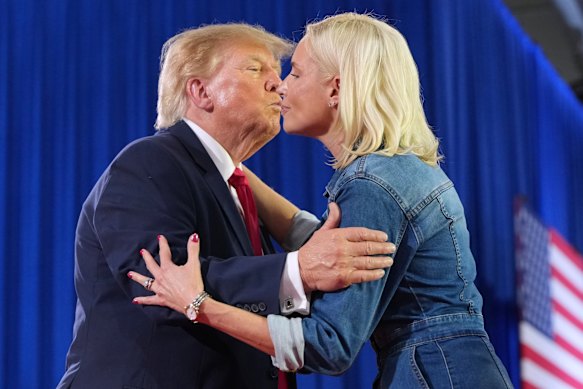
The Republicans have another advantage: the fundraising juggernaut of Trump’s super PAC, MAGA Inc, which had $US415 million cash on hand at the outset. It was slow to begin spending money, but by mid-October, it had disgorged about $US300 million. There is no real Democratic equivalent.
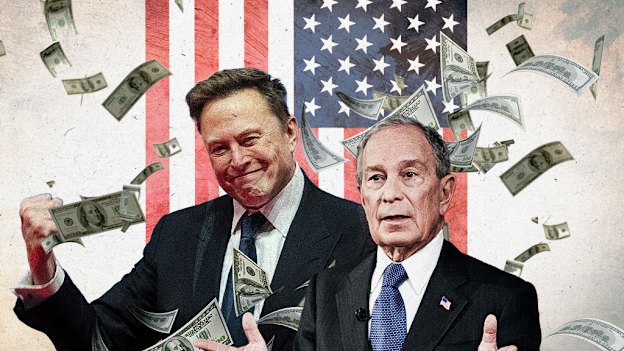
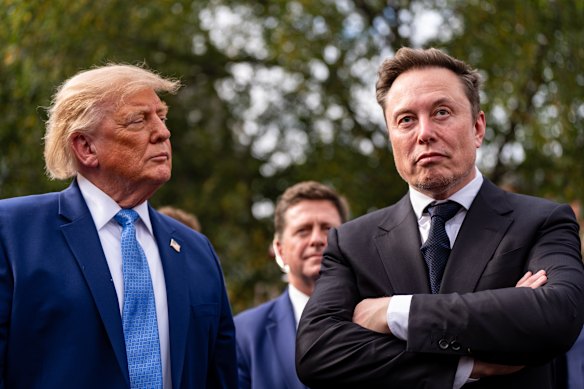
And then there is Elon Musk. The world’s richest man has ploughed at least $US366 million into Republican campaigns this election cycle, including more than $US276 million since July 1, filings to the Federal Election Commission (FEC) show.
That included two payments to the Senate Leadership Fund PAC, the Republicans’ main vehicle for Senate campaigns: $US75 million on September 9 and $US83 million on September 23. The payments, $US158 million in total, were transferred the next day to the campaign to elect Ken Paxton over Talarico in Texas.
“Elon Musk is trying to buy this Senate seat,” Talarico said this week. “There is something deeply wrong with a political system that allows one trillionaire to buy his own personal US senator.”
It’s not just money. Musk has used his massive following on the social media platform he owns, X (formerly Twitter), to denigrate Talarico as a “creep” and promote a conspiracy theory that Talarico spent 10 days in a mental health facility during the campaign.
Musk is the largest known donor to this midterm campaign by a wide margin. But there are others. MAGA Inc received $US8 million from property developer Steve Wynn in September, $US5 million from both Blackstone chief executive Stephen Schwarzman and businesswoman Diane Hendricks, and $US1 million from US-born crypto entrepreneur Bijan Tehrani, who lives in Melbourne.
On the Democrat side, businessman and former New York City mayor Michael Bloomberg chipped in a handy $US80 million in September and October, The New York Times first reported. Bloomberg famously spent $US1 billion on a failed 2020 presidential bid.
But while Democrats do use PACs, they typically raise their money through direct contributions to individual candidates’ campaigns. That is why almost all the top-raising candidates on the FEC database are Democrats, led by Jon Ossoff in Georgia and closely followed by Talarico. The only Republican to scrape into the top 10 was incumbent senator Susan Collins in Maine.
It has been this way for years, but in this election, it is pronounced. Talarico’s campaign raised far more than Paxton’s in the September quarter – $US60.2 million to $US10.2 million, FEC records show. In Ohio, Democrat Sherrod Brown raised $US23.1 million while Republican senator Jon Husted raised $US4.8 million.
Even in the red state of Kansas, Democrat Adam Hamilton raised $US9.4 million from July to September, much more than Republican incumbent Roger Marshall, who raised only $US800,000. Across all the tightest Senate races, Democrats out-raised Republicans multiple times over.
This carries another advantage for Democrats because, under US regulations, candidates typically enjoy much lower prices on the ads they buy than the PACs and super PACs. They must be offered the “lowest unit cost”, sometimes referred to as the “candidate rate”.
“It is much lower than the market rate. It is essentially closer to at-cost,” says Sean Cooksey, a Republican strategist and former chair of the FEC appointed by Trump. In highly contested elections in a big market, the cost differential can be “quite large”, he says – upwards of 10 times.
“You can imagine the most important football game in one of the closest, most contentious jurisdictions or races – there’s going to be very significant demand for that ad space, obviously very limited supply,” Cooksey says.
“You end up in a situation where advertising dollars used by the candidates themselves go a lot further and can purchase more ad space dollar for dollar compared to any other independent group.”
Earlier this year, the Federal Communications Commission, headed by Trump ally Brendan Carr, changed the rules to allow party organisations and joint fundraising committees to access the lowest unit cost.
The change was challenged by the Democrats in court, but has so far survived and is in place for this election. The Supreme Court also removed caps on co-ordinated spending between candidates and party HQ.
For example, the Republican National Committee last week bought $US3.8 million worth of ads for Hinson’s campaign in Iowa. “This marks the first time on record that the RNC is running a co-ordinated ad buy with a non-presidential candidate,” AdImpact said in a recent memo.
The question, then, is whether fundraising by Democratic candidates – and the better bang they can get for their buck on TV and radio – can make up for the enormous cash advantage enjoyed by Republicans at party HQ and through their super PACs and mega donors.
To date, Republicans have vastly outspent Democrats in the eight most competitive Senate contests – by about $US300 million, according to AdImpact.
“Republicans have aired more broadcast TV ads than Democrats in every battleground Senate general election except Ohio,” the group’s latest report said. In Ohio, although Republicans spent tens of millions of dollars more than Democrats, Democrats aired 200 more ads.
Cooksey, the Republican strategist, says both parties are now facing diminishing returns because of the huge amounts of money being spent and the onslaught of advertising hitting voters. “Once you have four commercials during a single football game, there is very limited utility to buying a fifth.”
But Cooksey defends the behaviour of mega donors such as Musk. He says there’s no evidence that any amount of money will change the will of voters, “other than at the margins”.
Why do both parties raise and spend so much money, then? “It’s a bit of an arms race,” he says. “Part of it is to create equal and opposite opportunities to counter-message the other party.
“People are very motivated, and there’s a lot at stake in American elections. And it matters at the margin. No one would dispute that a campaign with $US100 million will have some marginal advantage over a campaign with $US1 million.”
Cooksey knows the sums seem gigantic, but he says they have to be put in context. If Republican tax cuts were worth $US1 trillion, for example, one would expect people to spend nearly that amount to make them happen.
“Given the size of the American economy, given what’s at stake legislatively in America, given the value of different policy outcomes in the real economy, it’s sort of surprising to me that people don’t spend more,” he says.
Nonetheless, Morgan Jackson, the Democratic strategist, notes the Republicans’ cash advantage is not moving the needle in key Senate races, including in his state of North Carolina, where the GOP has moved funds away from its candidate, Michael Whatley, to spend in Kansas instead.
“Money is not making the difference,” Jackson says. “I’ve seen Republican consultants who have said the more money they spend … the Democratic candidate continues to grow in the polls.
“The fact that we’re talking about Kansas today, Alaska, Iowa and Texas – states that were firmly in [the] Republican column for years and are now tilting blue this cycle – I think goes to show you that voters are desperate for change.”
Read more on US politics:
Get a note directly from our foreign correspondents on what’s making headlines around the world. Sign up for our weekly What in the World newsletter.
Disclaimer : This story is auto aggregated by a computer programme and has not been created or edited by DOWNTHENEWS. Publisher: www.smh.com.au