
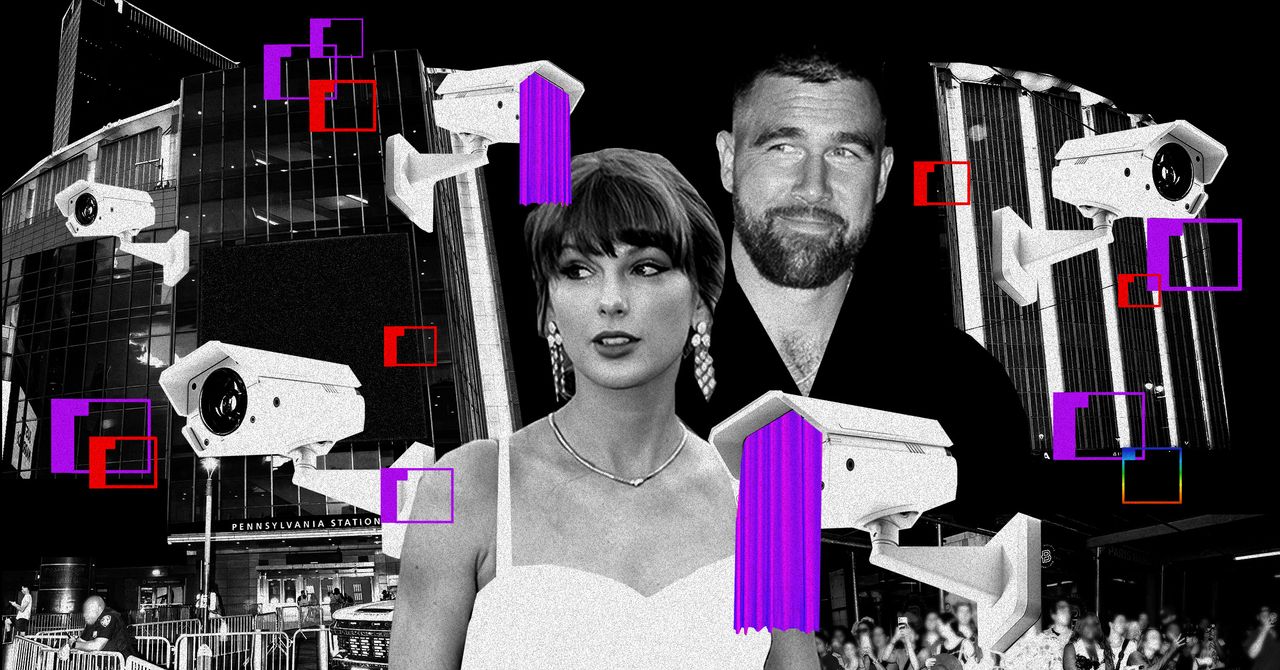
Madison Square Garden owner James Dolan has insisted that the face-recognition system and array of surveillance cameras deployed at his venues is “very, very useful for security”—a big reason why MSG “is the most secure venue in the country.”
On the night of July 2, security in and around the Garden was particularly intense. Roughly 130 cops were deployed to the area. New York City officials were preparing to shut down the surrounding blocks to both vehicles and pedestrians the next day for a major, major event.
July 2 was, of course, the kickoff to Taylor Swift and Travis Kelce’s wedding celebration, an approximately 100-person rehearsal dinner at Madison Square Garden’s Infosys Theater. And yet, on that extremely sensitive evening, Dolan’s MSG locked nearly all of its security team out of the network of surveillance cameras inside the arena, according to an internal document reviewed by WIRED. The move functionally prevented MSG security from fully operating the venue’s controversial face-recognition program that evening, two sources familiar with the Garden’s operations say.
While the shutdown order reviewed by WIRED only applied to July 2, those sources add that they were told the lockout was repeated on July 3, Swift and Kelce’s wedding night, which drew roughly 1,000 of the biggest names in media, music, business, and sports.
At every stage of their planning, Swift’s and Kelce’s teams went to extraordinary lengths to keep private what happened inside the Garden. Guests had to sign a nondisclosure agreement before they could receive a digital invitation. Tents were set up for cars to park in, so people could move in and out in relative secrecy (and, presumably, avoid the biometric surveillance gear positioned at the standard entrances). Wedding attendees were told there was a no-phone policy. The only detailed description of the event posted by a wedding night guest was quickly deleted.
According to the internal document, an MSG executive ordered on July 2 a seven-hour lockdown of the Garden’s video management system, made by the security tech company Genetec, “due to a client privacy request.” Security staffers who ordinarily monitor the building’s internal cameras and the accompanying face-recognition software were barred from doing so. The memo states that only a handful of company leaders and engineers were allowed into their Genetec accounts. The rest were “disabled.”
“If you somehow still have access to cameras after 3PM, you will be forcibly logged off,” the document warned MSG security personnel.
Since 2018, Dolan’s company has experimented with biometric surveillance at its venues, which include Radio City Music Hall and the Beacon Theater in New York, as well as the Sphere in Las Vegas. The organization contends that the technology is a security measure, but there are many publicly documented cases where the face-recognition system appears to have been for something else: retribution.
Fans who’ve been critical of Dolan have had their faces captured and then put on watch lists. A lawyer representing a cop was banned in April because his client is suing MSG. A mom trying to take her then 9-year-old Girl Scout to a Christmas show at Radio City Music Hall had her face flagged and was blocked from entering. The reason: She was an attorney, and her firm was in a legal dispute with one Dolan-controlled entity.
Genetec’s software serves as the backbone for MSG’s video security system, monitoring feeds from the various cameras and allowing security personnel to manage the applications that rely on those feeds, including face recognition. Cameras at the guest entrances are tied into a face-recognition system made by eConnect. If someone’s face triggers an alert, Genetec then allows that person to be easily tracked across the camera network. According to a person familiar with the security surveillance setup, “This makes it much easier to track a person, because we can jump from camera to camera in real time and follow them.”
As WIRED previously reported, Garden security used these systems to monitor a transgender woman second-by-second when she was in the arena. The cameras even noted when she went in and out of a bathroom.
Attendees at the Swift-Kelce pre-wedding celebration were spared such prying eyes. Civil libertarians say they understand why the couple might not want Dolan’s surveillance system deployed in full. But those activists see the accommodation as more than a one-off. It’s a preview of “a future where privacy is a luxury for the elite few and the rest of us are subjected to pervasive surveillance everywhere we go,” says Evan Greer, director of the digital rights group Fight for the Future.
MSG’s venues host private events not infrequently. NBCUniversal takes over Radio City Music Hall every year to preview its shows for the next season; Warner Bros. Discovery goes to other Dolan-owned properties. But those customers did not ask to disable any aspect of the Garden’s security system, according to a source with direct knowledge of the matter. “It has never been done,” the source says, reflecting on their years at MSG, “and the request wouldn’t have been entertained.”
Even when the New York Police Department takes over Madison Square Garden, the cameras have stayed on. The NYPD regularly holds its graduation ceremonies from the Police Academy within the arena. As WIRED previously reported, the MSG face-recognition system contained a photograph apparently taken from one of those events. It shows an officer in his Police Academy dress uniform.
Which would make this celebration an outlier.
There’s the argument that Swift and Kelce, two of the planet’s most famous people, bought some modicum of privacy for themselves and their guests when they spent the estimated $1.2 to $1.6 million to book the Garden. It’s a venue with “some unique advantages,” former NYPD intelligence official John Miller noted for CNN. “The Garden has no windows, is covered by a roof, and access to the venue can be tightly controlled. That limits the ability of paparazzi, helicopters with powerful, long-distance cameras, or drones to capture the kinds of images they have at other celebrity weddings in outdoor venues.” Of course, for that money, they could have reserved any number of islands more private than Manhattan, and an event space more discreet than the so-called “World’s Most Famous Arena.”
“People who have their wedding at Madison Square Garden don’t make that choice for privacy,” says a security professional who is deeply familiar with the venue.
Early July was a particularly hectic time. The city was considered to be in a “heightened threat environment” by the New York Police Department, because of the America 250 celebrations and ongoing war with Iran. (That threat estimate is presumably one reason why the cameras outside the Garden—which can be accessed by the NYPD—stayed on, according to the memo.) Swift’s presence, of course, amped up the stakes enormously. In May, a man was sentenced to 15 years in prison for planning an attack at her concert in Vienna.
The Garden’s interior camera network is supposed to help in those situations, and more. What if someone snuck into the ultra-exclusive event? What if that person was a real threat to the people inside? Dolan, in a 2023 interview, told a local news anchor that the combination of surveillance cameras and face recognition did important work to keep such dangerous people out: “Are you someone who is on this list? If you’re a terrorist it’ll say, ‘That’s a terrorist.’”
But the NYPD supplies no such data to the Garden, a department spokesperson previously told WIRED. While some photographs from the FBI’s most-wanted list have been uploaded into the system, a lawsuit from a former MSG security staffer contends that was done to establish “an after-the-fact false narrative” that the face recognition was primarily geared towards stopping hostile actors, rather than individuals Dolan perceived to be personal threats.
“Clearly the technology is not that helpful if it wasn’t needed at one of MSG’s highest-profile events of the year,” Michelle Dahl, executive director for the Surveillance Technology Oversight Project, said in a statement.
That said, there are indications that some cameras were rolling during the event. A notice near the Garden’s entrance alerted visitors that there would be “photography and videography” on the premises from June 29 to July 3—the date of the wedding—and that, by entering, guests agreed that their images and voices could be used in “any and all manner, format, and media.”
The Garden has long had a reputation for being the epicenter of global entertainment, a place that attracts the very brightest stars. But the Garden’s handling of its high-profile visitors has come under scrutiny recently, after the hacker collective ShinyHunters posted an internal MSG database of more than 39,000 VIPs. MSG sued WIRED for defamation for its reporting on the database; in the lawsuit, MSG confirmed that the “spreadsheet-like export” was stolen after an employee’s credentials were compromised by a social-engineering attack, and that it no longer employed that individual. The lawsuit also confirmed that a small subset of those celebrities were designated some sort of “risk.” Among the 400 or so found by WIRED are the actor and musician Jamie Foxx; former ‘Real Housewife’ Ubah Hassan; Shang-Chi star Simu Liu; Formula One driver Lewis Hamilton; and Achraf Hakimi, the captain of Morocco’s World Cup team.
Sources previously indicated to WIRED that these risk scores could reflect internal assessments of whether the VIPs might say something less than positive about Dolan and the Garden’s management or become involved, even indirectly, with some sort of public relations issue. MSG acknowledged that it maintains a “Threat Management notes field” for VIPs that might address, among other things, “prior incidents at MSG venues, the conduct or intensity of an individual’s fanbase or associates, or identity-verification concerns.” There was “a separate database” for “genuine security risks,” the lawsuit noted.
The celebrity database also included fields for race, gender, and sexual orientation, as MSG confirmed in its suit. The actor Elliot Page and the beauty influencer Emira D’Spain, for instance, were two of the 93 VIPs marked as “LGBTQIA,” as were the singer Avery Wilson and the designer Zac Posen.
“James Dolan has serious questions to answer. First, why is he so obsessed with us?” Tony Simone, an openly gay New York state lawmaker whose district includes midtown Manhattan, posted on July 9.
The company, for its part, states that its “support for the LGBTQIA community is indisputable.” The sexual orientation field, MSG added in its lawsuit against WIRED, was used for “inclusion-oriented outreach, including Pride events, community engagement, sales opportunities, and donations.”
Page, D’Spain, Posen, and Wilson also received a “risk” designation in the Garden database, albeit a “low” one. (In its lawsuit, MSG notes that only 4 percent of the celebrities it “tagged with an orientation of ‘LGBTQIA’” have threat management notes.) Some of Swift and Kelce’s guests were also given risk scores, including Selena Gomez; her husband, the producer Benny Blanco; the broadcaster and former football player Michael Strahan; the actress Mariska Hargitay; the singer Benson Boone; and the rapper Ice Spice.
Representatives for Swift and Kelce did not respond to requests to comment for this story. In an email, a spokesperson for MSG declined to comment, “due to the fact that we are in active litigation with WIRED.”
While face recognition is pervasive at Dolan-owned venues, it is not universal. The iconic Chicago Theater, for example, doesn’t collect biometric data because private entities are forbidden to do so under an Illinois law that prohibits such surveillance without written consent. In its lawsuit against WIRED, the Garden highlighted at least two statements from current and former lawmakers that discussed WIRED’s reporting along with “existing and proposed biometric-data legislation.” WIRED’s coverage was damaging to the organization, the Garden added, because the public’s reaction to it would increase “the foreseeable regulatory and political consequences to MSG.”
Attempts to rein in MSG’s face-recognition system in New York City and state long predate WIRED’s reporting. A multiyear inquiry by the state liquor authority into the Garden’s use of face recognition ended this week with a “slap on wrist,” in the words of The New York Times. A recent measure in the State Assembly targeting biometric surveillance in public spaces (like MSG) was cosponsored by Simone and Zohran Mamdani, who now serves as New York’s mayor. It’s not hard to imagine why event planners intent on privacy would want to disable the controversial MSG camera system for their ultrahigh-profile clients. “I don’t blame them for turning it off, but let’s be clear,” said Dahl. “Privacy shouldn’t just be afforded to the rich and famous.”
Disclaimer : This story is auto aggregated by a computer programme and has not been created or edited by DOWNTHENEWS. Publisher: wired.com




