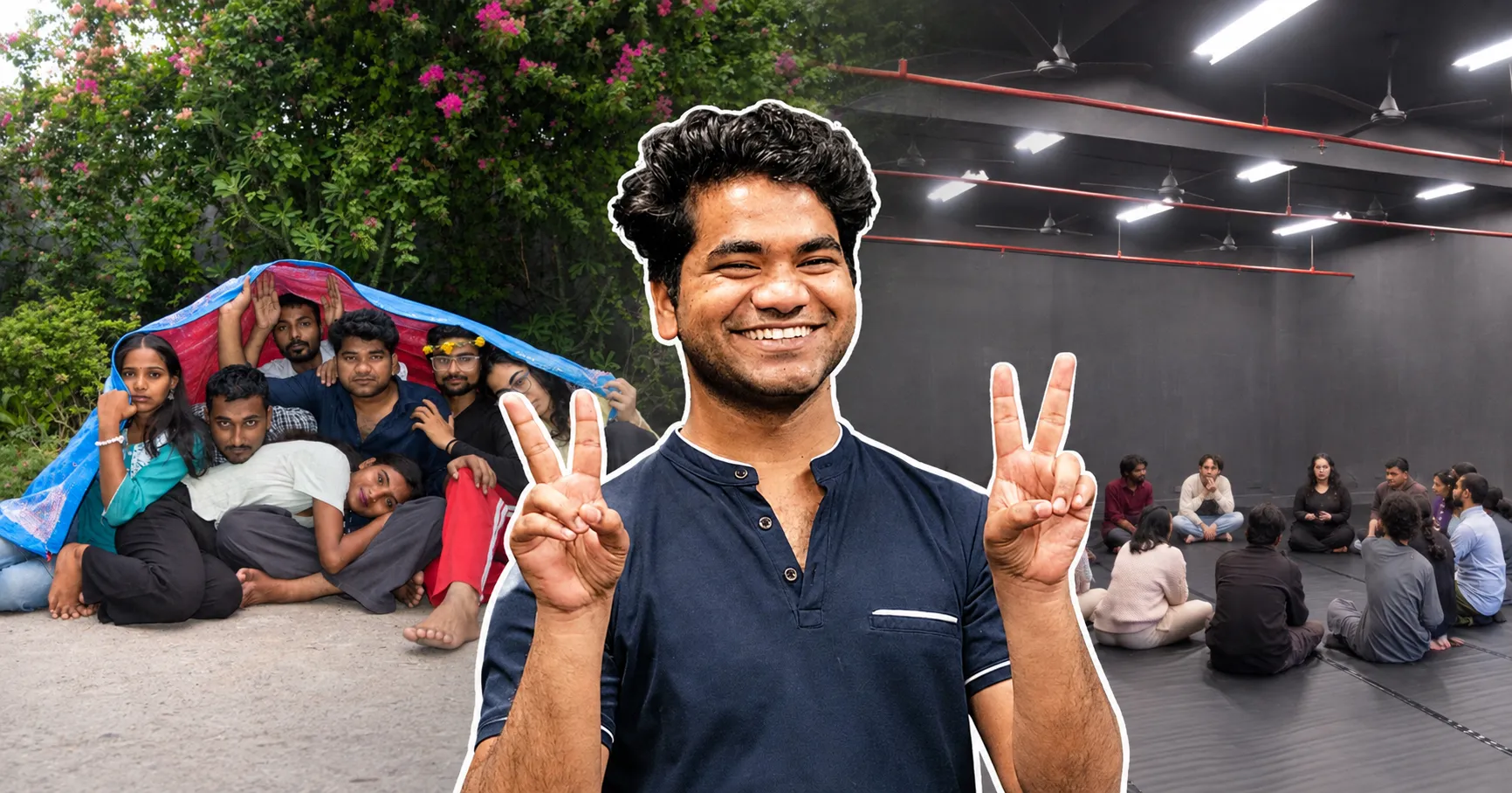
“Acting is not a real job that pays. How will you survive with theatre?”
For Lalit, whose father drove an auto-rickshaw and whose mother was a homemaker, it was a difficult question to answer. He loved theatre, but his family worried about how he would earn a living from it.
But passion is stubborn that way. Even when today’s questions go unanswered, it stays.
Lalit kept training with theatre groups across Delhi, often paying out of pocket, until a poster near Mandi House, the city’s theatre district, caught his eye. It was for Bargad, a fellowship offering free training and a monthly stipend.
He instantly knew where he had to be. “What’s the harm in trying, I thought to myself and am I glad I did?” he recalls with glee.
In January 2025, he joined its first cohort of 14 fellows and on day one, co-founder Amba asked them to write down what they hoped to gain from the programme. “She asked us to re-visit it after six months,” Lalit says.
He had hoped that the programme would lead him to a “well-known drama school” and return with a qualification he could show his family. So he wrote, folded the paper and slipped it into a pocket.
His family’s question was still unanswered. But it was one Bargad had been built to confront.
Who gets to tell their stories?
Behind the fellowship was a larger question: who gets to pursue theatre when training costs money, time and the security of a regular income?
For Amba, Co-Founder of Bargad and Academic Head of the Fellowship, the journey into this question began with her own experience of the performing arts. After training at the London Academy of Music and Dramatic Art and working in London for five years, she returned to India with a desire to build a theatre practice of her own.
The question for her wasn’t just one of who gets access to theatre training and professional opportunities, but whose stories, imaginations and artistic voices get valued in the first place.

“I realised there is heavy gatekeeping in the performing arts, and how much of it is shaped by caste and privilege – an accident of birth,” she says. “Who gets through the door? And historically, who has been told that the door belongs to them? Bargad is an attempt to question that gatekeeping,” Amba says
For Anirudh, Co-Founder of Bargad and Course Director of the Fellowship, the question became personal about 10 years ago, while working on a play about the Criminal Tribes Act. Until then, he says, his privileged background had blinded him to many inequalities.
“I was born into a privileged caste and class with access to education and exposure, and I lived most of my life in a little bubble, blind to everything around me,” he tells The Better India. “That play was my first honest encounter with the reality of caste and with Ambedkar’s writings. It felt as if everything I had learnt and believed was a lie. The ground beneath me shifted.”

In 2025, this led to the founding of Bargad by Amba-Suhasini K Jhala and Anirudh Nair, with Sanyukta Saha, who runs the Agaaz Theatre Trust, and Shambhavi Singh, founder of Oddbird Theatre. Its first cohort began in January 2025.
For Amba, widening access meant more than inviting new people into existing institutions. It meant changing the conditions that decide who can enter at all.
Paying students to make theatre possible
There on, Bargad’s first answer was practical: make training free and pay the people undertaking it.

The first two cohorts received ₹10,000 a month and the third, which begins January 2027, will receive ₹15,000. Classes run from 4 pm to 8.30 pm, six days a week, allowing fellows to earn during the day. Many applicants are financial contributors in their families, and attending classes can mean giving up hours they would otherwise spend working.
“For the fellows, the opportunity cost of taking time out to train in the arts is quite high,” Anirudh says. “The guarantee of a stipend also helps convince their families.”
Before joining, Lalit had paid to learn theatre and sometimes depended on his siblings for money. The stipend gave him a measure of financial independence.
“For the first time, I was being paid to do theatre,” he says. “Initially I was in disbelief but I knew this would be a great opportunity to afford what I enjoyed the most. With the stipend, I did not have to ask my brother or sister for money, and I spent it on travel, books and personal necessities.”

He did not tell his parents when he was selected; only his brother knew. The question of what theatre could offer him remained unresolved, but for the first time, he had room to find out.
Bargad also challenges the assumption that a lack of formal training means a lack of ability. Applications grew from around 75 in the first year to about 200 in the second. Candidates can apply in English or Hindi through written or video submissions.
An independent online jury shortlists around 30 applicants for three rigorous in-person audition rounds, followed by a group audition testing their listening, collaboration, responsiveness to direction and ensemble skills. A second jury selects the final 14.
“We keep the batch deliberately small so that each fellow receives sustained individual attention, close mentorship and the space to take risks, experiment and grow within a close-knit ensemble,” explains Amba.
The six-month curriculum covers voice, movement, acting, improvisation, writing and devising, with visiting practitioners from Delhi, Mumbai, Bengaluru and Chennai. The emphasis is not only on learning techniques, but on finding ways to use them to make original work.
A scene is never really finished
Neel Chaudhuri, a devising teacher who has taught at Bargad since its inception, works with fellows to develop performances from prompts in the subject of ‘Devicing’ or as he puts it, “to learn to learn to look within and ideate on what story one would like to tell independently.”

In ‘Divising Labs’ held every other week, fellows build short scenes and return to them over time, watching how an idea changes with further work. “The idea is not that they have to make a perfect scene in two weeks, but that they should follow a process, learn how a story is conceptualised and all that goes into seeing it to fruition,” he says.
The distinction is important. Rather than treating the first version of a scene as a finished product, the process encourages fellows to revisit their choices, test different approaches and discover what the work might become. The focus is on developing an idea, not simply producing something quickly.
That approach also opens up what can count as material for theatre. “A scene need not begin with an extraordinary event or a fully formed story. An everyday object, a remembered incident or a private discomfort can become a starting point. The work lies in examining the experience and finding a way to communicate it to an audience,” Neel explains.
Classes are conducted mainly in Hindi, and faculty are asked to work bilingually. “Fellows can ask questions and experiment without feeling that they must already know the conventions of theatre. And language is a big part of it,” he says.
When life becomes the story
For Prerna Bisht, who joined the fellowship in 2026 after an unsuccessful application the previous year, that process began with food.

During a workshop led by Vamsi, an interdisciplinary theatre artist who explores the layered relationship between caste and food, fellows were asked to tell stories through what they ate. The prompt took Prerna back to her childhood in Haryana, where her family’s non-vegetarian food was treated as something to conceal.
“My father would shut every door and window while cooking so that nobody would know what we were eating,” she says. “Once, a neighbour’s child walked in, and we hurriedly hid our plates. For a long time, I was ashamed of my food and I often ate my school lunch hidden from everyone,” Prerna recalls with a tinge of sorrow in her voice.
The memory was about more than a meal. It captured how the fear of being judged could follow someone beyond the home, turning an ordinary part of one’s life into a source of embarrassment.
The workshop gave Prerna a way to revisit that experience and examine what it had meant to her. “At Bargad, food became a way into a story about social pressure, secrecy and the shame I had carried into school. I felt liberated,” she says.

This is one of the possibilities of devising: experiences that might otherwise remain private can be shaped into material for performance. The process does not erase what happened. It gives the person telling the story a way to look at it differently and decide what they want to share.
Taking the story to the stage
After any programme, the question that often arises in the minds of students is: “What next?” In theatre, that anxiety can be manifold with scarce opportunities, rising costs and inaccessibility.
To solve this, the founders began Bargad ka Chabutra, a further six-month programme that alumni can apply to. It includes masterclasses on running workshops, fundraising and producing, among other supportive teaching. Students can also apply for one of two production grants of Rs. 1 lakh each.
Lalit’s cohort used one grant to expand a 15-minute scene about manual scavenging into Hawa Mahal, a full-length play. The group interviewed manual scavengers, whose experiences informed the production. Lalit then became a part of a larger production team and designed a set made from pipes and windows that also doubled as manholes.

Over seven months, the students developed the production, learning not only how to shape a story but also how to organise the work needed to bring it to an audience. For Lalit, that meant taking on responsibilities beyond acting and helping turn the group’s research into a stage production.
Finding space for the story
Getting a play on stage presented another challenge. Auditoriums around Mandi House can cost ₹80,000 to ₹1 lakh a day, while affordable independent venues are limited and often booked well in advance. Hawa Mahal had six performances, including one at Ashoka University.
For Lalit, the response after one performance made the work feel worthwhile.
“After three shows, in a post-show meeting, the audience told us thank you for telling this story,” he says.
But taking a story from the classroom to an audience requires funding, rehearsal time and space. The ability to develop a production is of little use if there is nowhere affordable to stage it. “In theatre, it is impossible to work without space, both to build work and to show it to audiences,” Neel says.

Bargad has tried to address this by building a network of spaces, people and resources that can help the fellows bridge the gap. Nikhil Mehta of Black Box Okhla has hosted the fellowship and its alumni programme. Other fellows have continued their work in different ways: a graduate from a village in Bihar received a Rs. 1 lakh grant to write a play, a fellow from the second cohort joined the National School of Drama, and another won a full scholarship to Drama School Mumbai.
Keeping the door open
Bargad’s future depends on making these opportunities sustainable. Over two years, the programme has relied on around 20 to 25 individual donors, contributing between Rs. 5,000 and Rs. 5 lakh.

Their support has helped keep it running, but relying on individual generosity makes long-term planning difficult.
“Sustainability is not about finding more well-wishers every year,” Amba says. “It is about finding long-term partners who understand that access cannot depend on annual generosity, so we can plan three, four, five years ahead.”
With more stable funding, she hopes to establish year-long courses in every metro, tour productions and offer larger bursaries. These ambitions would expand the opportunities available to performers who might otherwise struggle to enter the field.
Giving theatre a future
By the end of the fellowship, the qualification Lalit had once hoped for no longer mattered to him.

“I had so much confidence by then that I did not need a tag,” he says. “I can proudly say that I studied in Bargad’s first batch. Now, I don’t even know where that piece of paper I wrote on is,” he laughs.
His family’s question, how will you survive with theatre, still has no single answer. But Lalit now asks it as someone who has put a play on stage, and who is no longer waiting for anyone’s permission to make the next one.
Disclaimer : This story is auto aggregated by a computer programme and has not been created or edited by DOWNTHENEWS. Publisher: thebetterindia.com