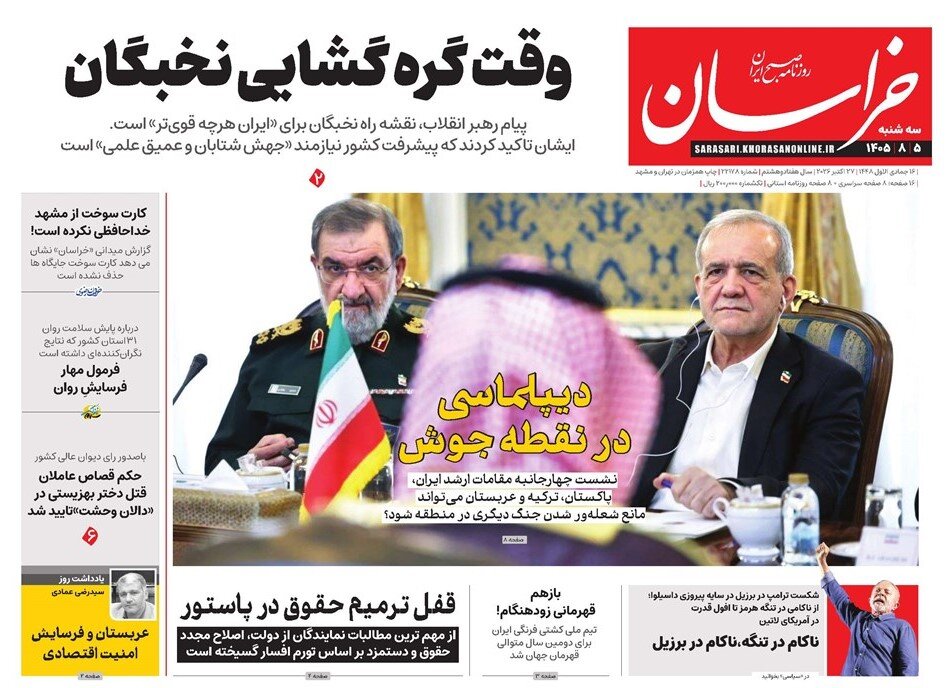
Khorasan examined the reopening of borders by Iran’s eastern and western neighbors, Pakistan and Iraq, after a forced retreat from restrictive policies. The paper argued that recent statements by Scott Bessent regarding cooperation between Washington and Iran’s neighbors to limit land routes represented a new stage in economic pressure on Tehran. However, developments on both borders showed that isolating Iran through regional blockades is neither easy nor cost-free.
According to the report, Iran remains an important partner for neighboring countries in sectors such as energy and essential goods. Any political decision designed to pressure Tehran for a limited period could result in the long-term loss of valuable markets. The newspaper noted that Iran provides substantial opportunities for foreign exporters, manufacturers, and service companies. Restricting access to this market would reduce sales and may even negatively affect employment in neighboring states. For this reason, attempts to economically isolate Iran could ultimately damage the interests of regional countries as much as, or even more than, Iran itself.
Ettelaat: Shadow of war and a window for diplomacy
Ettelaat focused on the complicated relationship between military developments and diplomacy. It wrote that disagreements over negotiation terms have intensified the challenges facing both Tehran and Washington. Iran seeks relief from economic and maritime pressures as well as guarantees against future confrontations. The United States, in contrast, continues to emphasize nuclear restrictions and security arrangements. The analysis stated that neither side wants to enter negotiations from a position of weakness, making a comprehensive agreement difficult to reach. Declining trust is another major obstacle. When confidence erodes, even establishing common ground on basic issues requires more time and stronger assurances. The newspaper added that economic pressure may be increased in an effort to force concessions, but such measures can also reduce the likelihood of compromise. Successful diplomacy requires a willingness to understand the concerns of the opposing side and to search for realistic solutions rather than simply repeating demands.
Arman-e-Emrooz: Mediators on the move
Arman-e-Emrooz highlighted regional and international mediation efforts aimed at preventing further escalation. The paper noted that several actors are simultaneously attempting to create opportunities for dialogue. Qatar has sent a delegation to Tehran, Pakistan has expressed readiness to mediate, and Russia may assume a more active diplomatic role. According to the report, Iran has made clear that it is prepared for negotiations but only under conditions it considers acceptable. Issues related to the Strait of Hormuz and restrictions on ports are viewed by Tehran as interconnected and cannot be discussed separately. The newspaper argued that meaningful progress depends on confidence-building measures and practical actions by all parties. Maintaining stability is especially important because any serious escalation could affect neighboring countries, international trade, global energy markets, and broader security concerns.
Arman-e-Melli: Why Europeans have become active
Arman-e-Melli examined increasing European diplomatic activity toward Iran. The newspaper argued that since the outbreak of recent tensions and the closure of the Strait of Hormuz, many analysts have viewed European countries as among the most vulnerable to the resulting economic and political consequences. As a result, Europe appears to be searching for a new path out of the current situation. The European troika is reportedly interested in playing a more influential role in future discussions between Iran and the United States through a revised framework for negotiations. Political and security indicators suggest that European governments are working to avoid becoming directly involved in policies that could deepen confrontation in the region. However, Europe faces several challenges. Among them are unexpected developments involving energy cooperation between the United States and Russia, as well as growing speculation about a possible accommodation between Russia and Ukraine. These factors have complicated European strategic calculations and encouraged greater diplomatic engagement.
Farhikhtegan: How Iran should deal with US
Farhikhtegan discussed strategic principles that should guide Iran’s approach toward the United States. The article outlined four main recommendations. First, Iranian proposals should be framed in terms of mutual interests rather than demands. This approach can present negotiations as constructive opportunities rather than confrontational exchanges. Second, if circumstances lead Washington to support ending tensions and pursuing an agreement, Iran should seek structural guarantees instead of relying solely on written or verbal commitments. Third, Tehran should expand the number and diversity of mediators, partners, and supporters involved in diplomatic efforts. Fourth, despite their limitations, international organizations should remain important instruments for advancing national objectives and protecting interests. The article concluded by arguing that the United States should be judged by its actions rather than its statements. Real policies, treatment of allies, and tangible outcomes are ultimately more important than public rhetoric in determining intentions and future relations.
Disclaimer : This story is auto aggregated by a computer programme and has not been created or edited by DOWNTHENEWS. Publisher: tehrantimes.com