Marshall Faulk is an extraordinarily active 53-year-old. The first-ballot NFL Hall of Fame running back is the head football coach at Southern University in Baton Rouge, La. He runs a foundation in his name that assists underprivileged youth. He works out. He plays a lot of golf.
And he has Parkinson’s disease.
Faulk revealed his diagnosis on The Caring Neurologist podcast this week, saying he noticed Parkinson’s symptoms on the golf course.
“The rigidity in my hand, just sometimes after I play a lot or I practice a lot,” he said. “I just thought it was normal nerves when putting and stuff like that. But it started to be times where I was playing, but I wasn’t in a match, and it would still do that. I was like, ‘Wow, is that normal?’”
Faulk said he was diagnosed about 18 months ago. An unfailing optimist in his social media dispatches and a fiery truth-teller when addressing his team, the former Rams Super Bowl champion described himself on the podcast as “one of the lucky ones” because he caught the disease early.
“The doctor was like, ‘You need to go get checked,’” he said. “You need to go have X, Y and Z done. You’re at an age, it’s possible; it’s likely that it’s not, but you need to go get checked.’”
He jumped on the phone to speak with other former NFL players who share the diagnosis.
“They told me about some of the symptoms and things they had that they thought [were] just football-related, that it didn’t relate to Parkinson’s in any manner,” Faulk said. “They wish, in those early stages, if they had maybe just known a little earlier, they would be in better shape.”
Former Green Bay Packers greats Brett Favre and Ahman Green currently live with Parkinson’s. So does former quarterback Bernie Kosar.
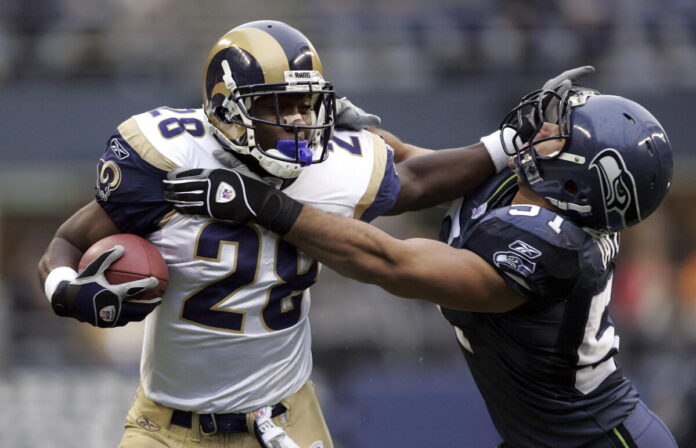
St. Louis Rams’ Marshall Faulk, left, straight-arms Lofa Tatupu of the Seattle Seahawks during a 2005 NFL game.
(Elaine Thompson / Associated Press)
Perhaps the most noteworthy sports figure to battle Parkinson’s was boxing great Muhammad Ali, who died in 2016. Faulk met Ali at a dinner and said on the podcast that he is comforted by the memory.
“He leaned over to me and he whispered, ‘You a bad boy,’” Faulk said. “And then he made a couple other comments. I was like, ‘He’s all there.’ So knowing that, I didn’t look at it like life is going to end.”
Faulk was seemingly indestructible as a player. An All-American at San Diego State, he was drafted second overall by the Indianapolis Colts in 1994 and immediately made an impact, rushing for more than 1,000 yards for the first of seven times and being named NFL rookie of the year.
Faulk was traded to the then St. Louis Rams ahead of the 1999 season and led their “Greatest Show on Turf” offense to a Super Bowl XXXIV victory in January 2000. The following season, Faulk was named NFL MVP. He transitioned to the NFL Network broadcast booth after retiring in 2005 having rushed for 12,279 yards and 100 touchdowns while also catching 767 passes for another 36 touchdowns.
He got into coaching in 2025, joining Deion Sanders’ staff at Colorado. When the opportunity arose to become the head coach at Southern, Faulk didn’t hesitate even though he already had been diagnosed with Parkinson’s.
“I could have stayed at Colorado. I was comfortable. But I’ve never done well in life when comfortable,” he said at his introductory news conference at Southern. “And I’m not gonna lie to you. This is uncomfortable, and I like it.”
The Jaguars, an HBCU school competing in the FCS, are 3-4 in Faulk’s first season after going 2-10 in 2025. Faulk’s messages to his players go beyond football. On Thursday he posted this on Instagram: “Protecting your game goes far beyond avoiding injury. Protect your body. Protect your mind. Protect your circle. Protect your future.
“The decisions you make away from the field can have just as much impact on your future as what happens between the lines,” he continued. “Choose the people, habits, and environments that move you closer to where you want to go. Send this to a young athlete who needs this reminder today.”
Helping others is why he decided to open up about his Parkinson’s diagnosis, he told host Dr. Sandeep Thakkar on the podcast.
“I want to help as many people as I can,” he said. “What you want to do with that information is pass it on to the next generation to make sure that they have it better, that they know more. And you’re doing it to leave this world a better place than it was when I got here.”
More to Read
Disclaimer : This story is auto aggregated by a computer programme and has not been created or edited by DOWNTHENEWS. Publisher: latimes.com