Belgian deputy prime minister Maxime Prevot confirmed the death toll from this morning’s crash.
In a post on X, he said:
“A tragic collision between a train and a school bus took place in Buggenhout this morning. Four people have been killed, including two children. I would like to thank my colleagues from other countries who have already come forward to express their solidarity, and I naturally join them in offering my condolences to the families of the victims. My thoughts are with them, and also with the emergency services who had to deal with this harrowing incident.”
Europe correspondent
Seven people have died in France in an extreme early-summer heat event that is affecting a swathe of western Europe, as France and the UK set record highs for May and temperatures were forecast to rise further on Tuesday.
“What I can say today is that there have been seven deaths linked directly or indirectly to the heat,” a French government spokesperson, Maud Bregeon, told TF1 television, adding that five of the deaths were by drowning.
Météo France, the national weather agency, said Monday’s highest reading, 37.1C, was recorded near Hossegor, in the south-western department of Les Landes, and that temperatures across the west of the country could exceed 36C on Tuesday.
It said Monday was “the hottest day measured for the month of May since records began”, with the national average temperature, measured at 30 stations across the country, hitting 24.4C, compared with a previous high of 23.7C in 1944.
The UK’s Met Office said Monday was the country’s hottest May day on record, with temperatures hitting 34.8C at Kew Gardens, south-west London, a reading it described as “exceptional in the UK even in mid-summer, let alone May”.
In Spain, widespread highs of 36-38C in the Guadiana, Guadalquivir and Ebro valleys were expected to continue possibly until Friday, the state weather service, Aemet, said, adding that “in some of those areas, temperatures could reach 40C”.
Let’s cross to Jon Henley in Paris for the latest on the heatwave in large parts of western Europe.
Norway has also summoned the top Russian diplomat in the country, the foreign ministry in Oslo said.
In a statement, Norway’s foreign minister Espen Barth Eide confirmed the top diplomat was summoned to “protest against the threats against foreign personnel in Ukraine that Russia has made in recent days.”
“We also emphasised that we have condemned Russia’s violent attacks on Kyiv this weekend. Russia is behind very extensive drone attacks, in addition to using the Oreshnik missile against Kyiv for the first time. It is unacceptable.”
Back to Ukraine, the EU has summoned Russia’s top diplomat in Brussels over Russian warnings telling foreigners and diplomats to leave Kyiv amid planned new strikes on the Ukrainian capital.
EU’s foreign policy spokesperson Anitta Hipper said on X:
“[Russian] threat to foreign citizens & diplomats to leave Kyiv is an unacceptable escalation. @eu_eeas summoned the Chargé d’Affairs, calling to stop hitting civilians & [Russia] to engage in genuine peace talks starting with a full and unconditional ceasefire.
@EUDelegationUA stays in Kyiv.”
Earlier, she told the commission’s daily press briefing:
“[The threat] shows once more, actually, one thing that we already knew, that Russia is absolutely not interested in any peace and has a total disregard for all the efforts towards the peace.”
The authorities confirmed the four deaths, including two children aged 12 and 15, and two adults aged 27 and 49.
Five other children were seriously injured, but their condition is stable, HLN reported.
The exact circumstances of the crash are still being investigated.
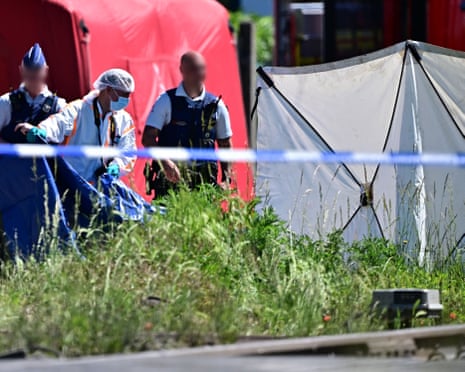
Belgian deputy prime minister Maxime Prevot confirmed the death toll from this morning’s crash.
In a post on X, he said:
“A tragic collision between a train and a school bus took place in Buggenhout this morning. Four people have been killed, including two children. I would like to thank my colleagues from other countries who have already come forward to express their solidarity, and I naturally join them in offering my condolences to the families of the victims. My thoughts are with them, and also with the emergency services who had to deal with this harrowing incident.”
The European Commission president, Ursula von der Leyen, responded to the crash on her social media.
She said:
“I was heartbroken to learn of the tragic accident between a train and a school bus in Buggenhout today. My deepest condolences go out to the victims’ families and their loved ones. Today, Europe grieves with Belgium.”
Belgium’s mobility minister Jean-Luc Crucke told Belgian broadcaster RTL that four people died in the crash – two children, the driver and the other adult.
“It’s tragic,” he was reported as saying.
“My first thoughts are with the victims, but also with those who were injured and their families.”
Two people were seriously injured, he added.
We are getting first pictures from the scene of the crash, which took place at a level crossing in Buggehnout at just past 8am local time.
The crossing was reportedly closed at the time of the incident, HLN reported.
Reuters notes that Belgium, where a dense railway network crisscrosses towns and villages, has a history of accidents at level crossings. Five people died in such accidents in 2025, railway infrastructure operator Infrabel says on its website, the lowest number recorded since 2020.
No injuries were reported on the train.
A collision between a train and a school bus in the Belgian town of Buggenhout on Tuesday morning with several people reported to be affected.
Reuters and local media reported that several people were killed in the crash, but this has not been officially confirmed by the authorities so far.
Local media Het Laatste Nieuws reported that 7 children and two adults were believed to be on the bus at the time of the crash.
Belgium’s interior minister, Bernard Quintin, said there were several “victims,” without offering more detail.
“With great dismay, I learned of the tragic accident in Buggenhout, where a school bus was struck by a train. My thoughts go out to the victims and their loved ones. I wish the injured much strength,” he said on X.
Spokesperson for the federal police, quoted by Le Soir, did not disclose any further information on the condition of people affected by the incident.
The French government said Tuesday that seven people were reported to have died in connection to the recent heatwave baking much of western Europe, five of which were drownings, AFP reported.
“What I can say today is that there have been seven deaths directly or indirectly related to the heat,” government spokesperson Maud Bregeon told television broadcaster TF1.
Bregeon added that the figures and specific causes of death would need “to be clarified once the episode we are currently experiencing has come to an end”.
Jon Henley in Paris and Sam Jones in Madrid
More than 350 French towns have recorded their highest-ever temperatures for May as France and the UK set national heat records amid an extreme early-summer heat event that could see the mercury rise to 40C in parts of Spain by the end of the week.
The UK’s Met Office said the country’s all-time record for May was broken when a temperature of 34.8C was recorded at London’s Kew Gardens.
Météo France said late on Monday that new monthly highs for May had been recorded at 352 weather stations mainly in western France, with the highest – 37.1C – registered near Hossegor, in the south-western department of Landes.
“This is an unprecedented event with a one in 1,000 chance of happening at this time of year based on the climate from 1979 to 2025 and virtually impossible in the preindustrial era,” Christophe Cassou, a climate scientist, told Le Monde.
More new highs are likely to be set in France, Spain and the UK, forecasters said, with temperatures exceeding norms by 12C or 13C in what Météo France described as a “premature, remarkable and long” heat episode expected to last several more days.
US secretary of state Marco Rubio said that the war in Ukraine “needs to come to an end,” after his conversation with his Russian counterpart, Sergei Lavrov.
Responding to the strikes on Kyiv over the weekend and repeated warnings about more attacks planned in the coming days, Rubio said:
“Look, every time you see these big strikes from one side or the other, it’s a reminder of why this is a terrible war that’s now gone on longer than the second world war, and it needs to come to an end.”
Rubio said that Lavrov wanted to reiterate his warning to the US to pull its diplomats from the Ukrainian capital, but appeared to downplay it, saying:
“They sent a notice to all the embassies, and I think he was just calling me personally to tell me – they told all the embassies to – Kyiv’s going to be a very dangerous place – Kyiv’s been a very dangerous place now for a number of years.”
Despite the warning, several European diplomats insisted they would stay put in the capital, including the EU’s ambassador Katarina Mathernova.
But Rubio cautioned against the threat of further escalation:
“Look, the danger in all of these wars as they continue and then they go on is that they always have the threat of escalation, of spreading into something new.”
Curiously, Rubio said that Lavrov also wanted to “relay” a message from Russia’s Vladimir Putin to US president Donald Trump, without offering more details.
Elsewhere, I will look at the European Commission president Ursula von der Leyen’s visit to Lithuania as she wants to offer her solidarity with the region amid growing Russian threats, follow closely Hungary’s Péter Magyar as he delivers a speech on planned reforms in the Hungarian parliament, and bring you the latest on the record-heating heatwave across Europe.
It’s Tuesday, 26 May 2026, it’s Jakub Krupa here, and this is Europe Live.
Good morning.
Disclaimer : This story is auto aggregated by a computer programme and has not been created or edited by DOWNTHENEWS. Publisher: theguardian.com