
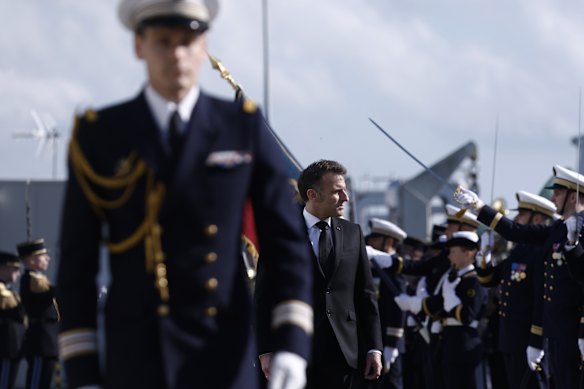

One of France’s top ministers says the country would be willing to sell submarines to Australia if the AUKUS pact collapses, despite the acrimony sparked by the cancellation of a $90 billion deal five years ago.
The Morrison government ditched a contract with Naval Group, a shipbuilding firm majority-owned by the French government, in 2021 in favour of a plan to acquire nuclear-powered submarines with the United States and United Kingdom.
The move triggered a diplomatic rupture between the two nations, with France recalling its ambassador from Canberra and the then French foreign minister accusing Australia of a “stab in the back”.
Australia later paid $835 million in compensation to Naval Group and Prime Minister Anthony Albanese travelled to Paris to mend ties with French President Emmanuel Macron.
Asked whether his nation would be willing to enter another submarine deal with Australia, French Trade Minister Nicolas Forissier said that France was “not looking at the past”.
“We will, of course, always be ready to [pursue] any partnership that would answer to the needs of Australia because we’re friends,” he told reporters in Sydney.
“We are open to develop any partnership because I think we, again, are very much like-minded. We have the same philosophy.”
Retired rear admiral Peter Briggs has called for Australia to ditch AUKUS and instead seek to acquire a fleet of 12 Suffren-class nuclear-powered attack submarines from Naval Group.
Briggs has argued the US will not have enough spare submarines to provide any to Australia, and that it would be more cost-effective and lower risk to acquire Suffren-class submarines given they are already in service with the French navy.
“It offers the solution to our AUKUS problems,” he wrote in a 2024 piece for the Australian Strategic Policy Institute.
A Suffren-class submarine weighs 4600 tonnes compared to 7800 tonnes for the Virginia-class boats Australia plans to acquire from the US. It carries a crew of 65 submariners compared to around 132 for a Virginia-class submarine.
The Suffren-class use low-enriched uranium fuel and needs refuelling every 10 years, whereas the US and British designs use highly enriched uranium and are intended never to be refuelled.
Forissier said the topic of submarines had not come up during his discussions in Australia, and local officials insist they are fully committed to AUKUS.
Admiral Samuel Paparo, the top US military commander for the Indo-Pacific, this week told congress the AUKUS plan was “on track”, even though the US needs to turbocharge its submarine production rates.
Asked at a conference last month whether it was too late to abandon AUKUS is favour of a new deal, Briggs said that “it is never too late to stop a plan that is not going to bloody work”.
Senior Defence Department official Hugh Jeffrey told the same conference: “Defence has been directed to pursue AUKUS and we are pursuing AUKUS and that’s our plan. I would not venture into the space about ‘Plan B’ or ‘Plan C’.”
Jeffrey said Australia would be left without any submarines to replace the ageing Collins-class boats if political leaders again change their mind, urging everyone involved to “get on with business”.
“This effort under AUKUS is the fourth, by my count, attempt to replace a submarine program that we began in the 1980s. Each effort, since then, to replace it has fallen afoul of domestic politics. Are we really thinking that this should be the fourth?” he asked.
“If you really want to be in a position where we have no submarines, then turn back. ”
Forissier is the first European trade minister to visit the country since Australia and the European Union struck a free trade deal in late March.
He said he was hopeful Australia and France would be able to work together on critical minerals so they do not become “hostages in the future”, an allusion to China’s dominance of the key components for everything from iPhones to solar panels.
As a result of the free trade agreement’s removal of tariffs on European imports, Forissier said he expected Australians to buy more champagne and French dairy products.
French consumers were also becoming more open to drinking imported Australian wine, he said.
Forissier said that with global trade conditions become more “violent” and uncertain, it was important for countries such as Australia and France to work together as a force for stability.
US President Donald Trump imposes tariffs but “sometimes he forgets them two days after”, he said, referring to Trump’s shortlived threat of 200 per cent tariffs on imports on French wine and champagne when Macron declined an offer to join his ‘Board of Peace’ to oversee a post-war Gaza.
Cut through the noise of federal politics with news, views and expert analysis. Subscribers can sign up to our weekly Inside Politics newsletter.
 Matthew Knott is the foreign affairs and national security correspondent for The Sydney Morning Herald and The Age.Connect via X, Facebook or email.
From our partners
Disclaimer : This story is auto aggregated by a computer programme and has not been created or edited by DOWNTHENEWS. Publisher: www.smh.com.au


