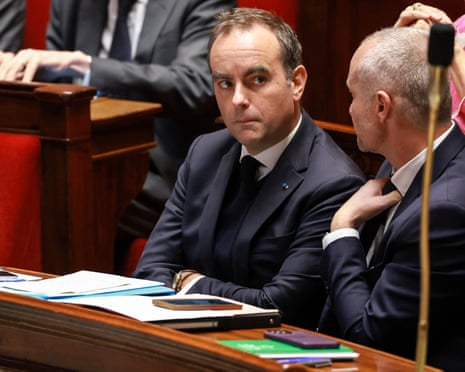
Back to France, the French prime minister, Sébastien Lecornu, told lawmakers of plans for “massive” deployment of police forces ahead of further protests expected on Saturday.
In a passionate speech in the parliament, Lecornu framed the situation as a choice “between violence the Republic,” as he doubled down on his claims that the protests morphed into “an insurrectionary scheme led by far-left and ultra-left groups.”
He insisted that “a return to order is the prerequisite for everything else,” stressing he also wants to address the substantive requests posed by the student movement.
He also acknowledged some issues with the police planning and intelligence gathering so far.
And back to the debate in the French parliament, the interior minister, Laurent Nuñez, confirmed that military forces will be deployed to reinforce police during the upcoming protests on Saturday.
“We will deploy the Sentinelle force, obviously as a substitute to interior security forces… mostly to free police and gendarmes in their mission to maintain order,” Nuñez told the National Assembly.
He added that the response to any unrest will be “firm.”
As reported earlier, PM Lecornu said the police presence on the weekend would be “massive,” as the government wants to see an immediate return to order after last weekend’s riots (15:29).
Elsewhere, there are some positive news from Romania, where Luca Niculescu has been confirmed as the country’s new prime minister in centrist president Nicușor Dan’s fourth attempt at getting a new government in place.
Niculescu, a former journalist and diplomat who served as Romania’s ambassador to France, is expected to form a government led by ministers from the centre-left Social Democratic party and some technocrats – although it remains a very open question how long he will last in the post.
Back to France, the French prime minister, Sébastien Lecornu, told lawmakers of plans for “massive” deployment of police forces ahead of further protests expected on Saturday.
In a passionate speech in the parliament, Lecornu framed the situation as a choice “between violence the Republic,” as he doubled down on his claims that the protests morphed into “an insurrectionary scheme led by far-left and ultra-left groups.”
He insisted that “a return to order is the prerequisite for everything else,” stressing he also wants to address the substantive requests posed by the student movement.
He also acknowledged some issues with the police planning and intelligence gathering so far.
Italian defence minister Guido Crosetto has warned that recent riots in Milan and other parts of Italy were part of a broader “hybrid war” against the West, the Italian news agency Ansa reported.
Speaking at a conference in Rome, Crosetto said:
“The events in Milan and elsewhere in Italy are fundamentally different from those seen in other eras; they are the product of what I call hybrid warfare – a form of conflict being waged against our nations through unconventional tools like TikTok, social media, and YouTube … The West has yet to realise this or take any meaningful action in response.”
He continued:
“If three out of every 10 young people took part in these demonstrations – and I am not just referring to ‘maranza’ (youth gangs) or second-generation Italians – and if six out of 10 agree with these sentiments, it is because they have been subjected to a ‘counter-education’ from somewhere – not from their families or schools.
This has instilled in them values, ambitions, a worldview, and points of reference that stand in direct conflict with the society we live in and with our democratic rules.”
As we mentioned in a previous post, US special envoy Steve Witkoff has arrived in Norway ahead of talks with the Ukrainian president Volodymyr Zelenskyy which are aimed at ending the war with Russia.
It comes as relations between Zelenskyy and the US president, Donald Trump, are at their lowest since their public fallout in the Oval Office last year.
Only yesterday, Zelenskyy said the US was deliberately delaying deliveries of interceptor missiles to Ukraine, deepening the public spat with Trump. He has also said that Ukraine did not receive a warning from the US about an impending Russian missile attack on Sunday evening.
As the diplomacy in Oslo takes place to end the war, we are seeing more reports of deadly Russian attacks on Ukraine. Four people were killed and 27 others injured, including children, in Russian missile and drone attacks on the Kyiv region over the past day, according to regional police.
Three people were killed and six were injured in the Obukhiv district, where warehouses were damaged, police said. This morning, three people were killed and four injured when two vehicles caught fire in a Russian attack on the Kyiv-Odesa highway, Ukraine’s State Emergency Service said.
Meanwhile, Portuguese police cleared protest camps in Lisbon and Porto before dawn, removing activists who had occupied two central squares to protest against a worsening housing crisis, and making 55 arrests, Reuters reported.
Activists had occupied Lisbon’s Rossio square since Saturday, pitching around 200 tents, and Porto’s Dom Joao I square for around 10 days.
The camps mirrored housing protests in neighbouring Spain, and coincided with unrest over rising living costs in countries such as France, Belgium and Italy.
Italy is poised to approve new security measures after parts of the country were rocked by waves of protests over the weekend.
Italy’s deputy prime minister, Matteo Salvini, said that as part of the crackdown police will be able to detain under-18s at police stations for 12 hours, even if they have not committed a crime, provided there is evidence they pose a danger.
“We want to intervene quickly on young people,” Salvini told the RTL radio broadcaster ahead of a cabinet meeting to approve the measures, which have not yet been formally announced.
The security crackdown will also reportedly include banning gatherings for people deemed a threat to public order.
Thousands of people peacefully protested against living costs in cities across northern Italy over the weekend, but a number of the marches turned violent with some demonstrators seen looting stores and clashing with police.
Several hundred protesters, many believed to be minors, set bins ablaze and looted shops in the centres of Milan, where more than 5,000 people gathered over the weekend.
In southern Italy, farmers and truckers have been blockading ports and highways to protest against the surge in fuel prices resulting from the US-Israel war on Iran.
France will offer interest-free loans of up to €50,000 to businesses affected by the riots and looting over the weekend, economy minister Roland Lescure said.
The scheme is expected to open on Friday, and should help traders with cash flow issues as they seek to get insurance payouts, the minister said, quoted by French media.
First court cases are also being progressed, with justice minister Gérald Darmanin confirming that 149 people have been put in provisional detention or imprisoned as part of ongoing trials. In a separate TV appearance on Monday evening, he said around 2,500 remained in custody for questioning, Reuters reported.
The number is expected to go up, as BFMTV reported that some 40 people are expected to appear in front of Parisian courts this afternoon.
In other news, it looks like France may have another problem coming its way, with heavy rainfall in the south of the country.
Parts of Corsica are now under a red alert for rain and flooding, with local flooding observed last night in several towns and village in the region. An all-time rainfall record broken in Salon-de-Provence, BFMTV reported.
The Gard department is on orange alert, with the coastal areas on a yellow alert.
Some flooding was also reported near Marseille.
Nordic correspondent
As well as Steve Witkoff, Ukrainian president Volodymyr Zelenskyy will also meet the Norwegian prime minister, Jonas Gahr Støre and the Finnish president Alexander Stubb and Norway’s new King Haakon during his visit to Oslo.
Jared Kushner is scheduled to attend digitally.
Ahead of the talks, Støre said that Zelenskyy has asked Norway and Finland to arrange a meeting as part of the ongoing diplomatic work, at a critical time for Ukraine. “Together with president Stubb, I am pleased to have such a meeting here in Oslo.”
Afterwards there will be a press conference with Zelenskyy, Stubb and Støre and Zelenskyy has been invited for an audience at the palace.
The Ukrainian president is also due to meet with the Speaker and other members of the Norwegian parliament.
Nordic correspondent
More than a month after the country went to the polls, Sweden is still without a government.
The Centre party’s Elisabeth Thand Ringqvist this week became the second party leader to be tasked with attempting to form a new coalition government (Europe Live, yesterday).
It comes after the Social Democrats’ Magdalena Andersson, whose party won the most votes in September’s general election, tried and failed to get the left leaning parties to come to agreement and lost a prime minister vote in parliament. The biggest stumbling block has been the Centre party’s refusal to go into government with the Left party.
This morning, however, after accepting the speaker’s task on Monday, Thand Ringqvist said she was not ruling out anything but that she wants to form a “middle government”. She has until Monday to report back to the speaker.
“I have booked in meetings with all party leaders but it will primarily be those who I have said can be part of a middle government,” she told broadcaster SVT. “I am not ruling out anything beforehand.”
Thand Ringqvist said she is not prepared to drop any of her so-called “redlines” when it comes to the Left party and the Sweden Democrats, both of whom she has ruled out going into government with. “That is why I am looking at the possibility of a middle alternative,” she said.
The Left party said that regardless of the outcome, they hope that Thand Ringqvist’s attempt will take parties out of the current deadlock.
Left party spokesperson Ida Gabrielsson said:
“Then it will be possible to sort out wether there are other alternatives. We want to have a government with S, V, C and MP (the Social Democrats, Left, Centre and Green parties). But the Centre party wants to have one in the middle. In which case it is good to find out whether it is possible or not.”
Social Democrat Mikael Damberg said his party will have “constructive discussions” with the Centre party if she wants to speak with them but that “you don’t get away from the maths of the Swedish parliament”.
The French parliament will look into formally opening an inquiry into the protests and violence seen in recent days, including the law enforcement measures used in response, after a political agreement was reached on this point, BFMTV reported.
No doubt we will hear more on this in due course.
I am also keeping an eye on events in Oslo, where US envoy Steve Witkoff arrived in the last hour for talks with Ukraine’s president Volodymyr Zelenskyy and the leaders of Norway and Finland.
Norway’s PM Jonas Gahr Støre and Finland’s Alexander Stubb will also join the discussion.
Televised images from Norwegian public broadcaster NRK showed Witkoff’s private jet landing just before noon at Oslo’s Gardermoen airport, AFP reported.
Ahead of the meeting with Witkoff, Zelenskyy spoke with US secretary of state Marco Rubio and said the pair had “a substantive conversation.”
Zelenskyy said:
“I am grateful for his readiness to help and his clear position. First, ballistic missile interceptors, which are needed to protect lives. Second, early warning of Russian ballistic missile attacks, which is vital. Third, the situation with Starlink/Starshield, which needs to be restored. Of course, all of this comes against the backdrop of our diplomatic efforts to end this horrific war and the constant killing of people.”
On his part, Rubio insisted that “nothing is being deliberately denied to Ukraine,” AFP reported.
Meanwhile, the EU’s trade commissioner Maroš Šefčovič said the bloc’s relationship with the UK is of “vital importance in the current geopolitical, security and economic context,” as he set out the bloc’s expectations ahead of next month’s EU-UK summit on 20 November.
Speaking at the European parliament in Strasbourg minutes after holding a phone call with UK’s Europe minister Hamish Falconer, he said the EU had three priorities for any talks with London.
Crucially, he wanted the two sides to fully implement the existing agreements, which include the protection of six million EU citizens resident in the UK and about a million UK nationals in the EU.
“We must ensure they can fully enjoy their rights now and in the future. That is why we continue to push for solutions on all matters affecting them,” he said.
He also said that “the work continues” on implementing the Windsor framework agreement, with its significance for Northern Ireland.
Šefčovič said the summit will also be a chance to look at sectoral issues, pointing to last year’s progress on fisheries, energy and Erasmus+.
“We aim to complete negotiations on a common sanitary and phytosanitary area, a linkage between our emissions trading systems and the creation of a youth experience scheme as a package for the summit,” he said.
He said there are also ongoing talks about the UK’s participation in the EU’s internal electricity market, and “an appropriate financial contribution from the UK towards the reducing economic, social and territorial disparities between regions in the union.”
The summit will also look at foreign policy issues, given the EU and the UK’s continued support for Ukraine.
He added that “given the geopolitical context, which is much changed since the withdrawal of the UK from the EU,” there is also scope for more work on supporting integrated value chains between the EU and the UK.
For a good summary of where we are when it comes to the French protests, you can catch up with Jon Henley’s commentary for The Latest.
“What we saw on Saturday was really an exceptional level of violence, even by French standards. In several towns and cities, there were attacks on those institutional targets. …
If this kind of violence continues, then that’s clearly a message that’s going to start appealing to more and more French voters.
Facing growing political pressure over the protests and riots, France’s PM Sébastien Lecornu will convene political parties for a meeting on Thursday, a member of his team said.
The conversation is also likely to touch upon the issue of policing, with critics saying the initial response to the protests was too heavy-handed.
He will also meet with trade unions on Wednesday.
The government has come under criticism from parties across the political spectrum, with far-right presidential candidate Marine Le Pen describing the unrest as a “wake-up call” that exposed a “profound crisis” of authority.
Meanwhile, president Emmanuel Macron has secured the delivery of an additional 200,000 tonnes of diesel per month from the United Arab Emirates and Bahrain during a tour of the Gulf, the French presidency said.
With the addition of deliveries from Saudi Arabia, France has commitments for 295,000 tonnes per month, representing just over 10 percent of its consumption, the presidency added.
Macron is undertaking a tour of key energy suppliers in the Gulf in an effort to secure oil and diesel supplies and bring down prices in France, after a weekend of violent protests sparked by soaring living costs.
A 40-year-old man was arrested on Tuesday on suspicion of being involved in the arson attack that ravaged Limoges town hall over the weekend, French media reported.
The man is reportedly a “far-left activist” with a prior record that saw him placed on the security services’ watchlist, according to Le Figaro.
French prime minister Sébastien Lecornu said that targeted curfews introduced in parts of Paris and other major cities “have contributed to calm overnight,” as he suggested more curfews could be introduced if needed today.
In a particular symbol of stepped up security measures, a helicopter flew over the French capital’s Place de la Republique, one of the epicentres of the unrest, sweeping a powerful searchlight across the square, AFP said.
While some restrictions, such as those in Paris, initially applied only for the night from Monday to Tuesday, others, particularly in Bordeaux and Nice, were set to remain in force for several days, the agency noted.
Meanwhile, Italy’s government decided to dispatch 500 army troops to Milan after two days of unrest in the city, with shops in the city centre affected by riots and looting.
I will keep an eye on the latest from both France and Italy.
Elsewhere, the European parliament in Strasbourg will debate EU-UK relations this morning, and Nato’s Mark Rutte will host the Turkish foreign minister for talks. Lithuania’s president Gitanas Nausėda is in Poland to discuss regional security.
I will bring you all the key news from across Europe here.
It’s Tuesday, 20 October 2026, it’s Jakub Krupa here, and this is Europe Live.
Good morning.
Disclaimer : This story is auto aggregated by a computer programme and has not been created or edited by DOWNTHENEWS. Publisher: theguardian.com