
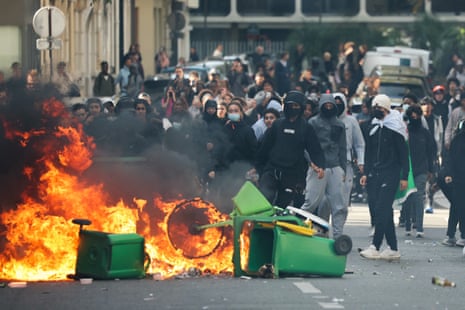
The education minister says 400- 500 high schools will remain partially or fully shut following a week where riot police clashed with high school students as protests on classroom conditions have spread nationwide.
Lessons will be “totally or partly suspended” given the unrest, says Education Minister Edouard Geffray.
He said 24 schools had been “burned or ransacked” since the start of the movement.
At least 5,000 people, mainly teenagers, have been arrested while dozens of people, including students and teachers, have been injured. Unions are calling on teachers to strike.
The protests began last week in the Paris region, with students staging sit-ins over conditions like overcrowding in classrooms, teacher shortages and dilapidated buildings.
The rallies in some cases have become more violent with protesters wearing masks and setting off fires in the street and vidoes showing police officers using batons on students.
More protests had been scheduled for Tuesday this week, prompting law enforcement this weekend to say the situation had grown “out of control”.
Paris police chief Patrice Faure told students to abandon their school blockades to return to peaceful forms of protest and suggested to parents there was influence from “professional rioters”.
Read more on the protests here:
We’ll draw our live coverage to a close for today. For the full story on the deals announced from the German chancellor’s surprise visit to Ukraine, you can read this report from my colleague in Kyiv.
-
Friedrich Merz arrived in the Ukrainian capital this morning to pledge aid and defence deals to Zelenskyy; his arrival was marked soon after by the Russians striking a key bridge in the city
-
His visit comes as there are near daily bombardments of the Ukrainian capital by the Kremlin, which has hit now both the Northern and Southern Bridges across the Dnipro River which commuters heavily rely on. Russia has also been hitting gas stations in residential neighbourhoods and government and academia sites.
-
Germany has become Ukraine’s biggest provider of military aid since Merz entered office in May 2025, surpassing the US as American support has declined.
-
On Sunday, Merz announced another $1.5bn in aid, over a billion of it going towards military aid including long-range strike weapons, drones and satellite tech to help Ukraine hit Russian launch pads.
-
In France, the government is keeping up to 500 high schools closed tomorrow amid student protests which have “grown out of control”, say police.
-
The French Education Minister said 78 teachers and education staff had been wounded in the protests late last week where there were outbursts of violence and masked protesters damaging property and setting fires in the street.
-
On Sunday, police detained a 16-year-old over the assault of a 59-year-old teacher who had been doused with gasoline and assaulted on the sidelines of a school protest.
-
But students and some human rights groups have also condemned “brutal” policing tactics from riot squads.
-
Students have been protesting since mid-September about poor conditions in school including a shortage of teachers, overcrowded classrooms and dilapidated buildings. The protests, which began in Paris, have spread across the country with a national action day last Friday. Organisers have called for more protests on Tuesday.
Some more lines in from Ukraine and the German Chancellor’s visit to Kyiv being marked with another Russian strike on the city’s bridges.
Merz used the visit to announce a new showstopping package of aid to Ukraine worth over $1.5bn. About $1.1bn is military aid including long-range strike weapons, combat drones and satellite tech.
Merz said this was so Ukraine could also target Russian launch pads. Increasingly this year we’ve seen long-range strikes from Ukraine landing deep into the heart of Russia. Ukraine has also targeted oil refineries and infrastructure in St Petersburg and Moscow.
Ukraine and Germany had also signed 15 agreements covering security co-operation as well as weapons production and procurement. They also finalised a deal expanding joint drone defence projects.
Merz said Germany would fund the making of drones aimed at intercepting Russia’s jet-powered drones which have been increasingly used by the Kremlin this year to get through Ukraine’s defences. This was urgently needed to strengthen Ukraine’s air defence, he said.
Zelenskyy said Russia had launched 900 such drones this week alone, of which Ukraine had only been able to intercept half.
Severe rains and flooding in Spain’s Catalonia region has led to the deaths of two people in towns north of Barcelona, local authorities say.
One person died when a wall at a campsite in Tordera collapsed and the other drowned in a flooded garage in Montornes del Valles, emergency services said.
At least one other person is also missing following the torrential rains overnight which trapped people in cars and prompted emergency rescues.
Spain’s Meteorological Office (AEMET) warned of “very heavy or torrential rainfall” in Barcelona and Girona on Sunday, noting the storm would be moving northwards and rain could “exceed 200 mm in 12 hours. Extreme caution is advised.”
Prime Minister Pedro Sanchez has also uregd residents to “avoid non-essential journeys” and follow directions from emergency services.
Some more detail from France’s Education Minister Edouard Geffray’s comments earlier where he said 400-500 schools would continue to be closed on Monday, following on from Friday’s shut down.
There are roughly 3,700 high schools, or lycees, across the country.
Geffray said lessons were being suspended because the security situation was still not stable enough following outbursts of violence last week amid mass demonstrations.
He claimed activists had infiltrated the protests, “hijacked it from the students themselves, and engaged in extreme violence”.
“Clearly, this poses a risk to both our staff and our students,” he said, noting that 78 education staff had been wounded – “something we have never seen before”.
“They were deliberately targeted because they were employees of the national education system,” Geffray alleged.
In the southern town of La Ciotat, police detained a 16-year-old on Sunday for the assault of a teacher who was doused in gasoline and attacked on the sidelines of a school protest on Friday.
Meanwhile, organisers have called for the protests to continue on Tuesday saying the government hasn’t properly addressed their concerns, raised just a few weeks into the new school year about overcrowded classes and absent teachers.
Students and some rights groups have condemned the heavy-handed tactics of police, accusing them of brutality in removing students from protests.
My colleague Charlotte Higgins has written today’s Sunday read on Russia’s war on Ukrainian books:
On a Saturday morning in August, Viktor Kruglov, the co-founder and chief executive of the publisher Ranok, was at his headquarters in Kharkiv – the eastern Ukrainian city that, along with Kyiv, is the centre of the country’s publishing and printing industry. Built 15 years ago on the site of a former bread factory, the footprint of the premises is about 10,000 sq metres (107,640ft). Books were stacked 12 metres high on rank after rank of shelves.
Kruglov, along with five senior colleagues, were on the warehouse floor to discuss the approaching school year. The warehouse was holding 628,000 new schoolbooks. “It was the high season of distribution,” he said, “so we were checking all our processes: how to do it more successfully, how to do it in time.”
Read more here:
Russia has struck another major bridge in Kyiv as the German chancellor, Friedrich Merz, arrived in the capital in a show of support for Ukraine.
A Russian drone hit Kyiv’s key Northern Bridge over the Dnipro River, marking the fourth consecutive day that Russia has targeted bridges used by thousands of residents commuting between the city’s two banks. Video footage showed cars driving across the bridge as the drone plunged into the roadway and exploded in a burst of fire. Two people were injured in the strike, said Kyiv’s mayor, Vitali Klitschko.
The attack came shortly after Merz arrived in the city on an unannounced visit intended to underline Germany’s backing of Ukraine as the country enters one of the most precarious periods since Russia launched its full-scale invasion in 2022.
Germany has become Ukraine’s biggest provider of military aid since Merz entered office in May 2025, surpassing the US as American support has declined.
The education minister says 400- 500 high schools will remain partially or fully shut following a week where riot police clashed with high school students as protests on classroom conditions have spread nationwide.
Lessons will be “totally or partly suspended” given the unrest, says Education Minister Edouard Geffray.
He said 24 schools had been “burned or ransacked” since the start of the movement.
At least 5,000 people, mainly teenagers, have been arrested while dozens of people, including students and teachers, have been injured. Unions are calling on teachers to strike.
The protests began last week in the Paris region, with students staging sit-ins over conditions like overcrowding in classrooms, teacher shortages and dilapidated buildings.
The rallies in some cases have become more violent with protesters wearing masks and setting off fires in the street and vidoes showing police officers using batons on students.
More protests had been scheduled for Tuesday this week, prompting law enforcement this weekend to say the situation had grown “out of control”.
Paris police chief Patrice Faure told students to abandon their school blockades to return to peaceful forms of protest and suggested to parents there was influence from “professional rioters”.
Read more on the protests here:
In the Bosnian capital, Sarajevo, Ismar Garasljevic, a 51-year-old high school teacher tells Reuters:
“More than 30 years after the war, the situation is still the same; we are talking about nationalism … The same faces, the same story, constantly.“
There is this feeling of more of the same in the bitter ethno-nationalist politics in Bosnia.
There are multi-ethnic opposition coalitions led by the Social Democratic Party but also the major ethnically-based political parties in the Bosniak SDA, Serb SNSD and Croat HDZ BiH.
They have been the ones in government so far but their differences in central government have blocked progress on measures like transparency laws which are needed for Bosnia to gain EU membership. It secured candidate status in 2022 but has progressed little since then.
Reporter Guy de Launey in Sarajevo also has this report from Bosnia on why so many young people have left the country in the past decade:
One local organisation that tracks emigration estimated that more than 600,000 people had left the country in the decade after the 2013 census, when the official population was 3.5 million.
“If I weren’t optimistic, maybe I would also move out,” said Timur Vilić, a 28-year-old municipal councillor in Sarajevo, who is standing on Sunday for election to the cantonal government. He represents Our Party – a multi-ethnic, non-nationalist, liberal movement that he admits faces a struggle to appeal to voters in a country dominated by ethnonationalist parties.
The problem for Our Party – and other non-nationalist movements – is that the young people who make up their support base are voting with their feet, rather than making their mark on ballot papers.
In theory, Sunday’s vote should be one of the great European festivals of democracy, with the election of no fewer than 14 prime ministers and five presidents. But the plethora of posts on offer reflects a fiendishly complicated system of governance.
The Dayton agreement’s creation of two powerful regional “entities” – with a weaker central government – was intended as a stopgap to ensure peace after the ruinous conflict of the 1990s. Instead, it has perpetuated the divisions in the country. Most Serbs live in the Republika Srpska (RS), while the Federation is home to most of Bosnia’s Croats and Bosniak Muslims. There is no incentive for the ethnonationalist leaders to change that situation – or to appeal to young people who see a brighter future outside the country.
“They don’t want young people to be interested, and young people are not interested in politics,” said Sarah Ćato. The 19-year-old student of political science and international relations is eligible to vote on Sunday for the first time – but she says that her age group feels unseen by the political mainstream.
“Young people don’t know how to vote or who to vote for because nobody’s standing for us,” she said, adding that the reluctance to engage in politics reflects its status as a “taboo subject” after the end of the conflict in 1995. “I think educating youth from middle school on how to be a good citizen should be mandatory.”
In Bosnia, ethno-nationalist politics are at the fore of today’s elections.
Voters are casting ballots today for the country’s three-person multi-ethnic presidency, lawmakers in the national parliament as well as the heads of institutions of Bosnia’s two powerful regional “entities”.
It’s a complicated governance structure – set up in the 1995 peace agreement that ended the preceding three-year civil war.
While Bosnia is one of the poorest countries in Europe after that devasating war, it has remained peaceful.
Still its politics remain divided along ethnic lines between the country’s Bosniaks, who are mainly Muslims, and its Serbs and Croats.
The entities – which are stronger than the central government – was set up to maintain that peace but have largely perpetuated the divison. Most Serbs live in the Republika Srpska (RS), while the Muslim-majority Federation of Bosnia-Herzegovina is home to most of Bosnia’s Croats and Bosniak Muslims.
And tensions are rising between the two. Bosnian Serb leaders have pushed for the separation of their entity from the rest of Bosnia, and populist party figures like Russia sympathiser Milorad Dodik, said at a final rally on Friday night that modern Bosnia “is dead” and “doesn’t make any sense”.
Earlier, while visiting the science academy in Kyiv targeted by Russian drones on Monday, Merz decried the “war crime”.
“These barbaric attacks on the civilian population of Ukraine must stop. These are daily war crimes,” the German chancellor said.
The National Academy of Science in Kyiv is just a few hundred meters from the German Embassy.
The German leader also issued a comment to Putin, telling him to “end this senseless war” and that “we are ready to talk”.
Zelensky noted that the strikes on Kyiv had continued even amid the chancellor’s visit.
In Latvia, the small republic right on Nato’s eastern flank, Prime Minister Andris Kulberg’s centre-right party has won the most support in the country’s parliamentary election.
The vote on Saturday had been dominated by concerns over neighbouring Russia as well as cost-of-living and economic issues- and saw about 51% turnout.
Kulberg’s United List party – which won 42 of the 100 seats in parliament, an unprecedented result- will now go about forming a coalition to govern.
Kulberg became prime minister in May after a political crisis over the handling of stray drones suspected to have come from Ukraine, brought down the governing coalition that was in place.
Kulberg, then in opposition, then secured parliamentary approval to lead a new coalition.
He has vowed to push on with his pro-Ukraine and EU direction. Latvia, a small country with a 1.8 million population, which borders both Russia and Moscow-allied Belarus has always supported Ukraine against Russia’s invasion.
Disclaimer : This story is auto aggregated by a computer programme and has not been created or edited by DOWNTHENEWS. Publisher: theguardian.com




