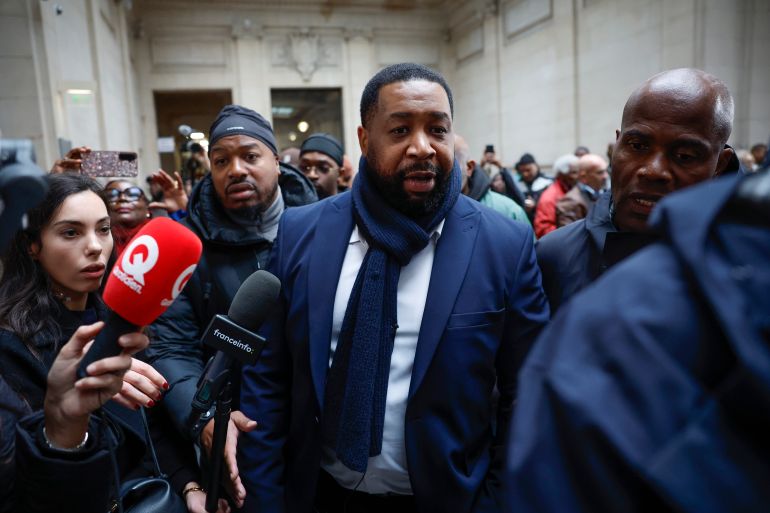
A French court has found three French police officers guilty of intentional, racist violence during the 2020 assault of Michel Zecler, a Black music producer, and sentenced them to prison.
The landmark ruling has once again shone a spotlight on the issue of police brutality in France, which activists say is rarely prosecuted despite being systemic and often racially motivated.
Recommended Stories
list of 3 itemsend of list
Here’s what happened in the case and what it means now:
What was the verdict?
The Paris criminal court convicted three police officers of assaulting Zecler in Paris in 2020, ruling that the attack was racially motivated. The court also found the defendants guilty of falsifying a police report about the incident.
The officers – 29-year-old Aurelien Lapersonne, 50-year-old Philippe Tondeux and 37-year-old Pierre Plantier – were each sentenced to five years in prison, part of which was suspended.
All three have been barred from serving in the police force again.
Who is Michel Zecler?
Zecler is a 47-year-old French music producer who co-founded the independent rap label Black Gold Corp. Zecler has worked in the French hip-hop industry for years, including helping to put together the prominent 2016 rap tour called L’Age d’Or du Rap Francais.
Music journalist Olivier Cachin described Zecler as easy-going and humble. “He just works, staying very much in the background,” Cachin told French newspaper Sud Ouest. “He’s not a ‘look-at-me’ type… He’s just a big teddy bear.”
Why was Zecler beaten by the French police?
Officers stopped Zecler outside his Paris music studio on November 21, 2020, accusing him of failing to put on a compulsory face mask, as required by France’s COVID-19 restrictions at the time.
Advertisement
The officers then pushed Zecler back into the building and assaulted him – an incident captured by his security cameras.
Over five minutes or so, the officers punched, kicked and used batons to deliver some 30 blows to Zecler, severely injuring him. He suffered head trauma and a complete rupture of his biceps tendon.
Zecler said the officers repeatedly used a racist slur during the beating, and that the assault had left him “completely devastated”.
What happened during the trial?
Officers Lapersonne, Paltier and Tondeux were found guilty of aggravated group assault that was racially motivated.
They were also convicted of falsifying an official police report in which they accused Zecler of being violent towards them – claims unsupported by the security footage.
The presiding judge said the officers had been dishonest in their report “to shield (themselves) from disciplinary and legal consequences, with no regard for the criminal consequences faced by Michel Zecler”.
Officer Lapersonne, who submitted the report, initially claimed that Zecler had attacked the officers and “struck out with his arms and legs”. When the presiding judge asked if he had “made that up”, Lapersonne responded during the trial, “Absolutely.” Lapersonne’s initial police report also failed to mention that the officers landed blows on Zecler.
“I deliberately omitted them. I think out of fear. It was stupid of me,” Lapersonne told the court.
All three of the convicted officers admitted to having used excessive force and apologised to Zecler, though they denied the charges of racism.
Tondeux, the oldest of the officers, said he regretted “the image I have given of the police”.
The judges said Zecler’s testimony, in which he claimed to have heard one of the officers use the racial slur “sale negre”, had been consistent from the beginning, while the officers’ falsified report damaged their credibility.
Speaking to the court, Zecler said he would likely not have been recognised as a victim if not for the security footage recording the incident.
How long have the French police officers been sentenced to prison?
All three were given five-year sentences, but with varying portions suspended.
Lapersonne, who was found to have first stopped Zecler and authored the falsified police report, had three years of his sentence suspended, while Tondeux had three and a half years suspended. Plantier had four years suspended and will serve the remaining year under electronic monitoring rather than in prison.
Zecler’s lawyer described the sentences as “falling short”, but said they set an important precedent.
Advertisement
“This precedent shows that even if a police officer lies, someone who comes forward to say the police did the worst to them can be believed,” said the lawyer.

What does the Michel Zecler case reveal about police brutality in France?
Zecler’s case is the latest to draw attention to the issue of police brutality in France, which is rarely prosecuted, as well as racial discrimination, following several high-profile cases in recent years.
In 2023, protests and riots broke out after Nahel Merzouk, a 17-year-old boy of North African descent, was shot and killed by a police officer during a traffic stop outside Paris. Police initially reported that an officer had shot at him because the teenager was driving his car at him, but this version of events was contradicted by a video circulating on social media. In March, a French appeals court ruled that the officer who shot Merzouk should stand trial.
In 2024, a judge handed suspended prison sentences to three officers who caused permanent rectal injuries to a Black man, Theo Luhaka, during a stop-and-search in 2017.
In 2016, Adama Traore, a 24-year-old man of Malian descent, died in custody after being restrained and apprehended by police following a dispute over an identity check. A case against three arresting police officers was dropped in 2023 and, in February this year, France’s top court, the Court of Cassation, ruled against reopening the investigation.
A 2025 report published by France’s Defender of Rights (Defenseur des droits), led by Claire Hedon, found that young men “perceived as Arab, black or from North Africa” are four times more likely to be stopped under police stop-and-search powers than the overall population.
They are also 12 times more likely to be subjected to more severe measures, such as being frisked during checks, the report found.
The European Court of Human Rights (ECHR) also condemned France last year for identity checks it deemed “discriminatory” following a case brought by six French citizens of African or North African origin.
Will the issue of police brutality be addressed in France?
France is coming under increasing pressure to address this issue.
The country was rocked by protests in September against proposed legislation that would grant additional protections to law enforcement officials using firearms in the line of duty.
The new law, which the French Senate is currently considering, will grant police officers a “licence to kill”, critics say.
“It’s a very dangerous piece of legislation. It’s liberticide,” Rim-Sarah Alouane, a legal scholar and an associate researcher in public law at the University of Toulouse Capitole, told Al Jazeera. “It would create a sense of impunity amongst police officers – which already exists, but this would strengthen that. It would undermine investigations and make access to the justice system even more difficult for victims and their families.
Advertisement
“It raises serious issues regarding equality under the law because it puts a presumption of innocence in favour of people because of their profession as cops.”
But while French officials have acknowledged isolated cases of police misconduct, they have so far pushed back against claims of systemic racism or discrimination by law enforcement.
In 2023, Laurent Nunez, then prefect of the Paris police, said “there is no racism in the police force.”
Activists say the French authorities’ refusal to address the institutional nature of police brutality further endangers minorities.
“The people who are dying are mostly Black or Arab,” French activist Assa Traore, the sister of Adama Traore, said in an interview with the Anadolu news agency earlier this year. “Admitting that racism exists is not a weakness. It’s about saving lives.”
Alouane said that Zecler’s case was obviously “about institutional racism, systemic discrimination and police violence”.
“Everything is connected. Not only are we dealing with police violence against a Black man, but that’s on top of attempting to conceal evidence and falsify a report,” said Alouane. “When these reports are falsified, we’re questioning the integrity of the entire system.”
Disclaimer : This story is auto aggregated by a computer programme and has not been created or edited by DOWNTHENEWS. Publisher: aljazeera.com