
Good morning. On Wednesday, Israeli legislators took the first steps towards dissolving parliament and calling fresh nationwide elections. Leading leftwing Knesset member Yair Golan hailed it “the beginning of the end of the worst government in Israel’s history.” Benjamin Netanyahu has spent 20 of the last 30 years as Israel’s prime minister, the last four of which have seen him helm a far-right coalition.
Under the incumbent government, settlement building in the illegally occupied West Bank has accelerated, while many international humanitarian NGOs have been banned from the Palestinian territories. Following Hamas’s killing of 1,200 Israelis on 7 October 2023, Netanyahu has orchestrated a campaign of violence in Gaza, wiping out more than 10% of the population, and flattening the strip in what the UN has declared a genocide. Netanyahu remains on trial for three counts of corruption.
Much has changed since Israeli voters last went to the polls. Public support for Israel in both western Europe and the US is at its lowest ever level. Israeli public opinion, meanwhile, has shifted further right.
For today’s First Edition, I spoke to Dahlia Scheindlin, a Tel Aviv-based political consultant and pollster, who has worked on nine Israeli election campaigns, about what is at stake and whether this vote may spell the end for Netanyahu. First, the headlines:
Five big stories
-
UK news | The parents of a girl critically injured in the Southport attack were allowed no more than 12 counselling sessions after the atrocity, while others described a “woeful” lack of support.
-
UK politics | Sadiq Khan has blocked a £50m Metropolitan police deal with the controversial US tech company Palantir, sparking a bitter row between the London mayor and Scotland Yard.
-
Israel | Israel has said it has deported all the foreign activists it seized from a Gaza-bound flotilla, after a global outcry over their treatment in custody.
-
UK news | Single-sex toilets and changing rooms in England, Wales and Scotland must exclude transgender men and women, according to a new code of practice from the equalities watchdog.
-
Ukraine | Ukrainian drones hit the Syzran oil refinery more than 800km inside Russia, setting it on fire, Volodymyr Zelenskyy said on Thursday.
In depth: A thorny, unsolved question cracks the coalition
In power since 2022, prime minister Benjamin Netanyahu’s Likud is the largest parliamentary party. That said, Scheindlin explains, no one expected his coalition government to last this long. “He is backed by two ultra-nationalist religious fundamentalist parties, and two ultra-orthodox religious fundamentalist parties.” Collectively, they hold 64 seats.
For years, Scheindlin continues, Netanyahu’s coalition government has been plagued by the same thorny question. “Can it pass a law to guarantee the continued exemption of most ultra-orthodox young men from military service?” This has long been divisive in Israeli society, and yet, the coalition has trudged along, without resolving it. To Netanyahu’s coalition partners, this exemption law is of paramount importance. “It has seen many governments collapse. This government repeatedly reached crisis point over it,” says Scheindlin.
On Wednesday, their coalition finally cracked. “Netanyahu’s partners said we don’t trust this government to pass that legislation any more.” A vote to dissolve parliament received the backing of 110 out of 120 lawmakers. A three-month pre-election run-up period is required by law. Late August is the earliest possible polling day, with a cut-off date of 27 October.
No guaranteed victory
Netanyahu remains the most popular potential PM – having topped the polls consistently since August 2024 – but that’s no guarantee of electoral victory. “He is coming in strongest in almost all surveys,” says Scheindlin, “although with slight variations lately.”
Made up of 120 seats, the Knesset is elected every four years through nationwide proportional representation. “Usually 30 to 40 parties compete,” Scheindlin says, “cross the 3.25% vote share threshold and you enter parliament.” No party in Israel’s history has won a majority of 61+ seats – so Netanyahu, like all those before him, relies on fragile coalitions.
“In all polling from the last two years,” says Scheindlin, “his coalition has been getting between 49 and 56 seats.” If public opinion remains as is, Netanyahu will fail to secure another majority.
Scheindlin also points out the remaining opposition parties which outnumber Netanyahu’s bloc aren’t necessarily more progressive. “Polling between 64 and 71 seats, these are dominated by what Israelis perceive to be moderate right, secular right, or semi-religious anti-Netanyahu parties.”
While Likud has remained steady at the top of opinion polls, the second-ranked party has shifted regularly. “It is always a party that Israelis perceive as centre or moderate right. In the six months before and after 7 October, it was the party led by [former senior minister] Benny Gantz.” Fortunes change fast. “That party is now polling way below the 3.25% threshold.”
Shifting alliances
The ever-changing political landscape makes allegiances fluid and hard to follow. Gantz has now been usurped to second place by former prime minister Naftali Bennett, though his new party – Together (Israel) – is not currently in the Knesset. “Israelis view it as the moderate rightwing party, though Bennett came from the far right,” says Scheindlin.
Bennett has achieved this feat by joining forces with once political rival, Yair Lapid. A former PM, Lapid’s past political persona was of a centrist, secular liberal. “Israelis perceive Lapid to be leftwing because he was the last PM to publicly support a two state solution, in September 2022. He doesn’t say that any more,” says Scheindlin. On the contrary, at the launch of their joint venture, Bennett declared: “We will safeguard the lands of our country and will not hand over a single centimetre to the enemy.” Lapid stood on stage with him.
In some polls, Together (Israel) are one seat ahead of Netanyahu, in most they’re a small number of seats behind.
There are plenty of challengers, too. Former IDF Chief of Staff Gadi Eisenkot was polling at six seats just a few months ago. That’s 13-15 now. “He is bereaved, having lost his son and his nephew in the Gaza war. Avigdor Lieberman is also a longtime challenger to Netanyahu, from the secular, nationalist right. He gets 10 seats in most surveys.”
Today, there’s a gap in the (relative) centre, after Yair Lapid joined forces with Naftali Bennett. “Then you have the Democrats, a merger of two former leftwing parties. Most Israelis view them as very leftwing; firm leftwingers view them as centrist.” With policies focused on affordable housing, trade unions and public services, they support a two state solution and oppose Israel’s occupation of the West Bank. The Democrats are polling about 10 seats.
“The two major Arab parties currently have 10 seats, and are still trying to decide their constellation. Will they merge? Stay separate? Form a new party? Jewish-Arab party, maybe? All of this is still in play,” explains Scheindlin.
A race wide open
While these opposition parties consistently garner a majority of seats, a path to power remains almost inconceivable. “The leaders from these opposition parties tell the public repeatedly they will not form a government which includes Arab parties,” Scheindlin says. “If they dropped this taboo, of course they would have a majority. But here is the catch, to announce that, the Zionist parties worry they would haemorrhage support to the further-right Netanyahu bloc, harming their chances.”
As such, Netanyahu may well cling on to power. “Many of his supporters believe in a conspiracy: that army chiefs and intelligence knew of [Hamas’s 7 October] plans, and let it happen, to embarrass the PM and bring him down. The belief in that conspiracy among coalition voters is growing over time,” says Scheindlin. “His polling, if anything, is getting a tiny bit better. His personal ratings are not at all bad. He has 45% of people who are always with him.” says Scheindlin, adding: “In the last election, his supporting parties combined won 48.3%. He doesn’t need to win a huge number of voters back.”
And polls do show 17-20% of Israelis remain undecided. “If the numbers remain as they are now, very small percentages could tip the elections. Let’s put it this way,” says Scheindlin, “This race is simultaneously extremely close and wide open.”
The end of Netanyahu?
Should Netanyahu’s majority fade, progressive parties would be in the distinct minority. But while the country would – in Scheindlin’s prediction – likely still be led by firm right-wingers, there would probably be some domestic change: “A less populist style, less divisive rhetoric, less targeting of civilian institutions. Maybe they would try to revive damaged diplomatic relations. They would like to advance the draft for the ultra-orthodox. Attacks on the Israeli judiciary may reduce.” Resisted by Netanyahu, an independent inquiry into what happened on 7 October would “almost certainly be established … That will be a huge focus on the campaign.”
“But least likely to change” Scheindlin continues, “is policy towards Palestinians.” She points to the role of Naftali Bennett – who would be at the heart of any new government and had a leading role in the Judea and Samaria Settlement Council before going into politics, an umbrella organisation for Israeli settlements in the illegally occupied West Bank. “He is dead set against a Palestinian state,” says Scheindlin.
“This different government might say we need to start ending wars, but not through anything that looks like concessions.” The aim, says Scheindlin, would be “to turn down the volume on the Palestinian issue to avoid international pressure. In many ways, it would be window dressing.” This is more than an educated guess, Scheindlin says: it’s what happened when current opposition parties governed in 2021/22.
Whichever outcome materialises, Scheindlin suggests, “the underlying problems as they relate to the Palestinians: occupation, self-determination, a two-state solution? I have a hard time seeing that changing.” Still, she accepts, the unexpected might just happen.
“Maybe a government with the range of ideologies currently found in the opposition parties – under sustained international pressure from multiple sides – could just find itself in the perfect storm for change.”
What else we’ve been reading
-
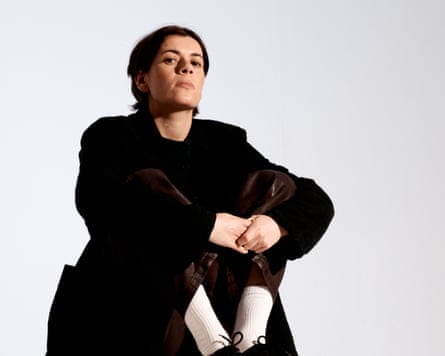
Liz Lawrence is thoughtful talking about how she came back to music after her sister died, and made a record exploring her need for songs that explore the “open and frank sadness” of grief. Martin
-
The latest instalment in Sam Wollaston’s Abandoned Britain series makes remarkable reading. He meets residents on the Carpenters estate in Newham, left in limbo during council “regeneration”. Michael
-
Simon Hattenstone’s interview with national treasure Derek Jacobi – with Derek’s husband Richard Clifford chipping in – is an absolute joy. Martin
-
Have you been searching for somewhere to hang out with 15,000 mannequins? You’re in luck. Mannakin Hall near Grantham offers you precisely this, one of 10 gloriously odd British sites to visit this bank holiday weekend. Michael
-
For Huck magazine, Miss Rosen explores some recently rediscovered photographs of the legendary period of New York’s counterculture centre, the Chelsea Hotel. Martin
Sport

Cycling | Alec Segaert won stage 12 of the Giro d’Italia on Thursday and his Bahrain Victorious teammate Afonso Eulálio snatched bonus seconds in the intermediate sprint to extend his overall lead.
Football | Southampton have provided footage of their training sessions to the English Football League’s independent disciplinary commission to try to prove they gained no material advantage from the Spygate saga.
Football | Eight nations have won the World Cup. An expanded field and a gruelling schedule means a new champion could emerge from the pack this summer.
The front pages

“London mayor blocks Met’s AI deal with controversial tech firm” is the Guardian’s splash today. The FT says “SpaceX, OpenAI and Anthropic IPOs to trigger Wall Street trading frenzy”.
On UK politics, the Telegraph says “Rayner in election fraud row”, while the Mail’s take is “Polling fraud row in Rayner constituency”. The Express says “Stop running away from the Brexit question Andy!”
The i Paper leads with “Police widen inquiry into Andrew to include sexual misconduct claims”, while the Mirror has “Andrew cops in sex crime probe” and Metro says “Immigration: it’s tit for stat”.
Something for the weekend
Our critics’ roundup of the best things to watch, read, play and listen to right now
Film
Eagles of the Republic| ★★★★☆
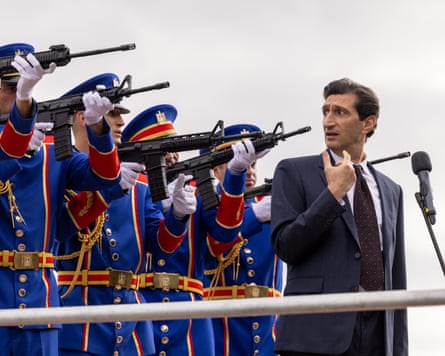
In the last of his “Cairo trilogy”, the Swedish-Egyptian film-maker Tarik Saleh turns a satirical lens to the glamorous world of the movies in this seductive black-comic political thriller set in present-day Egypt. It is a rackety, despairing, funny film with something of Billy Wilder, or István Szabó’s Mephisto, or Bertolucci’s fascism parable The Conformist. Saleh’s lead is his longtime leading man Fares Fares, playing the ageing movie star, George Fahmy – a pampered idol comfortable doing cheesy crowd-pleasing potboilers, but now bullied into performing in a sinister government-sponsored biopic of the president (with news footage of the current president, Abdel Fattah al-Sisi, cheekily cut in). Poor, preening George finds himself ordered to attend dinner parties and soirees convened by the reactionary junta – the self-styled “eagles of the republic” – who all profess a feline, insincere admiration for his cinematic art. The actor flies high before a horrible and sickening descent. Peter Bradshaw
TV
The Boroughs | ★★★★☆
A retirement village Scooby gang of heroes take on a horrific creature in a series that is funny, tender and wise. The Boroughs takes its time to crank up the plot. It moves, you might say, at the pace of its inhabitants, but that is only to the good. While channelling the spirit of Spielberg, the series speaks, via monsters and electroplasm, to eternal human fears. Death is one – the fear of dying alone and friendless, after one’s loved ones, or after years of living in a terrifying, memory-less present – and then gives us comfort, that together most monsters can be defeated. Lucy Mangan
Games
Forza Horizon 6, PC, Xbox, (PS5 due later) | ★★★★☆
The Forza Horizon games have always been about drama. Not just the tension and excitement of racing, but also the sensory impact of the natural environment – the sun rising over a dense city, rain clouds hovering above a valley floor. So in many ways, Forza Horizon 6 is a continuation of that and fans have been waiting years for Japan and now here it is: the whole country, reduced, remixed and repackaged as a driving paradise. It does not revolutionise what this series has always done, there is nothing radical here to attract a whole new base of players. But that’s fine. There is no other way most of us will ever get to sit in a Porsche 911 GT3 and cruise into the Daikoku parking area with Yellow Magic Orchestra playing on the radio. Keith Stuart
Music
Kurt Vile: Philadelphia’s Been Good to Me | ★★★★☆
Tap into Philadelphia’s Been Good to Me and you will find that Vile sounds as alarmingly great as ever, and more formally forward-thinking than he’s ever been. The album never labours its points or trades in anything so tacky as radical departures in sound or style. Vile’s music has always been about existence, but it’s rarely been this existential, and the songs’ hypnotic, elliptical structures create a stark sense of unease and unrest. It is, emphatically, a Kurt Vile record – loose, lush, ambling, aimless, and totally, deeply poetic, bruh. Shaad D’Souza
Today in Focus

Are we heading for another Ebola crisis?
The Guardian’s global health correspondent, Kay Lay, and reporter Prosper Heri Ngorora, based in Goma, report on the Ebola outbreak in the Democratic Republic of the Congo.
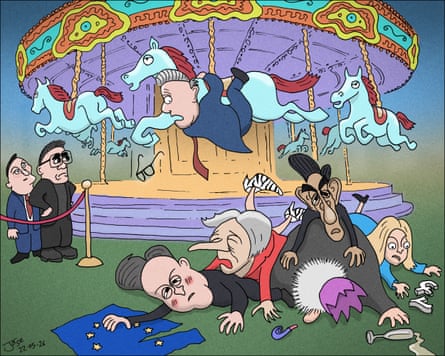
Cartoon of the day | Jason White
The Upside
A bit of good news to remind you that the world’s not all bad

An aardvark calf born at Chester zoo in April, and nicknamed Womble, is thriving thanks to the dedication of a team of zookeepers.
Womble was healthy at birth but its mother Oni wasn’t producing enough milk, so keepers began bottle-feeding the calf every two hours around the clock in a heated incubator.
Aardvarks face increasing threats in the wild due to habitat loss and hunting, and births are extremely rare in captivity – Womble is only the second aardvark born at the zoo in its 94-year history.
Zookeeper Sophie Tyson says: “Womble has gone from strength to strength and is doing brilliantly, so now lives full-time with mum Oni, and it’s wonderful to see them snuggled up side by side together.”
Sign up here for a weekly roundup of The Upside, sent to you every Sunday
Bored at work?
And finally, the Guardian’s puzzles are here to keep you entertained throughout the day. Until tomorrow.
Disclaimer : This story is auto aggregated by a computer programme and has not been created or edited by DOWNTHENEWS. Publisher: theguardian.com