
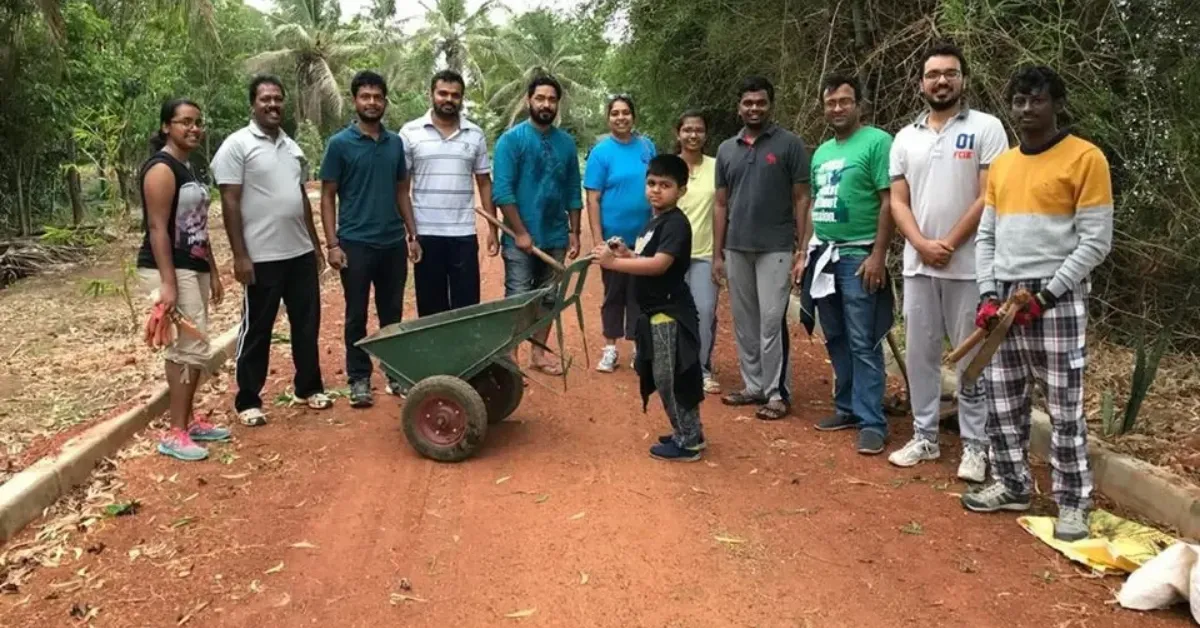
On 11 October 2026, residents, students, volunteers and civic officials gathered along the banks of Jakkur Lake in north Bengaluru for the 75th edition of #IamBengaluru – Volunteer for Parks. The event turned a weekend morning into a collective effort to care for the city’s shared spaces.
According to media reports, the event, supported by Multigen, brought together families, environmental organisations and public representatives for a clean-up drive and activities focused on environmental awareness.
Among those present were former IIIT-B director Professor Sadagopan and Bengaluru North City Corporation commissioner Pommala Sunil Kumar. Sadagopan urged residents to move beyond voicing complaints and take part in sustained efforts to improve their surroundings.
Citizen participation can help nurture greener public spaces. It also raises an important question: how can communities contribute without civic authorities stepping back from their responsibilities?
At Jakkur, a phone-in joins the clean-up
The event also brought that question into the conversation. As Mirror Now reported on 12 October, Commissioner Sunil Kumar acknowledged the challenges civic bodies face in managing waste and public littering. He said infrastructure alone could not solve the problem without a change in public behaviour.
He announced a Tuesday phone-in session on solid-waste management, in addition to the existing Friday sessions. He also invited residents to monitor waste-management micro-plans at local mustering centres, where sanitation workers organise their work.
The event also included de-weeding, plogging and workshops for children. Students from Greenfield Public School in Sampigehalli were among the participants.
When a morning walk becomes a watering round
At Vengaiah Lake in east Bengaluru, residents are using their daily walks to keep young trees alive instead of organising a large clean-up.
In a report published on 15 May, Bangalore Mirror documented the Bhagiratha initiative. Lake walkers bring water in bottles and cans to nourish hundreds of saplings during the summer. Among them are K N Guruprasad, a resident of T C Palya, and Naveen A B.
Guruprasad brought cans and arranged for a private water supplier. Naveen also joined the effort, bringing water and collecting wastewater from his home’s reverse-osmosis purifier for the saplings. Volunteers also help keep the lake’s surroundings free of garbage.
The initiative is noteworthy because it builds on an existing habit. Residents do not have to set aside a separate day for conservation. They fold it into a routine they already follow.
Forty residents, one road, three hours
In January, the problem was not litter around a lake but dust accumulating along a road in east Bengaluru.
According to The Times of India, around 30–40 residents of Balagere, Panathur and Varthur, many of them IT professionals, gathered on 17 January to clean a 100-metre stretch between Balagere T-Junction and Varthur police station.
Using money raised through crowdfunding, they rented equipment and removed a tractor-load of silt in about three hours. Residents said mechanical sweeping machines were not deployed regularly, so roadside dust built up and was stirred up by passing traffic. They also raised concerns about respiratory problems, allergies, damaged roads and risks to commuters and schoolchildren.
Reclaiming a footpath, one wall at a time
In March, more than 70 volunteers from CGI India, including children, took part in a clean-up and beautification drive along Old Madras Road in Indiranagar, Bangalore Mirror reported on 10 March.
The stretch between Halasuru Lake and SV Road Metro Station had accumulated garbage and posters, and broken footpath slabs made it less welcoming for pedestrians. Working with the Greater Bengaluru Authority and the citizen collective The Ugly Indians, volunteers removed rubbish, cleared posters and repainted walls.
A similar partnership emerged in Basavanagudi in May. On 17 May, residents, college students, volunteers and civic workers spent more than four hours clearing waste from Mallikarjuna Temple Street in NR Colony. Deccan Herald reported on 27 May that the drive followed complaints about garbage heaps, foul smells and public urination along a stretch used by students, hospital visitors and temple-goers.
Members of the Basavanagudi Ward 154 Residents’ Association, APS College and BMS College segregated the waste, while municipal sanitation staff and engineers helped remove it using tractors and auto-tippers. Organisers said they intend to extend similar drives to other parts of the ward.
What 75 minutes can tell us
On 12 September, students from Christ University’s Bannerghatta campus joined the Indian Ploggers Army and Bengaluru South City Corporation for a clean-up around Madiwala Lake.
The New Indian Express reported on 13 September that the 75-minute plogging drive collected 110 kg of plastic waste. It filled 15 sacks with bottles, milk packets, wrappers and straws from within a 100-metre radius of the lake. It was the Indian Ploggers Army’s 1,032nd drive, led by its founder Nagaraj, popularly known as Plog Raja.
The haul shows what a short, organised effort can achieve. It also shows how much plastic reaches the edges of a public water body in the first place.
Care as part of civic life
Across these initiatives, one thread runs through: people are making care for shared spaces part of ordinary civic life. A student picking up a wrapper, a walker watering a sapling and a resident reporting illegal dumping can all help build a culture in which public spaces are not treated as somebody else’s problem.
But volunteerism cannot replace public services. Bengaluru still needs reliable waste collection, street sweeping, sewage treatment, action against illegal dumping and sustained maintenance of parks and lakes. Civic bodies must remain accountable for delivering them.
The value of these citizen-led efforts lies not in showing that residents can do the government’s work. It lies in showing how communities can change everyday behaviour, bring neglected problems to attention and work with public agencies to protect the spaces everyone shares.
Source:
‘Residents, civic officials clear garbage from Mallikarjuna Temple street in Basavanagudi’: By DHNS, Published on 27 May 2026
‘Plogging drive at Madiwala Lake clears 110 kg plastic waste’: By Express News Service, Published on 13 September 2026
‘Citizens want to step in to stop lake from turning into gutter’: By Iffath Fathima, Published on 4 May 2026
‘When residents, students joined hands to clean up tech park’s backyard in Bengaluru’: By Vindhya Pabolu, Published on 30 May 2026
Disclaimer : This story is auto aggregated by a computer programme and has not been created or edited by DOWNTHENEWS. Publisher: thebetterindia.com




