
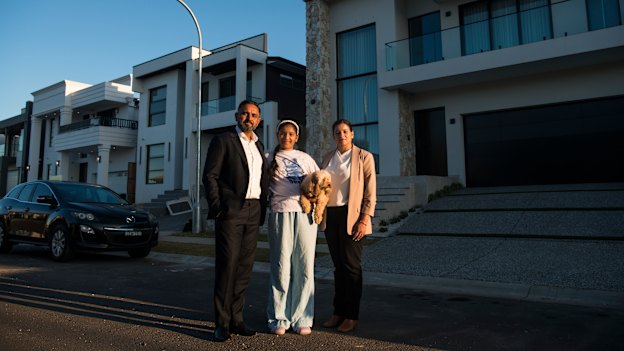
The Mangat family bought into a suburb that promised four public schools. That didn’t happen.
Like most families who move to Box Hill in north-western Sydney, Aman Mangat, her husband Raj and their two daughters were attracted to the suburb’s large homes and community feel. But there was just one thing missing: schools.
With no public high school in Box Hill that teaches past year seven, Aman’s eldest daughter Amlina, who is in year 12, commutes to a private school in Parramatta. And while the youngest daughter Iskara travels a shorter distance – 20 minutes by car to a school in Schofields to avoid the demountables at Box Hill primary – it means someone must be available every day to pick her up.
“We can’t have that leisure of her walking home,” Aman said. “It’s eating into our time a lot.”
In 2018, the former NSW Liberal government released plans for four new public schools in Box Hill, but those plans never came to fruition. The Labor government installed a temporary primary school in 2025 and a temporary high school in 2026 that caters for year seven only, with year eight to commence in 2027.

Father of two Aravind Vijay, who successfully campaigned for the suburb’s temporary primary school, was left “dumbstruck” after being told his eldest son would not be able to attend because their home sits just outside the catchment. It means the family will have to undertake a 45-minute round trip to the over-capacity Rouse Hill Public School, passing the local school that’s just 10 minutes away.
The Mangats and Vijays are among tens of thousands of Australian families who have moved into Sydney’s newest suburbs in the north-west and south-west, lured by the promise of world-class schools – only to find the schools have been cancelled or delayed. As the population booms in these greenfield sites and more homes are built, residents are finding vital infrastructure remains an afterthought.
When the Herald visits on the first day of term one, the entrance to the Box Hill temporary primary school is full of nervous parents waiting to pick up their children. In front of them is a sea of grey demountables tightly packed together. There are no trees, and the rear of the school is still under construction.
In 2018, the Box Hill-Nelson area had 119 total student enrolments. Five years later, that number exploded to 1445 – an increase of 1114 per cent – the NSW Enrolment Growth Audit says.

A permanent Box Hill primary and high school will open in 2028 at a new site in Box Hill, and the NSW Labor government has bought the land of the temporary school to turn it into a permanent one. A spokesperson for the NSW Department of Education did not say when this would happen, but said the government would “continue to monitor demographic trends and student population projections” to determine when to build a new school.
When the Box Hill precinct was rezoned in 2013, it was expected to accommodate 9600 homes and 28,000 people. In the next decade, The Hills Shire Council estimates the number of residents to soar to 50,000. The council, which also covers greenfield sites such as the Gables and North Kellyville, has warned that The Hills will need 15 more new public schools to keep up with the population.
It’s not just a problem in The Hills: western Sydney is expected to grow in population by 32 per cent between 2026 and 2046, compared with 13 per cent in most eastern and inner-city areas, according to the Centre for Western Sydney. With more people moving to Sydney’s west, the question remains: will there be enough schools?
‘Lessons have not been learnt’
A 2022 inquiry into the planning and delivery of school infrastructure in NSW found that poor demographic planning had resulted in schools in high-growth areas reaching and exceeding their capacity in unacceptably short time frames – particularly greenfield areas in Sydney’s south-west and north-west. It has led to many students having to undertake “longer-than-acceptable commutes” to the next nearest school, more families turning to private schools or children having to attend schools that don’t have adequate facilities to cope with the high number of enrolments.
No schools better encapsulate these planning mistakes than the Ponds High School – which was reported as having more than double its enrolment cap in 2025 and is the biggest public school in the state – and the early years of Oran Park Public School in the south-west.
The first primary school in the suburb, Oran Park Public School had 11 kindergarten classes when it opened in 2014. That number swelled to 21 classes just seven years later.
The same school had 13 demountables in 2015, but by 2020 that number was 27. The 2022 inquiry said the former state government had tried to manage demand for Oran Park Public School – which had about 1500 students and was 40 per cent over capacity at the time – by reducing the catchment boundaries, to the extent that the school primarily drew from one street in the local area.
“The local community has compared the demountables to the look of Manus Island, and it is clear that the school’s development was a demographic planning disaster,” the report said.
Oran Park had no public high school until 2020, with the Herald reporting last year that Oran Park High eclipsed 1600 students just five years after opening.

But there have been some improvements for schools in the suburb – today, the number of students enrolled at Oran Park Public School has decreased to 1380 and there are no demountables.
Deputy Premier and Minister for western Sydney Prue Car said the Independent Commission Against Corruption’s recently released report into School Infrastructure NSW found staff were asked to alter population data, with the “effect of diverting funds from north-west and south-west Sydney”.
Car said the Labor government is now delivering the new and upgraded schools these communities need.
“We have also reformed the way school infrastructure is planned and delivered to ensure best practice and that schools are built where they are needed most,” she said.
“There is more to do, and we will continue to deliver the school infrastructure required so every child has access to a world-class public education.”
Camden Council general manager Andrew Carfield said the challenge for all levels of government is whether they can keep pace with the growth the south-west is experiencing. It’s a concern that was also raised in a new education report from Business Western Sydney, with executive director David Borger saying that the decisions made today on where to build schools will determine whether growth delivers opportunity or “leaves some people behind”.

The 2022 inquiry is more sceptical. It found that the former Liberal government had not been adept in using the long history of residential land release and school infrastructure planning and provision in western Sydney to guide decisions for new schools, and gave a warning for western Sydney’s future.
“Lessons have not been learnt.”
Tomorrow in Stranded Sydney: How Manwell’s 14-hour wait at a Sydney hospital revealed the healthcare crisis on the city’s fringe.
Disclaimer : This story is auto aggregated by a computer programme and has not been created or edited by DOWNTHENEWS. Publisher: www.smh.com.au


